Germany's Merz under pressure as AfD eyes second state win
We're expecting exit polls at around 6 p.m. local time (1600 GMT/UTC). Follow along here for all the highs and lows today:
Tired of missing our real-time updates? Click here to add us as a Preferred Source on Google. Then tap the "Star" or "Preferred" to keep DW News at the top of your feed.
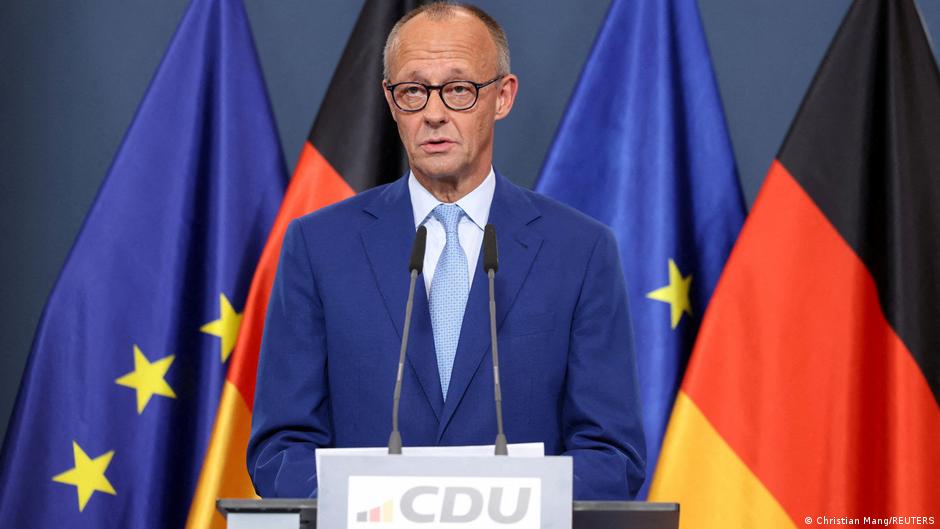
Chancellor Friedrich Merz set a defiant tone after blows sustained by his conservative CDU party in the votes in Mecklenburg-Western Pomerania and Berlin.
"The result in Mecklenburg-Western Pomerania cannot be talked away, it’s a disaster," Merz said in a statement.
He pointed out to Germany's economic problems and deepening divisions, saying that "the answer cannot be a return to the good old times."
"The answer must be to make out country fit for the future," he told reporters. "The reforms have to happen."
"These reforms are a cure against the authoritarian poison," the chancellor said, in apparent reference to the far-right AfD party.
"We are taking over this responsibility. I am taking over this responsibility because I want to bring our country forward," Merz added.
"10, 9, 8...": At the Social Democrats' election party in Mecklenburg-Western Pommerania, the crowd counts down euphorically as the projections are announced.
But when the numbers finally appear on the screen, there is simply silence. The Social Democrats had fought for victory, but now they’re in second place.
If the populist Sahra Wagenknecht Alliance (BSW) does indeed win seats in the state legislature, it will be a close call for a potential coalition between the SPD, the Left Party, and the Greens.
The first projections also show several parties hovering close to the 5% threshold needed to enter the state parliaments.
In Mecklenburg-Western Pomerania, the socialist Left Party looks safe on 7.5%, while the conservative Christian Democratic Union (CDU) and environmentalist Greens are both on 5.5%.
The left-wing populist Sahra Wagenknecht Alliance (BSW) is on exactly 5.0%, leaving its representation in the state parliament uncertain as results come in.
In Berlin, where the Left has surged into first place, the Greens are projected to take 15.0%, while the center-left Social Democratic Party (SPD) has fallen to 12.0%, down 6.4 percentage points.
The BSW is also projected at exactly 5.0% in Berlin. The business-friendly Free Democratic Party (FDP), on 2.5%, is projected to remain outside the state parliament.
The far-right Alternative for Germany (AfD) is set to win most votes in the state of Mecklenburg-Western Pomerania while the socialist Left Party has surged to first place in Berlin, according to initial projections.
In Mecklenburg-Western Pomerania, the AfD is projected to take 37%, edging out the center-left Social Democratic Party (SPD) on 35.5%. The center-right Christian Democratic Union (CDU), the party of Chancellor Friedrich Merz, is projected to slump to 5.5%, barely above the treshold to enter the state parliament.
In Berlin, the Left is projected to emerge as the single largest party with 24.5%, a gain of 12.3 percentage points compared to the last election. The CDU is second on 20.0%, down 8.2 points, while the AfD is third on 16%, up 6.9 points.
The center-right CDU has rented a room in Schwerin dance studio for its election night party. A disco ball is hanging from the ceiling. Once the results come, however, the conservatives will likely not be in the mood to dance the night away.
According to the polls, the party of German Chancellor Friedrich Merz is set for the worst defeat of its history in Mecklenburg-Western Pomerania.
If the CDU drops below the 5% threshold for the state parliament, the future of the federal chancellor could also be on the line.
It's astonishing to think about it: a party could almost double its previous election result and still be disappointed. That is the situation that the right-wing populist Alternative for Germany party (AfD) finds itself in Mecklenburg Western-Pomerania where guests are gathering for their election night party.
Polls suggest they could win around 36% of the vote. That is a huge improvement on their last election result, where they got 19% of the vote, and yet they had hoped for more. They'd hoped to break the 40% marker. They'd hoped to build on the momentum from Saxony-Anhalt, where the party's new star, Ulrich Siegmund, helped the AfD clinch almost 44% of the vote. That boost hasn't materialized in the last 2 weeks.
In fact, the center-left Social Democratic Party (SPD) have stolen a march on the AfD and have gone on, in the last poll, to overtake the AfD by 1 percentage point, which has compounded the feeling of disappointment.
However, there's still an hour or so until the first exit polls are released, and it could be a very different atmosphere inside the election night party if the AfD pull off a shock and do better than the polls suggest.
The top concern for voters in Berlin is the housing affordability crisis. Why is there such a shortage of homes and affordable ones for lower- and middle-income groups? Find out here:
Voter turnout in Mecklenburg-Western Pomerania's state election was running well ahead of previous elections on Sunday, as voters decided a closely fought contest between the center-left Social Democratic Party (SPD) and the far-right Alternative for Germany (AfD).
By 2 p.m., 40.7% of the state's 1.3 million eligible voters had cast ballots at polling stations, according to the state election authorities. At the same point in 2021, turnout stood at just 32.5%.
The figures suggest particularly strong voter interest in an election that could have repercussions for national politics.
Comparisons with 2021 come with an important caveat. That year's state election was held alongside Germany's federal election, helping push final turnout to 70.8%. However, turnout by 2 p.m. in the 2016 state election was also considerably lower, at 32.8%.
Voting was largely proceeding normally after polling stations opened at 8 a.m.
The state parliament of Mecklenburg-Western Pomerania is located in Schwerin Castle.
The atmosphere there remained very relaxed until early afternoon, with tourists still coming and going to visit the castle and the museum inside.
The Social Democratic Party (SPD) plans to hold its election party in the Orangery, which is part of the castle.
It’s still quiet there as well; only a few camera crews have set up their broadcast equipment so far. For now, the only SPD representative on site appears to be state leader Manuela Schwesig — albeit as a cardboard cutout.
Voter turnout in Berlin's state election was running significantly ahead of the 2023 election by midday on Sunday, according to the city's election authorities.
By noon, 27.9% of eligible voters had participated, including postal voters. That was 4.5 percentage points higher than the 23.4% recorded at the same point in the 2023 election.
About a third of the voting certificates issued were for postal ballots, state election officer Stephan Bröchler told Germany's DPA news agency.
Election officials said voting at Berlin's 2,542 polling stations had so far proceeded without major problems. Polling stations opened at 8 a.m. and are set to close at 6 p.m.
Around 2.5 million people are eligible to elect Berlin's state parliament. Seventeen parties are contesting the election with their own lists, about half as many as the last vote, in 2023.
For the first time, 16- and 17-year-olds are also eligible to vote in a Berlin state election.
Berlin has been governed by a coalition of the center-right Christian Democratic Union (CDU) and center-left Social Democratic Party (SPD) since a court-ordered rerun of the troubled 2021 state election was held in 2023.
Some voters in Mecklenburg-Western Pomerania had an unusual start to election day on Sunday, casting their ballots on a public bus after officials were unable to open their polling station.
Election authorities in the northern city of Rostock temporarily turned the vehicle belonging to the local public transport company into a polling station in the Kassebohm district.
The makeshift arrangement lasted for about half an hour before voters were able to use the intended polling station, located inside a privately run school building.
Rostock has 134 polling stations for the state election.
Berlin police said they had received reports of property damage at several polling stations as voting got underway on Sunday.
In one case, the lock of a polling station had been glued shut. Police said the station was nevertheless able to open on time and voting was not disrupted.
Authorities also received reports that campaign posters had been placed too close to polling stations.
Police advised people who notice such posters to contact the officials responsible for the respective polling station, saying emergency services were coordinating closely with election officials.
"It's been very quiet so far," Berlin's state election officer Stephan Bröchler told the DPA news agency, adding that no major election-related incidents had been reported.
The smooth start is particularly significant after serious organizational problems with Berlin's 2021 election led a court to order the vote to be rerun in 2023.
Voters have been lining up at polling stations to cast their ballots, as have the candidates (presumably to vote for themselves) in Berlin and in the northeastern state of Mecklenburg-Western Pomerania.
In the German capital, Werner Graf (Green Party) and Steffen Krach (center-left Social Democrats) cast their votes in the Tempelhof-Schöneberg constituency.
Further north, Leif-Erik Holm (far-right AfD) cast his vote in Schwerin, the capital of Mecklenburg-Western Pomerania.
Holm told local public broadcaster NDR outside the polling station that he was "optimistic" about his party's chances.
"The clouds have parted and the sky is turning blue," he said, referring to the color of his party.
His rival, the incumbent state premier Manuela Schwesig of the Social Democrats (SPD), cast her vote a short time later.
A quarter of Berlin residents will have no say in the German capital's city-state election because they lack citizenship. That's the highest proportion of residents excluded from the election yet, and many are unhappy.
Find out more about how foreigners are not included in Berlin's elections in this report.
In the run-up to Berlin's election, Elif Eralp's socialist Left Party is narrowly ahead in major polls — setting up a close race with the conservative CDU. But her party faces controversy over antisemitic rhetoric.