Gibran Alone in the Storm of Justice
FORMALISM, much like substantialism, has always captivated legal thinkers. Once revered, it can later be scorned—such is the existential fate of both formalism and substantialism.
This phenomenon of mutual negation is stimulated by the reality that both offer equal advantages and vulnerabilities. They rise and fall in tandem with reason, their true roots.
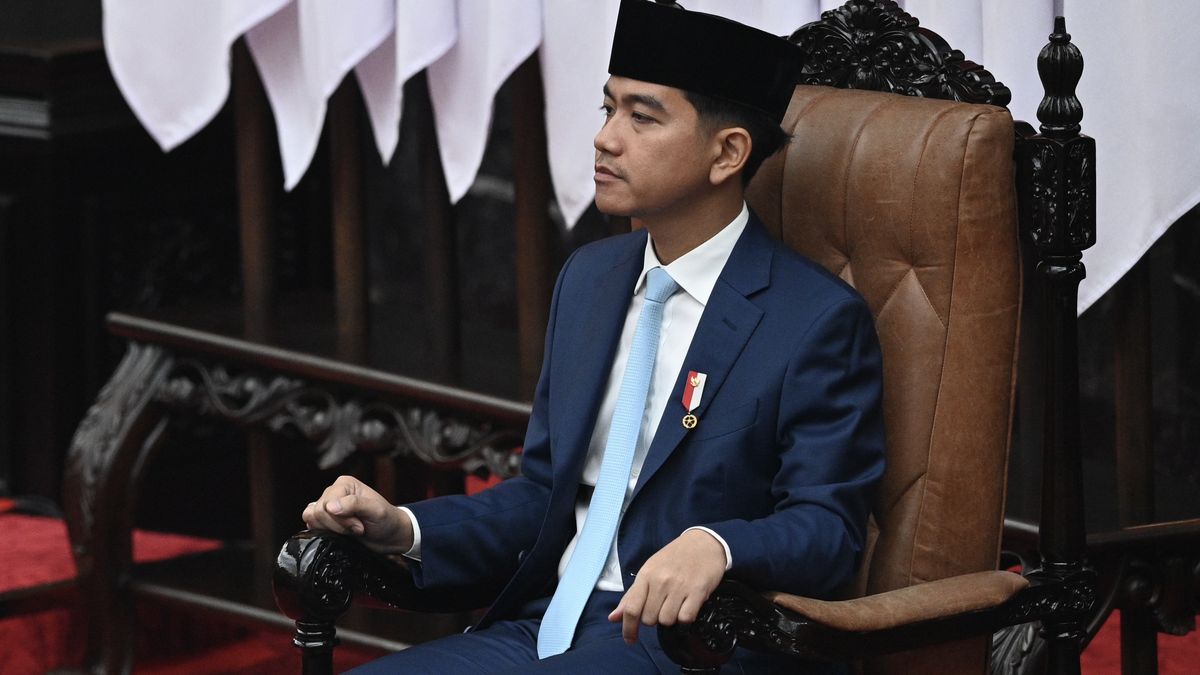
Gibran Rakabuming Raka, the Vice President and son of former President Joko Widodo, currently finds himself alone in the storm of justice.
His diploma from a senior high school has been challenged by several individuals in the Constitutional Court.
As the legal process unfolds, the law quickly divides into two equally logical spectra: formalist justice and substantialist justice.
Justice can never be judged by time. It does not float away with time. Always, it is destined to evade becoming a long-lost, beautiful story.
Justice remains an eternal memory. This is because justice has an ontological essence that remains alive and fresh through the ages, regardless of how it is conceptualized.
It is reason that brings it to life, which in turn fosters a longing for an organized existence, through which humanity dazzles in its existence.
At this point, treating the state as a political body appears synonymous with reducing the very essence of reason. The state, in this context, is better viewed and accepted as a system of justice, a conscious reflection of reason meant to be externalized.
In its ontological nature as a reflection of reason, this existential order always presents resistance to actions from any political body named the state, which betrays justice.
Justice is the cause of the unavoidable ontology of equality. Due to its ontological nature rooted in reason, equality does not grant any justification for anyone to be given rights in a way that disregards reason.
Justice is never silent. It arrives like a storm, and that is what is currently striking Gibran, the Vice President.
Not only is the fact that brought Gibran to his role as Vice President being questioned, but it is also seen as abandoning justice.
Kelsen, the chief architect of the Austrian Constitutional Court, whose ideas have been borrowed by Indonesia, may well assert that the norms of the constitution are supreme, serving as an integrative function. However, the status of supreme does not exist merely because of its placement within the constitution but rather because it reflects reason.
At this point, reason must be accepted within the epistemological spectrum as a justification that plays a role in guiding that is supreme.
Thus, law becomes necessary, unavoidable—not because of the might of the law itself, but only because it lends life meaning.
That is why the need for law is not spurred by the greatness of the law, but for the purpose of externalizing reason.
Practically, law is needed to provide a framework for reason to operate, in the form of creating order, as something necessary. This is a substantial expression that in its essence gives rise to a need for formalism.
Substantialism and formalism, in turn, find their place precisely in the need for the externalization of reason. Up to that point, once again, formalism and substantialism coexist within the same value framework.
It is a mistake to imagine that the necessity of law validates the law itself. The validity of law is not determined by the law per se.
Rather, from an ontological perspective, the validity of law is determined by the highest value that flows through the law.
And the legality of law is not dictated by the substance of the law but is determined by how coherently its makers can infuse that supreme value into norms.
This is why the evolution of law is not determined by its deficiencies but by contingencies that continue to arise with various categorical imperatives.
Unfortunately, contingencies do not always originate from the natural reasoning of every individual. More regrettably, contingencies often come too close to fiction, whose meaning only signifies emptiness, the absence assumed to be something that certainly exists.
Interestingly, Gibran's diploma from a high school equivalent was declared valid by the General Election Commission (KPU) without thorough and substantial verification. That is the crux of the issue.
This minor flaw has resulted in a concrete legal state that deems Gibran a legitimate candidate for vice president. This is a problem too absurd to be simplified into an administrative technicality.