Green Energy Is Coming for the Desert - The Intercept
Only ghosts and ruins remain in this dusty old town. Tucked under scenic hills of volcanic rock are the remnants of a bank, a railroad depot, and what looks to be a school, along with a handful of other deteriorating structures that are hard to make out. This is Rhyolite, Nevada, whose heyday was fierce but short-lived, something of a one-hit wonder. In 1904, after gold was discovered in the nearby Bullfrog Hills, prospectors descended upon this dry corner of the Mojave Desert with hopes of striking it rich.
Of the several mining camps that quickly sprang up in this part of the Great Basin, Rhyolite was one of the liveliest. By 1908, the town’s population had surpassed 5,000, and at its peak, there were 50 saloons, 35 gambling dens, brothels, a bathhouse, a newspaper, and over a dozen restaurants.
Rhyolite’s flame would burn out fast: The Wall Street panic of 1907 scared off would-be investors, and by 1910, just a few years after the mine opened, most of the gold had been extracted. With no mining jobs left, the town was soon abandoned. All three banks eventually shuttered, and by 1914, the last train departed the Rhyolite station, never to return. Entire buildings, including the old Union Hall, were relocated to a neighboring town, where they still reside. The leftover Rhyolite town site, now a tourist stop, is managed by the Department of the Interior’s Bureau of Land Management and has been a not-so-popular location for a string of low-budget Hollywood films you’ve never heard of, like “Six-String Samurai” and “The Island.”
“Deserts, believe it or not, actually have a high level of carbon sequestration.”
The Southern Paiute (Nuwuvi) and the Western Shoshone (Newe) inhabited this arid region between the northern Great Basin and the southern Mojave. This ancient land holds many tales. In the 1980s, archaeologists discovered what appear to be aboriginal campsites dating back at least 10,000 years, to the end of the last ice age. West of Rhyolite is Beatty, a town with a certain rural desert charm. It could be the wild burros roaming the streets or the raggedy Sourdough Saloon with hundreds of dollar bills tagged to the walls. Whatever it is, I understand the appeal for those uninterested in city life. The residents I spoke with told me it was the quiet landscape that drew them there.
I find myself in Rhyolite — just seven miles east of the broiling Death Valley National Park — to meet up with two activists who’ve dedicated their lives to protecting the surrounding Mojave Desert. Kevin Emmerich and Laura Cunningham, founders of the Beatty-based Basin and Range Watch, are concerned that two major solar projects on nearby BLM-managed lands will destroy the desert ecology and provide little benefit to the local community.
“This type of desert out there actually sequesters carbon in the roots of the creosote,” explained Cunningham, a wildlife biologist and desert tortoise researcher who has lived in the area for over 20 years. “There’s biological soil crust [with a] deep network under the soil that sequesters carbon, literally sucks it out of the atmosphere and turns it into oxygen. And deserts, believe it or not, actually have a high level of carbon sequestration. But when you scrape it up and drive on it, you crush the lichens, shrubs, and flowers, and release carbon. Building on these habitats is actually [contributing to] climate change.”
Deserts like the Mojave, Cunningham said, play an outsized role in absorbing climate-warming carbon. Of the world’s carbon sinks — the places that soak up carbon from our fossil fuel emissions — deserts account for up to 28 percent of land-based uptake. It’s one reason why a patchwork of solar farms out here is a troubling prospect.
“If we do use renewable energy, we want to put it in the built environment where it doesn’t have much of an impact.”
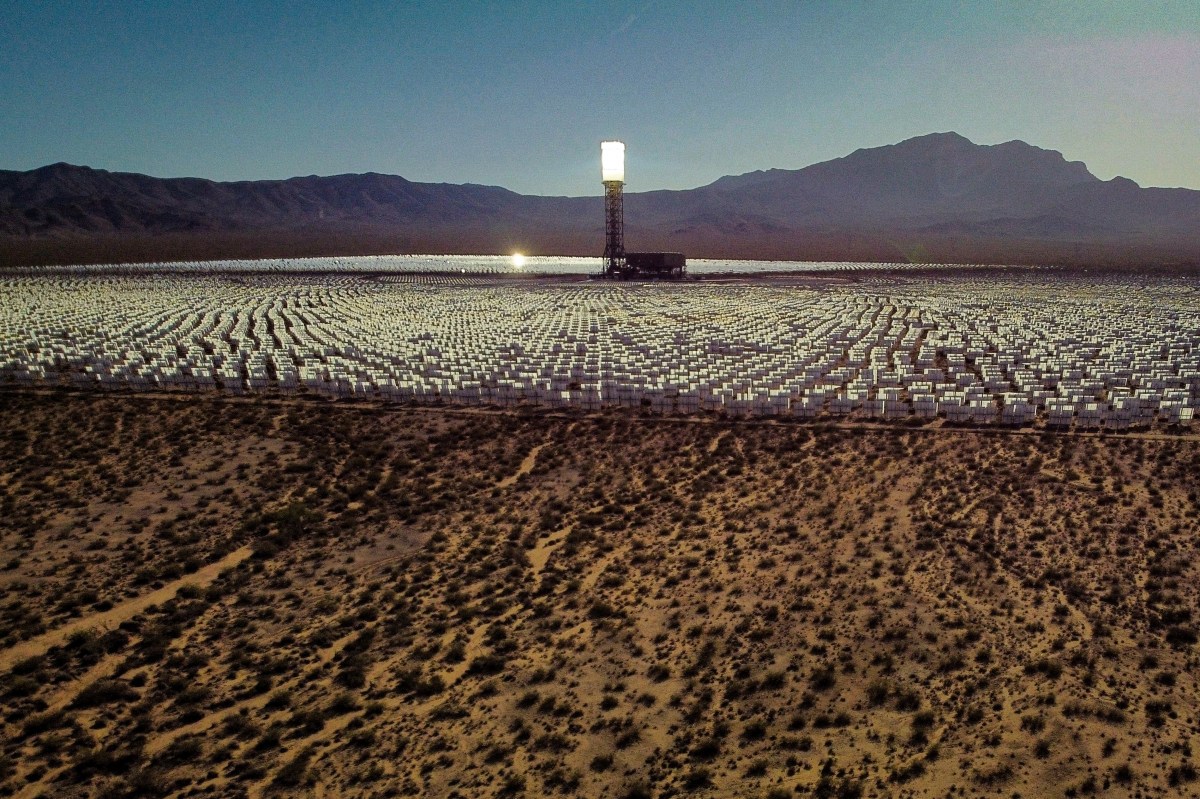
Cunningham’s partner, Kevin Emmerich, is what you’d call a desert rat. He’s tall, grizzled, and soft-spoken. He strikes me as a man who has spent a lot of time in remote places, and I say that with admiration. A former park ranger in Death Valley, he nods in agreement with Cunningham while pointing to a valley across the highway where two solar projects, if completed, would blanket over 8,000 acres of open space. He’s frustrated that the people who usually oppose wrecking biodiversity aren’t warier of the large-scale energy projects proposed for public lands.
“Other environmental groups are really conflicted about ‘green’ energy,” Emmerich said. “We just had a little spat with one group. They want some of this public land development. … If we do use renewable energy, we want to put it in the built environment where it doesn’t have much of an impact.”
While some environmentalists may be on the fence, others, like the small outfit Basin and Range Watch, are working tirelessly to halt the development of these solar farms. In 2010, in coalition with community groups and the Quechan and Cocopah tribes, it blocked the Imperial Valley Solar Project in California, which would have destroyed nine square miles of habitat and decimated more than 400 Quechan cultural sites. Basin and Range also supported the “Save Our Mesa” campaign, which succeeded in stopping the controversial Battle Born solar project near Moapa Valley, Nevada. Battle Born was proposed as an installation of solar panels covering 14 square miles of public lands. The grassroots pressure was so strong that the developer, California-based Arevia Power, told BLM they wouldn’t move forward.
When it comes to impacts, at least on paper, solar energy may have the fewest downsides (although they certainly exist). The technology requires less mining and is inexpensive and easy to deploy. But as Basin and Range Watch argues, it’s not enough to simply let these vast, open spaces be blanketed with fields of solar panels. There are better locations for solar that will yield better results for people and the environment. Many of our popular ideas about places like the Mojave — such as the idea that they’re lonesome, empty wastelands, devoid of life — sustain the myth that desert solar farms have fewer drawbacks and are essential in the fight against climate change. Not many assumptions could be more untrue.
Many of our popular ideas about places like the Mojave — such as the idea that they’re lonesome, empty wastelands, devoid of life — sustain the myth that desert solar farms have fewer drawbacks and are essential in the fight against climate change.
BLM has considerable sway in the West and has, for decades, had the power to radically shape the region, from its fragile ecology to its resource-dependent economies. It manages 245 million acres of land and 700 million acres of subsurface mineral rights in the United States. In all, BLM oversees one-tenth of the country. It divvies up rights to mine, drill, and graze. What the bureau say goes, and even under the antagonistic Trump administration, which is no fan of renewables, it is still overseeing massive green energy developments.
While Trump and his allies in Congress have drastically reduced subsidies for renewable energy projects, those incentives aren’t set to expire until December 2027. As a result, companies are hurrying to build out solar farms, wind turbines, and commercial battery storage. While Trump’s actions have hampered long-term growth projections for the renewables industry, it’s booming, for now.
“The energy transition is still underway, but the whiplash has very serious implications for our economy and for the investment culture of America,” explains Sanya Carley, the Mark Alan Hughes Faculty Director of the Kleinman Center for Energy Policy at the University of Pennsylvania. “Solar has still been on a phenomenal growth trajectory, especially across the entire world. … [It’s still] the leading source of growth in the energy industry in the United States.” Trump’s rancor has turned out to be more of a speed bump than a roadblock.
We’re independent of corporate interests — and powered by members. Join us.
Original reporting. Fearless journalism. Delivered to you. Will you take the next step to support our independent journalism by becoming a member of The Intercept?
By signing up, I agree to receive emails from The Intercept and to the Privacy Policy and Terms of Use.
In Nevada, BLM has parceled around 12 million acres for large utility-scale solar project construction. In 2024, the agency announced its Western Solar Plan, which would reserve 22 million acres of public land for future solar development. As of early 2024, seven major projects were proposed or in the works, covering 140 square miles of land. The Western Solar Plan would locate high-solar-producing areas on public lands across the dry flatlands of Arizona, California, Colorado, Nevada, and New Mexico, and on millions of acres of federal land in Idaho, Montana, Oregon, Washington, and Wyoming.
Patrick Donnelly, the Great Basin director for the Center for Biological Diversity, believes this massive, swift expansion of industrial-scale solar could destroy many of the region’s “crown jewels.” He’s worried solar arrays could surround Nevada’s Great Basin National Park and the Malheur National Wildlife Refuge in Oregon — ditto for the Great Salt Lake in Utah.
“It’s insane,” Donnelly, who isn’t shy about his frustrations, said. “BLM is going to make lanes available for solar at the foot of the Sierra Nevada,” which he calls “possibly the most beautiful place in the country.”
It’s hard to argue with Donnelly about the stakes. I spend weeks each year wandering the Mojave, decompressing from urban life. The desert is a refuge. As a teenager growing up in Montana, I used to believe wilderness only included trout streams, mountains, grizzly bears, and wolves. I was youthfully naive, and I now realize that wilderness includes saguaro, rattlesnakes, desert tortoise, and bighorn sheep. We shouldn’t exploit these places for our energy needs, whether for fossil fuels or solar power. These desert lands are crucial not only for the animals that inhabit them but also for their roles they play, such as carbon sequestration, in helping mitigate the climate crisis.
These lands are significant to Native Americans, who have inhabited this land long before Europeans showed up. For years, members of the Western Shoshone and Goshute tribes in Nevada have worked to designate a 25,000-acre monument called Bahsahwahbee near Great Basin National Park. The Western Solar Plan will carve out 7,000 of those pristine acres for development.
“Our ancestors were massacred at Bahsahwahbee. It is unconscionable that the site would be considered by the federal government as a development zone instead of a place to be preserved and commemorated,” Ely Shoshone Tribal Elders Delaine and Rick Spilsbury wrote for the Great Basin Water Network. “The federal government doesn’t propose developments in other cemeteries or seek to bulldoze other peoples’ churches. In fact, graves and churches are generally protected under federal and state laws. But for the resting place of our ancestors, we have to wonder why it’s OK?”
These large solar projects are sure to raze more Native lands to power hundreds of thousands of homes across the West, often in cities far from where the energy was first produced. Once the solar installations are built, few jobs are likely to remain in those regions, which contradicts the central arguments local governments make in support of the projects.
When it comes to the Western Solar Plan, most of the major environmental groups have either stayed silent or, like the Wilderness Society, uncritically supported it as a positive step to help California shift its grid to 100 percent clean energy by 2035.
“I feel like we are working out here on the marginalized fringe, and we’re sort of pushed more to work with grassroots groups, local communities, scientists, and people who aren’t beholden to their big climate donors [like other environmental groups],” Cunningham of Basin and Range Watch said. “[Energy developers] call this a wasteland, like there’s no biodiversity, and we push back against that. We support photovoltaic solar panels, first on rooftops, parking lot canopies, or on really disturbed ground. But this desert has life. The very, very bottom of the list [for solar development] should be public lands. Ecosystems built on utility-scale solar projects are the last thing we should support in the fight against climate change.”
Cunningham’s argument is convincing, and it’s hard not to think that much of this has to do with people’s perception of the desert as a wasteland, as she puts it. Even the late David Brower, the first executive director of the Sierra Club who was forced out for his radicalism, once remarked that he’d be willing to sacrifice the Mojave under the guise of diplomacy and compromise if it meant protecting scenic wilderness elsewhere. He later retracted the sentiment, but this reasoning still permeates much of the mainstream environmental movement, which is focused on slowing climate change at almost all costs — even if it means harming wild places in the process.
“I feel like we are working out here on the marginalized fringe. … This desert has life.”
Perhaps it will take an expert like Laura Cunningham and a desert-lover like Kevin Emmerich, who have a deep admiration for and understanding of desert ecology, to alter people’s perceptions. At least I hope so. It’s easy to imagine the public outcry that would ensue, for instance, if giant redwoods were on the chopping block to make room for a gargantuan solar field in the Sierra Nevadas. But, strangely enough, Joshua trees and desert tortoises don’t seem to hold the same intrinsic value.
Excerpt adapted from “Bad Energy: The AI Hucksters, Rogue Lithium Extractors, and Wind Industrialists Who Are Selling Off Our Future,” published by Haymarket Books in September 2026. © 2026 Joshua Frank.
What we’re seeing right now from Donald Trump is a full-on authoritarian takeover of the U.S. government.
Court orders are being ignored. MAGA loyalists have been put in charge of the military and federal law enforcement agencies. The Department of Government Efficiency has stripped Congress of its power of the purse. News outlets that challenge Trump have been banished or put under investigation.
Yet far too many are still covering Trump’s assault on democracy like politics as usual, with flattering headlines describing Trump as “unconventional,” “testing the boundaries,” and “aggressively flexing power.”
The Intercept has long covered authoritarian governments, billionaire oligarchs, and backsliding democracies around the world. We understand the challenge we face in Trump and the vital importance of press freedom in defending democracy.
IT’S BEEN A DEVASTATING year for journalism — the worst in modern U.S. history.
We have a president with utter contempt for truth aggressively using the government’s full powers to dismantle the free press. Corporate news outlets have cowered, becoming accessories in Trump’s project to create a post-truth America. Right-wing billionaires have pounced, buying up media organizations and rebuilding the information environment to their liking.
In this most perilous moment for democracy, The Intercept is fighting back. But to do so effectively, we need to grow.
That’s where you come in. Will you help us expand our reporting capacity in time to hit the ground running in 2026?
I’M BEN MUESSIG, The Intercept’s editor-in-chief. It’s been a devastating year for journalism — the worst in modern U.S. history.
We have a president with utter contempt for truth aggressively using the government’s full powers to dismantle the free press. Corporate news outlets have cowered, becoming accessories in Trump’s project to create a post-truth America. Right-wing billionaires have pounced, buying up media organizations and rebuilding the information environment to their liking.
In this most perilous moment for democracy, The Intercept is fighting back. But to do so effectively, we need to grow.
That’s where you come in. Will you help us expand our reporting capacity in time to hit the ground running in 2026?