Grey Street memories: gangsters, buses and porcelain traders - IOL
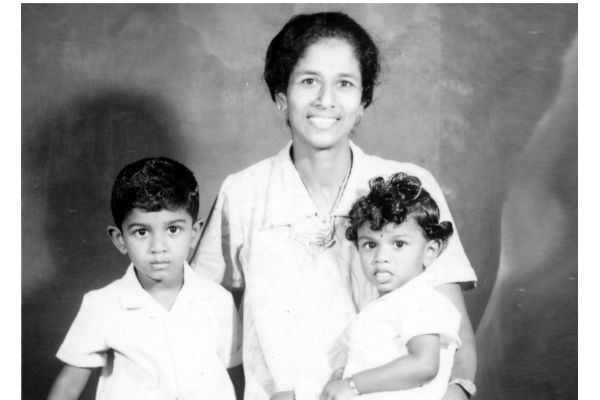
NOSTALGIA Kiru Naidoo with his mother, Lutchammamma Alimal Naidu, and his younger sister, Thirupurasundari.
“Old clothes, ornaments, old clothes!” I bet that brings back memories.
The women who traveled from far off to barter porcelain dogs, jugs, and swans for unwanted clothing were a frequent sight in Chatsworth. Sitting on a street corner, usually just off the main road, they would unwrap their bounty for display. In high-pitched, church-choir voices, they advertised their wares.
We never caught their names. For some reason, everyone was “Mama.” On the face of it, that was wonderfully respectful. On the other hand, there was the crude anonymity bred by colonialism and apartheid—recall the ugly days when white folks reduced all Durban Indians to “Mary” and “Sammy.”
My chatty mother, however, tried to bridge the gap.
Having grown up on a farm in Hillary, Lutchammamma Alimal Naidu of 2 Belfast Lane, off Arundel Road, had the amazing gift of speaking every Indian language from Urdu to Bhojpuri. When it came to African languages, isiZulu was as far as she could travel—and none of that embarrassing “Fanagalo” business, either. She could have passed for a rural Zulu woman in vocabulary, accent, and intonation.
As the firstborn son—“the golden child,” as my younger siblings lament—I went everywhere with my mother. We often caught the bus into town. I recall the screaming conductors in their Town Talk or ice-white Pointer shirts, their dungarees hanging low from the weight of the coinage stuffed into front and back pockets.
“What’s WEMA, Mummy?” I would ask. “And Washa, Happy Valley, and eThekwini?” She gave expert lessons in geography, linguistics, and history right there on the seat.
When we arrived at Grey Street and the taxi rank opposite Patel’s, gangsters and drivers alike would tip their fedoras in greeting. My mother dressed in sleek frocks and low heels that looked straight out of London’s Sloane Square. She stood out in the crowd. I would break her step to admire the line of Chevrolet Fleetlines, Ford Fairlanes, and Valiants that carried long-distance passengers, their touts hollering, “eMgungundlovu, Dukuza, Shepstone…”
I received a few more lessons before she chided, “Come along.”
Glancing at the men in tailored three-piece woolen suits and cigarette holders, I wanted to pause and take in the full experience of what it meant to be in “town.” But a stiff tug at my skinny arm would pull me along. “Don’t look. Those are the gangsters—the Duchenes, the Salots, the Crimson Leagues.”
In time, I got to know the TDKs—the Town Duchene Kids—when we visited my aunt in the Himalaya Flats on the corner of Old Dutch and Centenary roads, running off Warwick Avenue. My aunt was a stunner who piled her hair high like Audrey Hepburn, wore bright lipstick, and had dimples as deep as the Blyde River Canyon. The TDKs would help my mother carry her shopping bags up to my aunt’s flat and run errands to fetch a packet of sweet biscuits from the café downstairs. At other times, they could surgically slice a disrespecting cad from throat to Achilles heel in one flick of an Okapi knife. I also heard the legends of Bibi Salot, who carried a pearl-handled pistol in her garter and once shot a man from under the table.
When we retreated to the sanctity of Ganes’s Blue Flame bus back to Higginson Highway and Unit 3, I left the thrill of the gangsters behind. Later, playing dress-up in my father’s suits, I could never quite replicate the look those men conjured leaning against the light poles on Grey Street.
In our world, the typical trajectory was black trousers, a white shirt, and a bow tie for a job as a waiter. If you were lucky, a “connection” could fix you up with a job in a shoe or clothing factory. Landing a bank job, even as a clerk, was the pinnacle of achievement. In our little fishpond, the imagination did not extend to earning degrees or becoming university professors.
All that changed in a flash when Jeffrey from the pink house across the road was accepted into medical school, and Charlie Sigapragasen from around the corner started his studies to become a teacher. They created aspirations.
“Study hard and you can be like those boys,” was my parents’ mantra.
“Read, and you can be like the silver-tongued orator of the British Empire, the Right Honourable Sir VS Srinivasa Sastri,” my father routinely trumpeted.
Despite my father’s deep political consciousness, which ranged from communism to Black Consciousness, the irony of colonialism was lost on him in that moment. In Sastri, all he saw was a posh, highly educated Indian in a well-cut suit.
My father’s out-of-fashion suits came in handy when my mother needed something to trade for the porcelain ornaments.
“Where are you from, Ma?” my mother once engaged one of the traders when it became clear the woman’s isiZulu was less than basic.
For once, a place name and language stumped my mother. The location stuck in my head, as did the registration on their big yellow Ford F-250: LEB, if I remember correctly.
Nowadays, with vintage high on fashion trends, I only wish I had kept a few of my father’s broad-lapel bell-bottoms from Bronson’s, rather than the ornaments my mother left me in her will.
Naidoo is a local writer and a teller of long, short and tall stories. You may invite him for tea on 0829408163.