Hakeem Jeffries Seizes on Trump’s Push to Make the Midterms About Himself - Newsweek
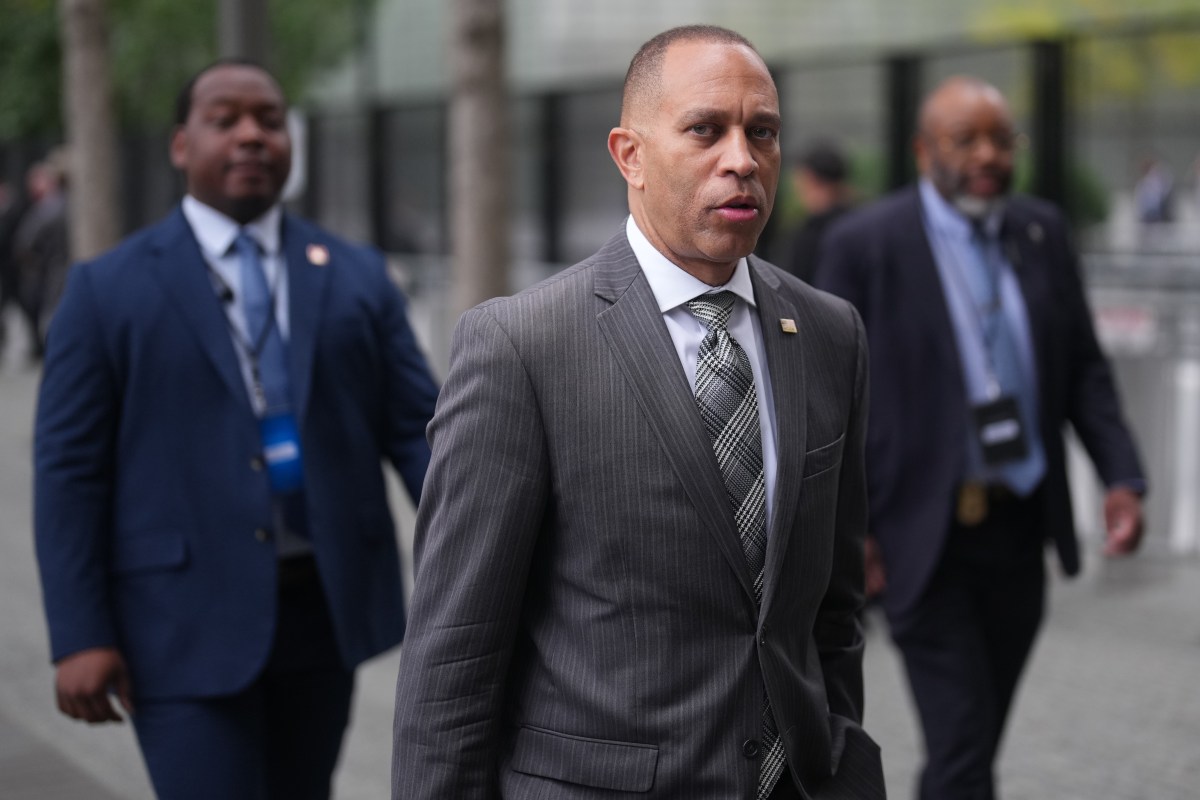
House Minority Leader Hakeem Jeffries on Sunday embraced President Donald Trump's strategy to turn this year's midterms into a referendum on his administration, arguing that voters are already evaluating Republicans through the lens of the president's performance.
Trump framed the upcoming election around his leadership during the first-ever Republican midterm convention in Dallas—a format more commonly reserved for presidential cycles. Acting as the event's central figure, the president urged his base to view the November contests as a direct extension of his presidency.
"Pretend that I'm on the ballot. I'm on the ballot, just one more time," Trump told the crowd.
Rather than pushing back against that framing, Jeffries leaned into it during an appearance on ABC News' This Week. The New York Democrat argued that Trump's record naturally anchors the campaign and signaled that his party is eager to press that advantage.
"Mr. President, we don't have to pretend," Jeffries told host George Stephanopoulos. "You are actually on the ballot."
Newsweek reached out to the White House for comment on Sunday.
Jeffries outlined a broad portfolio of issues Democrats plan to elevate, seeking to tie Republican candidates directly to Trump administration policies.
"Your failed economy is on the ballot. The cost of living crisis is on the ballot," he said, pointing also to U.S. involvement in Iran, rising gas prices, healthcare, and trade policy.
"The Trump tariffs, which have increased costs on everyday Americans by thousands of dollars per year, [are] on the ballot," Jeffries said.
The remarks highlight an evolving Democratic narrative: framing congressional races not merely as local matchups, but as a sweeping national referendum on Trump's return to power.
Whether that strategy mobilizes the electorate more effectively than Trump's base-building efforts remains the central question of the cycle.
"Donald Trump is absolutely on the ballot in November," the House minority leader said.
The president reinforced his turnout appeal with a promise that could become one of the campaign’s most contested proposals.
During the midterm convention in Dallas, Trump announced that every adult American citizen would receive a $5,000 payment if Republicans retain control of both chambers of Congress after the midterms.
"Because of our tremendous strength and success economically, I will issue a dividend to every adult citizen in the United States of America for $5,000," the president said. "Very much like a successful company will do a cash distribution to its shareholders."
Trump added that the money would have to be spent in the United States. It's unclear, however, how the government would monitor the spending of the dividends.
No legislation, eligibility framework or funding source accompanied the announcement.
With roughly 270 million adults in the country, paying each of them $5,000 would cost approximately $1.35 trillion.
Any proposal requiring federal spending would also face questions about congressional authorization and administration.
House Speaker Mike Johnson, a Louisiana Republican, was asked about Trump's declaration during an appearance on NBC News' Meet the Press on Sunday.
When asked by moderator Kristen Welker whether Americans could count on receiving the money, Johnson said that he would "commit that Congress will work through it and find consensus on that like they have to do everything else."
Welker pressed again, noting that Trump himself had already promised the payments.
"I'll work with the president hand-in-hand as I do all the time," the House speaker responded. "And we'll deliver for the American people. That's the promise."
The president's speech gives supporters a direct reason to connect the outcome of congressional races with his presidency, transforming an abstract fight over control of Congress into a personal and financial appeal.
Republicans are therefore testing two propositions at once: whether Trump can still bring presidential-year voters to the polls, and whether that benefit outweighs the opposition generated by his low approval ratings.
CNN’s latest Poll of Polls put Trump at 35 percent approval and 63 percent disapproval.
The September 1 average combined six national surveys of adults conducted between July 22 and August 31, including polls from Reuters/Ipsos, UMass Amherst/YouGov, Strength in Numbers/Verasight, Marquette Law School, AP-NORC and CNN.
Reuters/Ipsos surveyed 1,167 adults from August 28 to 31 with a margin of error of 2.9 percentage points. UMass Amherst and YouGov questioned 1,000 adults from August 21 to 26 with a margin of error of plus or minus 3.5 percent, while Strength in Numbers and Verasight surveyed 1,514 adults from August 14 to 19, with a 2.6 percentage point margin of error.
RealClearPolitics produced a less negative result, although Trump remained well underwater.
Its August 16 to September 11 average showed 39.2 percent approval and 57.6 percent disapproval, a net rating (those who approve minus those who disapprove) of -18.4.
The underlying surveys mix adults, registered voters and likely voters, one reason its result differs from CNN’s adults-only measure.
The New York Times average as of Sunday stood at 39 percent approval and 58 percent disapproval, giving a net approval rating of -19.
Silver Bulletin’s September 9 model placed Trump’s net approval at -19.5, slightly above its second-term low of -20.6.
Those trackers use different inclusion rules and weighting methods, so their precise figures should not be treated as interchangeable.
Still, all four point to the same conclusion: more Americans disapprove of Trump’s performance than approve.
One recent Economist/YouGov survey conducted from September 4 to 8 among 1,019 likely voters, with a plus or minus 3.4 percent margin of error, found 37 percent approval and 61 percent disapproval.
A recent Morning Consult survey, which ran between September 4-6, was less negative at 42 percent approval to 55 percent disapproval among 2,201 registered voters.
The distance between those results illustrates why averages are more useful than presenting one survey as definitive.
The White House has repeatedly played down unfavorable polling, arguing that Trump’s 2024 election victory remains the clearest measure of public support.
White House spokesperson Davis Ingle told Newsweek in a statement he has repeated many times: “The ultimate poll was November 5th, 2024 when nearly 80 million Americans overwhelmingly elected President Trump to deliver on his popular and commonsense agenda.”
Ingle said the administration was focused on jobs, inflation and housing affordability.
“No other President in history has accomplished more for the American people than President Trump, who is working tirelessly to create jobs, cool inflation, increase housing affordability, and more,” he said. “The President has already made historic progress not only in America but around the world, and this is just the beginning as his agenda continues taking effect.”
Contact Newsweek editor for this story: Anthony Murray.