
Hanuman Chalisa: The prayer that needs no temple - The Indian Express
I grew up in a home where religion was less commandment than inheritance. Diwali, Holi, Dussehra, Janmashtami and the Navratras connected us to family memory and to the larger Hindu faith into which we were born. But devotion was never demanded or displayed. My father began his working day with a sombre aarti and a single agarbatti. My mother emerged from her bath, sat in a chair and read the Hanuman Chalisa. Within minutes, she was done.
No diya. No elaborate altar. No audience. Faith did not require furniture.
My mother began this practice during a period when her already full life had become almost unbearably heavy. Someone advised her to read the Chalisa and keep it beneath her pillow. I do not know whether it was the prescription, the poetry or simply the precious privacy of those few minutes, but the reading remained. Decades later, if I cannot find her in the living room, dining room or kitchen, I know where she is: sitting quietly with the Chalisa after her shower.
For her, it has become protection, clarity, discipline, remembrance and habit. It is also catharsis—a few minutes in which nobody asks anything of the woman from whom everyone asks everything.
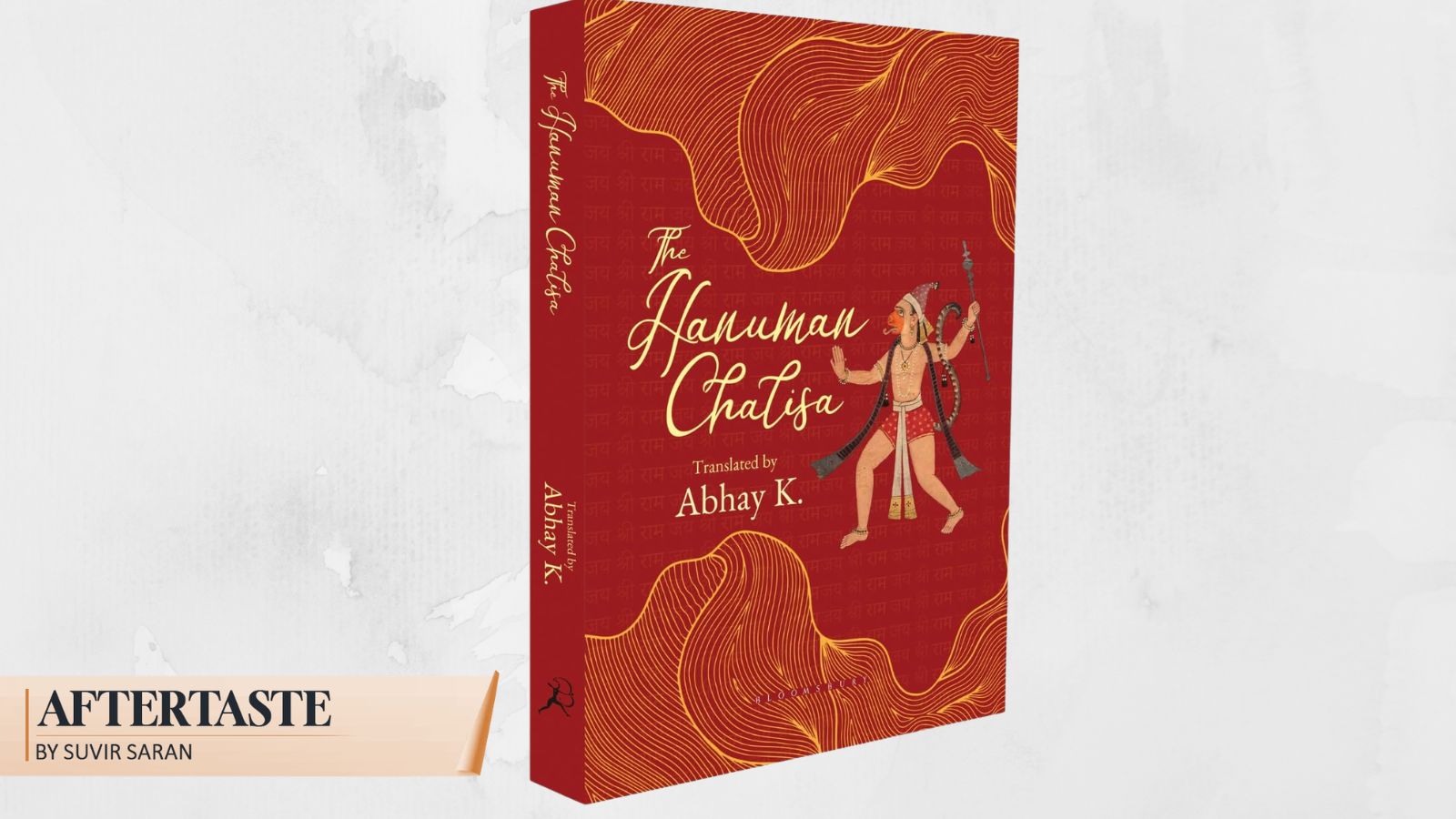
This intimate inheritance accompanied me as I read The Hanuman Chalisa, Tulsidas’s Awadhi hymn translated into English by poet and diplomat Abhay K. The Chalisa is astonishingly compact: 40 chaupais framed by opening and closing dohas. Abhay expands those few minutes of recitation into a handsome 108-page Bloomsbury volume, giving each verse four doorways: the original Devanagari, Roman transliteration, explanatory notes and a rhymed English rendering.
The arrangement is the book’s great generosity. Readers unfamiliar with Awadhi or unable to read Devanagari are not asked to stand outside the tradition. Nor does the English displace the original. Tulsidas remains visible and sovereign; Abhay builds a bridge towards him.
That bridge began, Abhay tells me, with a delegation from Trinidad and Tobago. The linguistic connection to India had weakened across generations, but the spiritual bond remained. They wanted a sacred text in accessible English—not dense, academic language, but words they could understand, memorise and sing with music.
Abhay, who has recited the Chalisa since childhood and turned to it during distress, recognised both the need and the challenge.
His ambition was not merely to translate meaning but to retain something of the original’s energy, movement and rhythm. That is a formidable undertaking. Not every rhyme possesses the effortless inevitability of Tulsidas; occasionally, English must bend so the music may continue. Yet this vulnerability is part of the work’s sincerity. Abhay chooses the risk of a singable poem over the safety of a bloodless, literal crib.
The annotations often offer the richest entry point into the hymn. Hanuman emerges not merely as the muscular deity of popular iconography, but as scholar, messenger, mediator and ideal bhakta. His strength is emptied of vanity. His intelligence serves others. He can become infinitesimal before Sita and terrifying before Lanka: humility and righteous power residing in the same being.
Most moving is the reminder that Hanuman, despite possessing immense powers, once forgot them until another awakened his memory. What better companion could there be for an age of anxiety and self-doubt? The Chalisa tells us that courage may not need to be acquired; it may need to be remembered.
We were taught that Hindu thought’s greatest gift was not ritual obedience but the civilisational intelligence of the Vedas and Upanishads—the recognition that consciousness binds us into one moral collective. Conscience must awaken whenever another being is humiliated, harmed or erased, and when human greed imperils the earth entrusted to us.
Seen this way, mythology is not failed history. It is humanity thinking through story. Hanuman need not be established as historical fact to offer moral truth. In a world crowded with men eager to advertise their power, he proposes something radical: the strongest figure in the story is also the least interested in becoming its centre. Perhaps that is why my mother still reads the Chalisa. Not because every miracle must be proved, but because an old rhythm helps her meet a new day.
Abhay K’s English carries that rhythm differently, and not always effortlessly, but it carries it across. Sometimes a bridge need not be flawless at every joint. It must help another human being reach the other side.
