HDB scales up robotics and automation solutions to increase construction productivity at BTO sites - CNA
The government will also further standardise precast components, with productivity gains that could translate into projects being completed earlier, said Minister for National Development Chee Hong Tat.
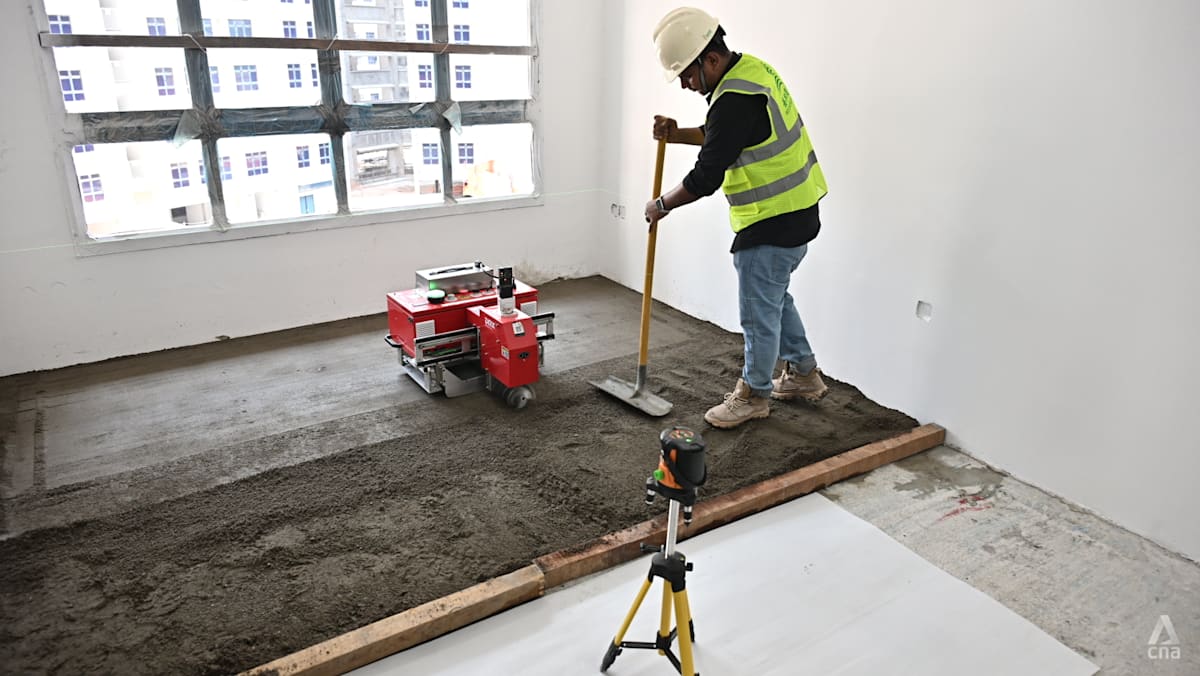
A screeding robot levels and smooths the floor before the tiling process at Woodgrove Edge BTO site on Sep 21, 2026. (Photo: CNA/Raydza Rahman)
This audio is generated by an AI tool.
Erin Liam 25 Sep 2026 07:51PM (Updated: 25 Sep 2026 07:52PM) Bookmark Bookmark Share WhatsApp Telegram Facebook Twitter Email LinkedIn Set CNA as your preferred source on Google Add CNA as a trusted source to help Google better understand and surface our content in search results. Read a summary of this article on FAST. Get bite-sized news via a newcards interface. Give it a try. Click here to return to FAST Tap here to return to FAST FAST SINGAPORE: With the precision of a laser, a robot no bigger than a dishwasher zigzags across the bare floor of a living room in a new four-room Build-to-Order (BTO) flat.
It carefully levels and smooths freshly laid concrete screed, creating an even floor surface to lay tiles or vinyl.
In another room, a worker bends over a mound of screed, setting out level pegs before painstakingly doing the job by hand.
The robot is not just faster; a worker can learn to operate it in a few days, compared with months of hands-on experience and repeated practice needed to master the job manually.
CNA Games Guess Word Crack the word, one row at a time Buzzword Create words using the given letters Mini Sudoku Tiny puzzle, mighty brain teaser Mini Crossword Small grid, big challenge Word Search Spot as many words as you can Show More Show Less A worker using the conventional screeding method at Woodgrove Edge BTO site on Sep 21, 2026. (Photo: CNA/Raydza Rahman) The screeding robot is part of the Housing and Development Board’s (HDB) roll-out of robotics and automation solutions to increase construction productivity and reduce manpower needs.
Speaking at the HDB Awards Dinner on Friday (Sep 25), Minister for National Development Chee Hong Tat said that to meet strong housing demand, the government must keep improving the way it builds flats by making better use of technology and manpower, raising productivity levels, and shortening construction timelines where possible.
“This is why our partnership with the industry is critical. We want to continue to work closely with all of you to find better ways to build, so that together, we can build more and build faster, while maintaining high standards of safety and quality,” he told attendees from the built environment sector.
Mr Chee said HDB will deploy smart hoists – automated, temporary lifts at construction sites – at about 50 per cent of all new BTO sites tendered from 2027, and scale up the use of screeding robots at more BTO sites.
“This is the next step of our scaling up efforts. But we will not stop here. I've asked HDB to work towards deploying these technologies at all new BTO sites,” he said.
Mr Chee said what matters is not how sophisticated the technology is, but whether it can help to solve practical problems at worksites.
He gave the example of the Smart Passenger and Material Hoist, which HDB has been trialling at project sites in Woodlands, Yishun and Rochor.
Unlike conventional hoists, which require a dedicated operator for each hoist, smart hoists can be called directly by workers to the floor where they are needed.
Smart hoists also have safety features, such as 2D LiDAR sensors, which scan for obstructions, and anti-pinch sensors that stop doors from closing if something is in the way.
One worker can supervise up to three smart hoists using live CCTV footage that can be viewed remotely, compared with one operator for each conventional hoist.
At a project with six smart hoists, for example, two workers would be needed instead of six, translating to a productivity gain of about 200 per cent for hoist operations, HDB said.
It added that with less manpower required for hoisting operations, workers can focus on other tasks such as supervision and quality checks.
“While this may sound like a relatively simple improvement, the manpower savings do add up across many blocks and many projects, leading to a sizeable overall increase in productivity,” said Mr Chee.
Mr Chee also gave the example of using robots for more repetitive and labour-intensive tasks, such as floor screeding.
“A screeding robot automates much of this process and creates a more consistent finish. Workers can then be deployed to take on other more productive tasks,” he said.
HDB said the time taken for a robot to screed a four-room flat is about a day, although actual productivity gains will depend on factors such as the unit layout and the worker’s experience in operating the robot.
The agency has conducted preliminary trials at sites in Bukit Merah and Ghim Moh, and will extend trials to at least four more BTO projects in 2027 to assess the robots under different site conditions and their potential for wider deployment.
HDB said that while the initial costs of adopting robotics and automation are expected to be slightly higher, costs are expected to go down with wider adoption and economies of scale, as the technologies mature and industry capabilities develop.
It added that higher construction costs do not translate directly into higher flat prices for home buyers.
On how the adoption of technologies will impact waiting times for BTO projects, HDB said the construction methods can shorten the time needed for specific construction activities and improve overall site productivity.
However, the construction timeline of a BTO project depends on various factors, including its design and complexity and site conditions, HDB said.
Mr Chee also announced the launch of HDB’s Enhanced Precast Components Catalogue (EPCC), which will be made available to industry partners from Sep 28 and implemented in projects tendered from December 2026.
The catalogue is a library of detailed specifications and drawings for how to fabricate 17 types of precast components – or building components manufactured off-site – that are commonly used in HDB’s BTO projects. These include precast bathroom units, household shelters and staircases.
Standardised precast components such as those used at Central Weave @ AMK, help to simplify precast production and construction.
These are productivity gains that could translate into projects being completed several months ahead of schedule, he said.
While the current catalogue covers the dimensions of commonly used precast components, the enhanced catalogue will standardise key specifications such as concrete grades, reinforcement provisions and connection details.
This will make it easier to use the same components across multiple HDB projects, Mr Chee said.
“There are benefits across the value chain. Consultants can spend less time on repetitive design work. Precasters can produce at greater scale and make better use of automation.
“Contractors can choose from a wider pool of suppliers, while workers can apply familiar construction methods across different projects,” he added.
Mr Chee said the government expects the enhanced catalogue to reduce project manhours by up to 20 per cent and provide more sourcing options.
HDB said the enhanced catalogue groups precast components according to how far they can be standardised.
Components that typically do not require project-specific changes, such as staircases and household shelters, will use common specifications across all HDB projects.
For the first time, this creates “off-the-shelf” standardised precast components, giving precast suppliers the option of building up a stock of these components to support future supply tenders.
While facade components are standardised within the catalogue, consultants will still be able to design visually unique facades through the use of attachments such as canopies and fins, HDB said.
They will also be able to use tools such as formliners – an elastic mould – to create textures on the facade or painted patterns.
“I would also like to reassure everyone that greater standardisation does not mean that everything will look the same. We are not baking cookies; so we are not going to use a cookie-cutter approach,” Mr Chee said.
“We can standardise components to improve productivity, while continuing to give HDB projects, each one, its own identity and character, based on the surroundings and the community.”