Hiuen Tsang stupa or King Jushka's town: Kashmir digs up 2,000-yr-old history
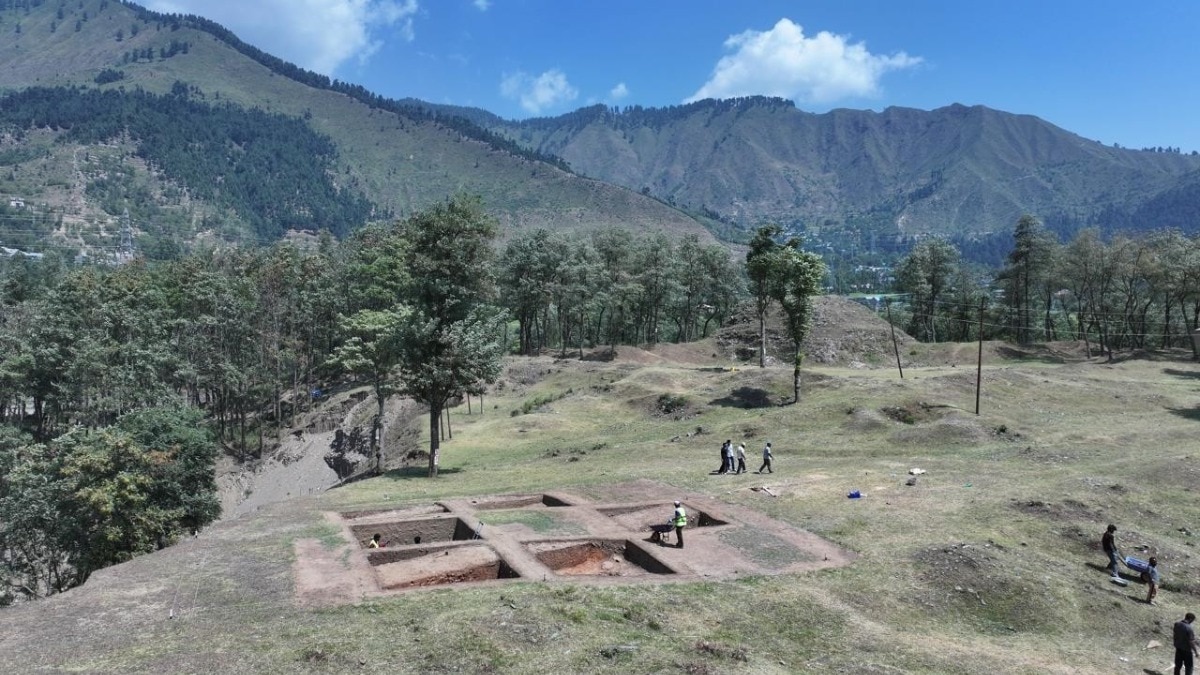
For the second consecutive year, archaeologists are excavating a site in the village of Zehanpora in north Kashmir’s Baramulla district—a 2,000-year-old Buddhist apsidal stupa complex located on the right bank of the Jhelum river and thought to be dating to the Kushan period of 1st century AD.
The excavation has intensified as researchers believe the site may hold clues to the 7th century Chinese scholar Hiuen Tsang’s forgotten monastery and giant stupa or the lost township of Kushan king Jushka.
The second phase of the excavation formally began on August 29. The previous phase was carried out last year. A team of scholars, researchers and students from the University of Kashmir in Srinagar and Degree College, Baramulla, is working at the site around the clock. So far, they have opened about six trenches and located the foundation of the stupa complex, estimated at roughly 20 by 20 metres.
“As we excavate and expose the 2,000-year-old structure, we have found the walls intact. They are built of pebble stone—a characteristic feature of Kushan-era architecture,” said Dr Mohammad Ajmal Shah, assistant professor at the Centre of Central Asian Studies, University of Kashmir, and the archaeologist in charge of the Zehanpora digging.
“The Kushans ruled Kashmir for more than 300 years between the 1st and 4th centuries AD and were predominantly Buddhist. Pottery and other artefacts recovered from the site further confirm it (complex) belongs to the Kushan period,” said Dr Shah.
It is already known that the Zehanpora mounds (earlier called stupa dunes) contained ancient structures, but their precise age was unclear. The current excavation has established they are around 2,000 years old.
Dr Shah, who has done his PhD on Kushan culture in Kashmir, had visited the mounds many times during his research and field trips with students. His interest deepened during a visit to the Guimet Museum in Paris, where he came across a roughly 100-year-old archival photograph. On the reverse read a line: “Stupa Dunes, Baramulla”.
“I immediately recognised it as Zehanpora,” Dr Shah told INDIA TODAY. On his return to Kashmir, he raised the matter with Kuldeep Krishan Sidha, director of archives, archaeology and museums, Jammu and Kashmir. Sidha understood and recognised the site’s archaeological and cultural importance.
Last October, the University of Kashmir and the Department of Archives, Archaeology and Museums signed a memorandum of understanding to collaborate on the excavation. Subsequently, the first excavation phase started in November.
In fact, in his radio talk Mann Ki Baat in December 2025, Prime Minister Narendra Modi referred to “rare pictures at French museum”, which he said “helped researchers connect the dots and confirm the historical importance” of the Zehanpora site. Modi said the discovery of the archaeological site had opened a window into Kashmir's glorious past, dating 2,000 years back.
“In Baramulla, J&K, there is a place called Zehanpora. For years, people had been seeing some tall mounds there. A scientific study of these mounds was initiated. It turned out that these mounds were the remains of a large structure built by humans,” Modi said in his talk.
“Zehanpora,” Sidha told INDIA TODAY, “is significant because it allows us to move beyond textual references to ancient Kashmir and recover the material history of the region through scientific archaeology. The site is emerging as a substantial Buddhist complex of the early historic/Kushan period, strategically located on the north-western approach to Kashmir and linked to Gandhara and Central Asia.”
Around 1923-24, the then J&K State Archaeology Department conducted a limited excavation at Zehanpora, but the work was short-lived and produced only a brief note rather than a detailed report that could have helped scholars in the future.
The Zehanpora site lies on the old Jhelum Valley route, once an important north-western gateway into the Kashmir Valley. Further excavation at the site may show whether it formed part of a wider Buddhist cultural and communication network. Before Partition, British visitors from Lahore had photographed the mounds.
The renowned Chinese Buddhist monk, scholar and traveller Hiuen Tsang (also known as Xuanzang) entered the Kashmir Valley in 7th century AD during the reign of King Durlabhavardhana of the Karkota dynasty. In his travelogue ‘Si-yu-ki’ (Records of the Western Regions), Hiuen Tsang describes crossing difficult mountains and precipices before reaching a “stone gate” that marked the western entrance to the kingdom near present-day Baramulla.
“Because Zehanpora sits on the old Jhelum Valley route used by travellers before the modern cart road was built along the left bank of the river, we are also examining the site in light of Hiuen Tsang’s account,” said Dr Shah. “He mentions a huge stupa on the way into Baramulla and spent a night at a Buddhist monastery at ‘Hushkara’ (Hu-se-kia-lo)—now the village of Ushkara on the left bank of the Jhelum in Baramulla. He stayed about two years in Kashmir, studying Buddhist texts, and recorded observations on the region, its people, culture and religion.”
Phase one uncovered settlement-related architecture, pottery, metal objects, a pebble wall and human remains. These finds offered early evidence of monastic remains and cultural deposits.
“These are not isolated artefacts,” Sidha noted. “Their archaeological context and stratigraphy can help reconstruct how people lived, worshipped, built, produced and interacted with communities beyond Kashmir. Detailed scientific analysis will be essential for firm historical conclusions.”
In the ongoing second phase, the team is focusing on the still-unexplored portions of the roughly 10-hectare site, which is divided into Zehanpora 1 and Zehanpora 2 by a power canal built in the 1970s.
“The superstructure of the complex is gone; it was probably made of wood,” Dr Shah said. “We have recovered more than two dozen iron nails, some as long as six inches and one foot, indicating that the wooden superstructure was fastened with iron. This also shows the sophisticated use of iron in Kashmir 2,000 years ago during the Kushan period, when the region traded with Central Asia and constructed irrigation canals. Beads have also been found; their material is still being analysed.”
The 12th-century Kashmiri chronicler Kalhana, in his ‘Rajatarangini’, records that three Kushan kings—Hushka, Jushka and Kanishka—each founded a township. Archaeologists have identified Hushka’s township at Ushkara on the edge of Baramulla, a well-preserved site. Kanishka’s township has been located at Kanispora on the outskirts of Baramulla, although it is not currently preserved. Jushka’s township has never been found.
“It is possible we are excavating the missing township built by King Jushka,” Dr Shah said. “Excavation is a slow, painstaking process. Fully exploring Zehanpora, given its size, may take 10 years or more.”
Sidha is optimistic that more extensive excavation could add new chapters to Kashmir’s history by providing material evidence for the development of Buddhism in Kashmir, settlement patterns, Kushan-period technology and economy, and the region’s place within Gandharan and Central Asian networks.
“For international scholars, Zehanpora has the potential to become an important reference site for studying the movement of Buddhism, people, technology and ideas across the Kashmir-Gandhara-Central Asia corridor,” he said.
“The real value will lie in completing the scientific excavation, preserving the stratigraphic context and subjecting the finds to multidisciplinary analysis. In that sense, the work is not simply uncovering monuments but reconstructing a forgotten chapter of Kashmir’s place in the ancient world,” he added.
As the excavation advances, conservation and long-term preservation of the Zehanpora site will be major challenges and may require international collaboration given its historical and archaeological significance.