Hong Kongers hit with unauthorised charges for new iPhone as banks launch probes - Bangkok Post
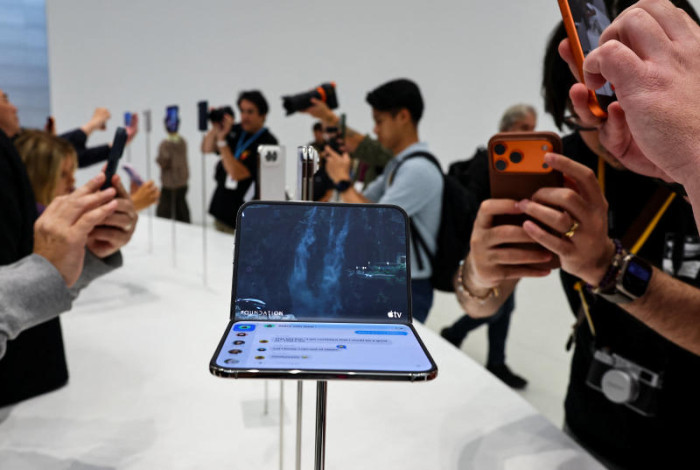
The new foldable iPhone Duo is on display during Apple's event at the Steve Jobs Theater in Cupertino, California, on Wednesday. (Photo: Reuters) Scores of Hong Kongers have complained about unauthorised transactions on credit cards used to pre-order Apple's latest iPhones, prompting major banks to launch investigations.
One internet user on the social media platform Threads said she received a message on Saturday night saying she had unauthorised transactions of HK$33,598 (142,000 baht) from Apple on her HSBC credit card.
"When I called Apple customer service, they hung up on me immediately. What should I do?" she asked.
It took her half an hour to reach an HSBC customer service officer to suspend her credit card, and she subsequently filed a police report.
Another internet user said she had at least four unauthorised transactions with Apple of HK$11,499 each on her Hang Seng credit card.
"Only after browsing Threads did I realise so many people had their credit cards stolen tonight to buy an iPhone 18 Pro on Apple … After seeing the posts and checking my own card, I realised I fell victim to it too," she said.
Similar incidents occurred to others with credits cards from different banks.
Internet celebrity "Szetosifu" told the South China Morning Post on Sunday that he tried to pre-order an iPhone 18 Pro Max at 8pm (7pm Thailand time) on Saturday.
He said he tried many times with his Hang Seng credit card, but failed to secure one after entering the card security code. His orders were rejected by Apple and he did not receive any receipt.
He eventually gave up, but after 10 to 15 minutes, he received 10 SMSs, each saying that he had used his Hang Seng credit card to pay HK$13,299 on Apple's Hong Kong website.
Szetosifu said he tried to call Hang Seng's hotline but no one picked up after a 30-minute wait. Nonetheless, he was not worried because he believed the bank was withholding the transfers and he would visit a branch on Monday to clarify the matter.
Apple unveiled the iPhone Duo, its first foldable smartphone, as well as the new iPhone 18 Pro series last week. Pre-orders for the latter opened at 8pm on Saturday and actual sales would start on Friday.
Francis Fong Po-kiu, honorary president of the Hong Kong Information Technology Federation, surmised that the Apple Online Store may have overlooked certain verification steps, including a process called 3D Secure, to ensure smooth traffic during the high-demand pre-order phase.
He said fraudsters might have exploited the shopping frenzy to carry out real-time fraudulent charges using credit card details previously obtained through phishing websites or black markets.
"Basically, Apple should take responsibility, and I believe they will. However, who will compensate? Is it Apple or the banks? I don't know," he said, adding that there should be sufficient time to cancel all the unauthorised transactions, as there was still a week before the actual delivery of the new iPhones.
Fong also said there could have been duplicate transactions caused by network congestion during the pre-order rush.
An HSBC spokesman said on Sunday that the bank would investigate and return unauthorised charges to customers under its card scheme rules where applicable.
"Customers who have used their credit card reasonably and with due care, and who report promptly, can rest assured that they will be guided through the refund process," he said.
He reminded customers to suspend their cards if unauthorised credit card transactions occurred.
Hang Seng Bank said that while the bank investigated, it would support affected customers and, like HSBC, initiate return payments where applicable.
"We'll fully support impacted customers who have used their credit card responsibly and with due care throughout the refund process," the bank said.
Standard Chartered Bank said customers who discovered any unauthorised transactions should notify the bank to suspend their credit card and report the incident to the police as soon as possible.
The bank would investigate in accordance with established procedures and submit chargeback applications to the relevant credit card organisations where applicable, it added. If its investigation confirmed that a transaction was not authorised by the cardholder, the cardholder would not be held liable for the relevant amount charged.
Bank of China Hong Kong said all its credit card customers were protected by a chargeback mechanism, and customers were not required to bear any liability for transactions verified as unauthorised.
A spokesman with the Hong Kong Monetary Authority said merchants could choose not to use or temporarily suspend additional authentication arrangements due to operational considerations. In such circumstances, however, the merchant would bear the liability and financial losses arising from unauthorised transactions.
The spokesman added that, generally speaking, if a bank credit card account was used for unauthorised transactions but the cardholder had not engaged in any fraudulent or severely negligent behaviour, then the cardholder was not required to bear any liability for the unauthorised transactions.
The South China Morning Post has reached out to Apple Hong Kong and police for comment.