
Hope fading for new Boeing deal during US-China summit, sources say
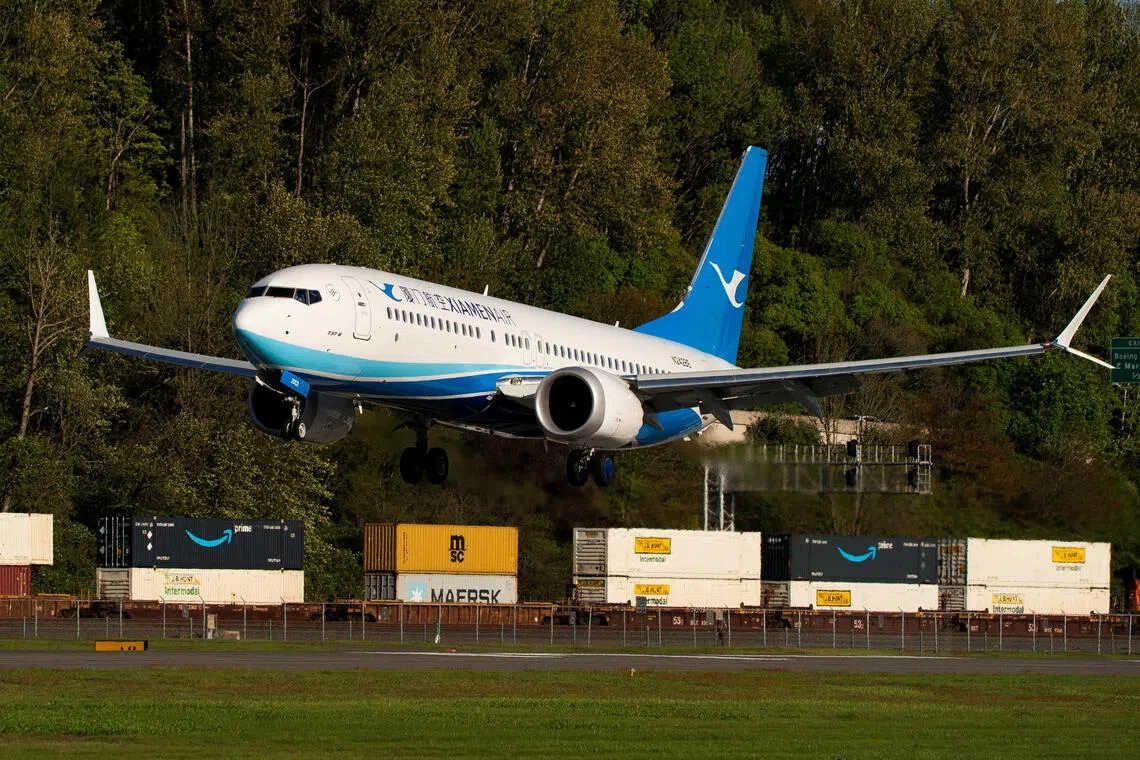
Boeing has lagged behind its rival Airbus, which has made more inroads in China.
SEATTLE – Hopes for a new China commitment to buy Boeing planes are sinking ahead of a summit on Sept 24 between the US and Chinese presidents, with negotiations still in flux, two people briefed on the matter have revealed.
The planemaker instead is trying to finalise a May deal for China to buy 200 planes rather than earlier hopes of securing new commitments for hundreds more jets, the sources said.
The provisional deal struck in tandem with US President Donald Trump’s last summit with Chinese President Xi Jinping in Beijing put Boeing back into competition for Chinese jetliner orders.
The US planemaker has been effectively shut out since 2017, while European rival Airbus has continued to expand its market share in one of the world’s biggest aviation markets.
China is expected to order around 9,000 new jets by 2045, more than any other region, according to Airbus and Boeing market forecasts.
The two Trump-Xi summits in 2026 were expected to catalyse a new round of Boeing purchases. Ahead of the spring summit, Boeing, Chinese and US officials were discussing a deal for as many as 500 jets.
After the May summit, Boeing CEO Kelly Ortberg said the smaller-than-expected 200-jet deal was an “initial tranche” of orders and that reopening the China market was the real win.
Investors and aviation analysts were expecting another large order to follow at the summit, but Ortberg last week played down that prospect.
“It will be a victory if the 200 airplane order can be saved,” said Richard Aboulafia, managing director of aerospace consulting firm AeroDynamic Advisory.
Scott Kennedy, a China specialist at the Center for Strategic and International Studies, said brokering new jetliner deals is not a top priority at this summit.
US and Chinese officials are more focused on extending a trade truce and discussing AI safeguards, weapons sales to Taiwan and trade deals on soybean and rare earth mineral exports, he said.
“A lot of trade relationships are hostage to these meetings,” Kennedy said. “New aircraft orders would be a benefit, but I don’t think that’s a necessity for this summit.”
The US and China agreed to extend by two months a trade truce that was due to expire on Nov 10, allowing more time to work on a potentially bigger trade deal, US Treasury Secretary Scott Bessent said on Sept 23.
Airbus has made more inroads in China than Boeing in recent years in part because it has a final assembly line in Tianjin and China-Europe relations have been “more benign” than those between China and the US, said Shukor Yusof, founder of Singapore-based aviation consultancy Endau Analytics.
“Boeing has lost much of its influence in our region, partly due to politics, but mostly because of its own internal issues,” he said.
There are still some hopes for progress between Boeing and China, particularly on the 200-jet deal announced in May.
US Trade Representative Jamieson Greer told Fox News on Sept 21 that “there are about 140 (jetliner orders) that are in a good state”, with another 10 orders being finalised.
One of the people briefed on the matter said final details for part of the May deal could be announced during the summit if contracts can be finalised, despite the challenges.
Before it was signed, there had been concerns from China over whether it would receive guaranteed access to spare parts, following earlier threats from Trump.
China’s commerce ministry said in May the US provided supply guarantees for aircraft engine parts and components under the Boeing deal. REUTERS

