
Houthis capture more Yemeni Red Sea islands, tightening grip on Bab el-Mandeb
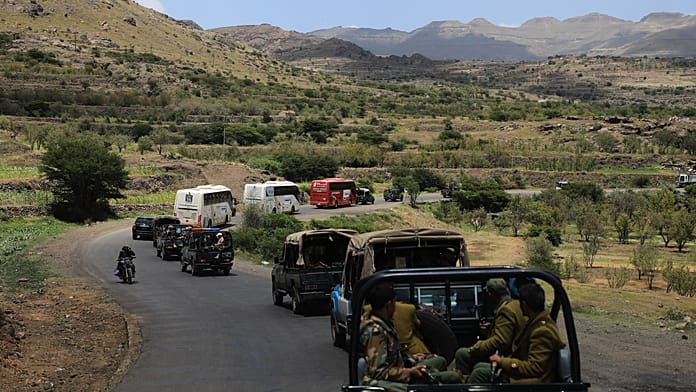
Yemen's Tehran-backed Houthis captured more islands in the southern Red Sea, government and Houthi officials said Monday, strengthening their control of a major maritime shipping route.
The capture of the islands of Greater and Lesser Hanish is the latest in the group's swift advance around the Bab el-Mandeb Strait, a key passage for oil shipments that has become even more crucial during the Iran war as the Strait of Hormuz remains under US and Iranian blockades.
Like Hormuz, located at the mouth of the Persian Gulf, the Bab el-Mandeb Strait — on the opposite side of the Arabian Peninsula — is a chokepoint that connects the Indian Ocean to the Red Sea, making it a key waterway for cargo traffic to the Mediterranean Sea.
For more than a month, the Houthis have been striking Saudi oil infrastructure and shipping in the Red Sea, stepping up pressure on global oil prices and boosting Iran's leverage in its war with the US.
Forces of the internationally recognised Yemeni government have been attempting to rally and fight back, but the Houthi gains have seemingly come with little resistance.
The Houthis deployed on the Hanish islands, 160 kilometres north of Bab el-Mandeb, after hundreds of government-allied forces withdrew from the archipelago, according to two government officials and a Houthi official.
The group officially known as Ansar Allah captured the archipelago after seizing the nearby mainland port city of Mokha and the island of Perim, inside the Bab el-Mandeb Strait.
In parallel, they waged an offensive further inland, particularly in the longtime battleground province of Taiz.
The Houthis also launched a fresh barrage of missile and drone attacks on Saudi military targets on Monday.
The Houthis said they fired dozens of drones and missiles at the kingdom — which backs the Yemeni government — prompting the Saudi Civil Defence to issue brief alerts in the neighbouring cities of Khamis Mushait and Abha.
The Saudi Civil Defence overnight said a Houthi projectile fell in a different area near the border with Yemen along the Red Sea, injuring two people and damaging a mosque and several other buildings.
Riyadh did not announce any new attacks targeting the Houthis.
The Houthis came to power in late 2014 after storming Sana'a and seizing the presidential palace and key military sites, forcing Yemen's government into exile.
The group triggered a return to hostilities in Yemen's civil war in July after a UN truce that had largely maintained quiet since 2022, when they let an Iranian plane land in defiance of Saudi control of Yemeni airspace.
Riyadh retaliated by striking the airport, prompting the Houthis to declare a blockade on the kingdom targeting its oil trade in July.
Some 150 civilians have been killed in fighting since 3 September, the government's Human Rights Ministry said. More than 200 civilians have been wounded, it said.
Thousands of families have fled their homes in Taiz and nearby provinces in the past day alone, said Khanzad Shah, acting head of Islamic Relief, a charity that operates in the area.
"Many of them don't have enough food or water as they had to flee with whatever they could carry. In some areas, whole villages have reportedly emptied," he said.
The UN has estimated that more than 80,000 people have been displaced in the past two weeks, including over 2,000 people who fled by boat to Djibouti.
The fighting threatens to reignite a war that for more than a decade brought disaster to Yemen, killing more than 150,000 people and driving the country to the brink of famine.
The internationally recognised government supported by an array of disparate militias controls the south and east, including the key southern port of Aden.
The Hanish islands, newly captured by the Houthis, had been controlled by the UAE-backed allies. However, the UAE dismantled its military infrastructure there earlier this year.
For years, Saudi Arabia waged an air campaign against the Houthis, while backing the government and allied militias, yet it has appeared reluctant to throw itself fully back into the war, despite the Houthi attacks on oil infrastructure and shipping.
The Houthis are tied to Tehran's so-called Axis of Resistance — a loose network of militant groups in several countries in the region including Hezbollah in Lebanon, Hamas in Gaza and militias in Iraq, all backed, trained and equipped by the IRGC to varying degrees.
On Sunday, the Yemeni government's military said it launched airstrikes on Houthi positions in the port city of Mokha, the coastal town of Dhubab and elsewhere in Taiz province.
The Houthis reported strikes by the Saudi-backed forces in Taiz province and artillery shelling in Saada province, the birthplace of the Houthi movement on Yemen's northern border with Saudi Arabia.
Sultan al-Arada, a member of the government's presidential leadership council, described the collapse of government forces in Mokha, about 80 kilometres from the Bab el-Mandeb Strait, and elsewhere on Yemen's west coast as "painful and regrettable."
He said in a televised interview aired late Saturday that forces "are currently regrouping and will return to the battle."
Rashad al-Alimi, who leads the presidential council, sought on Sunday to downplay the defeats as "incidental," according to comments published by the country's state-run SABA news agency.
The government "will remain clear and fixed on the goal of retrieving institutions and of reclaiming sovereignty over all national territories," al-Alimi said.


/https://i.s3.glbimg.com/v1/AUTH_da025474c0c44edd99332dddb09cabe8/internal_photos/bs/2026/H/3/qVKrzHQyeM6UvGuH1nww/arte-globo-2026-09-02t195744.608.png)