
How a red brick wall in Rosedale sparked a nasty neighbourhood feud — and a million-dollar legal battle - Toronto Star
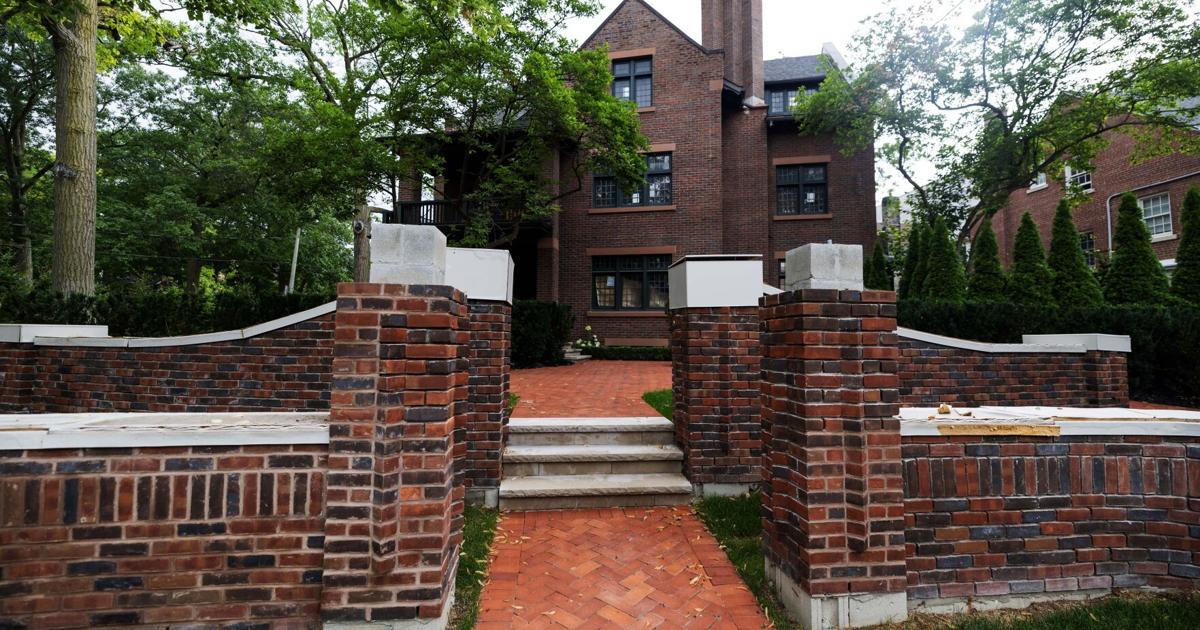
A brick wall in North Rosedale has sparked a nasty dispute and at least $1.05 million worth of defamation lawsuits that also allege conspiracy.
A Rosedale couple has built a 200-foot-long brick wall around their home in North Rosedale, which has roiled the tony Toronto neighbourhood.
North Rosedale is known for its wide streets, meticulously maintained historical homes, and the vast greenery of its tree canopies and surrounding ravines.
But in some corners of this, one of Toronto’s toniest neighbourhoods, tensions are simmering.
Michele and Matthew McGrath say they have been “villainized” over the structure that surrounds their home, which, they add, they had permission from the city to build.
It’s a dispute that’s turned nasty, pitting neighbour against neighbour. The McGraths say eggs have been thrown at their home, and rocks through its window. The couple have filed defamation lawsuits against their neighbours, the North Rosedale Residents’ Association — and even the local councillor, Dianne Saxe.
The councillor and residents, meanwhile, say the couple are merely trying to silence their critics and flout the rules.
None of the people involved in the fight would agree to be interviewed about it, and none of the allegations have been proven in court, but the story is revealed in thousands of pages of legal filings and in city council meetings that span years.
In a statement to the Star, Matthew McGrath said he has to limit his comments during the ongoing court case, but that it has been “both incredibly stressful and surreal to be repeatedly portrayed as having acted unlawfully and improperly, when in fact the opposite is true.”
It was back in 2019 that the McGraths started planning renovations to their three-storey, 9,000-square-foot Period Revival-style home, which they’d bought two years earlier for $4.5 million. It’s one of two adjacent homes owned by the family, with the second bought in 2023 for $4.4 million by a numbered company that lists Matthew McGrath as sole director.
The plans included extensive upgrades — inside and out — to the first house, which was built in 1906. One of the renovations called for the replacement of the wrought-iron fence and hedges that encircled the property with a brick wall.
This image from Google Maps from November 2020 shows the wrought-iron fence and hedges at the McGraths’ North Rosedale property.
The couple’s court documents say they partly wanted a wall around their yard for security, citing the thefts of cars in Rosedale, including their own.
To ensure the structure was in keeping with the look of the house, the couple personally visited 12 brick mason mills in Toronto before discovering a suitable, specialized kiln in Philadelphia.
On it, they planned to mount their family crest, which features what appears to be three lions, a cross pattée, a stag and a battle axe. Under it is a Latin motto, “Salus In Fide,” which means “Keep The Faith” or “Salvation In Faith.”
The design for the McGrath family crest with architect’s drawing of the wall.
“The wall was tastefully and meticulously designed to match the style of the house and character of the neighbourhood,” says the McGraths’ statement of claim.
Most of the wall would sit on the city’s right-of-way around the home, at the intersection of Whitney Avenue and Glen Road. The couple worked with the city from May 2023 to October 2024 to eventually get an encroachment agreement — with a list of conditions — and a permit for landscaping work, including to build the wall.
At no point, the McGraths contend, did anyone mention anything to them about a heritage permit: “To the contrary, (the city) confirmed that no additional permits were necessary.”
This would turn out to be a problem.
The McGraths’ property lies within a heritage conservation district.
Under the Ontario Heritage Act, that means property owners need a special permit to change, build or remove any building or structure. There are some exceptions — including landscaping work, such as the location of plants.
More than two decades ago, the heritage advisory committee of the North Rosedale Residents Association was created with the aim of making sure any new developments complemented the enclave’s character.
The still unfinished wall on the McGraths’ North Rosedale property.
The Whitney wall was one of four renovation projects in North Rosedale that the McGraths had carried out since 2022 — in the words of the residents’ court documents: “without regard for applicable laws, policies, bylaws and directives, and without consideration for the rights and interests of their neighbours.”
(City records from April this year show a garage on the neighbouring property that Matthew McGrath’s numbered company owns had been demolished without a permit. The city ordered them to apply for one, which the McGraths’ court filings said they did.)
When the McGraths negotiated the encroachment agreement for the masonry wall, they were “misleading” the city, according to court documents filed by lawyers for Melanie Shishler, a former member of the heritage committee and one of those named in the McGraths’ lawsuit.
The couple “failed to disclose” how close the wall would actually be to the sidewalk, Shishler’s lawyers allege: “Their drawings indicated inaccurately that the wall would follow the path of their previous wrought iron fence.”
When he was cross-examined by Shishler’s lawyer in July, Matthew McGrath said they used drawings, for the encroachment agreement, from before the intersection next to their property was reconfigured by the city in 2020. When they went to build the wall they had to “adapt the construction to what was actually present,” adding that city staff didn’t flag it as an issue.
Shishler and other neighbours said their main concern was preserving the heritage of one of Toronto’s oldest neighbourhoods, but they were also worried about traffic safety, claiming the wall could block sightlines onto Whitney Avenue from Glen Road.
According to court filings by Shishler’s lawyers, the McGraths contended their wall was “landscaping,” but “as a matter of common sense, a 200-foot long masonry wall that reaches over seven feet in height is obviously not ‘landscaping.’”
Saxe, the local councillor, originally backed the McGraths’ plans at community council. She said later she didn’t know a heritage permit was necessary until Shishler and others raised the matter.
But a month after the couple started construction in November 2024, Saxe started fielding complaints.
In January 2025, with the wall mostly built, the city and Saxe gave the McGraths the bad news: They needed the heritage permit and would have to apply for one within a month to keep the wall.
“In our view, our landscaping wall is a landscaping feature that does not need a heritage permit,” according to Matthew McGrath’s affidavit. “I also believe this is why the city never took the position that we needed a heritage permit for the landscaping wall until the neighbour group’s pressure campaign.”
The “‘heritage warriors’” took issue with the wall, the couple’s court filings allege, mostly because they had not been consulted during the process.
The McGraths said they did stop construction of the wall. But they didn’t take it down — even though city council told them to in March 2025.
Coun. Dianne Saxe originally backed the McGraths’ plans at community council.
Instead, a few months later, they applied for retroactive approval for a heritage permit.
City council rejected that application in October 2025 and asked them, again, to take down the wall.
Council made its vote based on advice from city staff and the Toronto Preservation Board, which said the wall “does not comply” with official plans for the neighbourhood nor the official guidelines the municipality adopted to preserve the area’s heritage values.
The McGraths have since filed an application with the court to get the city to declare the wall doesn’t need a heritage permit — and that the city cannot go back on its encroachment agreement.
As part of the terms for a potential settlement of this application, the McGraths agreed to redesign the wall. The height of the brick portion would be just over a metre and an iron fence at the top for security would help improve visibility for traffic. City staff agreed to submit a report to council backing a heritage permit.
At July’s council meeting, city staff advised councillors to approve the application by the McGraths for a heritage permit. City staff also said the traffic sightlines were “fine” with the new design proposal.
But not everyone was happy with the proposed settlement.
Some councillors said they felt there were serious principles at stake: the retroactive approval of a wall built without the necessary permits was one. That the McGraths refused to take it down multiple times was another.
“If you get a ‘stop work’ order, you can’t just send lawyers, guns and money at it,” said longtime Coun. Gord Perks at July’s council meeting, his last before retiring.
Coun. Alejandra Bravo agreed, saying the McGraths had “all the resources in the world to find out” how to build the wall correctly.
“Power, privilege, resources, money cannot hyper-entitle you in front of this council,” Bravo said. “To me, this is a slam dunk.”
And the couple is suing a local councillor for doing her job, Bravo told council, but whose voice at council was subject to the “chill” of a defamation lawsuit. In accordance with council’s policies, Saxe recused herself from the debate.
Brad Bradford, who’s running for mayor, was the only councillor who spoke in favour of the McGraths.
“Yes, they ran into an issue with the heritage permit,” Bradford said. “They’ve worked hard to come back to rectify it … It’s not anything more elaborate.”
Council refused both the new design and the permit, again, in a vote of 20 to four.
In a court filing in August, the McGraths called council’s decision “frustrating and disheartening.”
The North Rosedale couple are suing for at least $1.05 million in separate defamation lawsuits that also allege conspiracy. The McGraths alleged Saxe, 13 neighbours and the North Rosedale Residents’ Association told the community the pair had “unlawfully, unethically and deceitfully” built the wall, according to statements of claim filed in December. (Several neighbours have since been dropped from the lawsuit.)
According to the McGraths’ statement of claim, Saxe made statements — in letters circulated to the community, social media posts and newsletters — alleging explicitly and implicitly that the couple acted unlawfully.
For example, in a January 2025 email to the McGraths’ architects — which they say Saxe also circulated to the broader community — the councillor wrote that the McGraths “did not obtain the legally required permit.” In an October 2025 newsletter, she also referred to the “large wall that was illegally built on public property.”
“The McGraths have been villainized within their own neighbourhood,” said their statement of claim. “Their house has been egged. Rocks were thrown through their window. Pictures of Michele and her children were circulated, and her country of origin and accent were mocked.”
The local councillor and residents’ association have asked the court to toss the McGraths’ defamation lawsuit.
In a statement of defence filed in March, Saxe denied defaming the McGraths, saying that informing constituents of local issues and how council handles them fall within her duties as a councillor.
“Any harm done to the plaintiffs’ reputation, which is not admitted but denied, is the result of the plaintiffs’ own conduct,” said Saxe’s court documents. They note that the McGraths hired an architect, planning lawyer and have previous experience working with the city’s heritage department.
Saxe and the residents association both argue the McGraths’ defamation suit is an attempt at silencing public discourse on issues that matter to the community, which the province has laws against.
“It is an abusive attempt by … a wealthy married couple, to bully into submission unpaid community volunteers,” said a joint factum for the residents filed in court as a high-level summary of the main arguments.
The lawsuits are still pending, but there have been casualties.
The local heritage committee, for one, has disbanded.
“I am firm in my view that I have done nothing wrong,” said Shishler’s affidavit. She adds she never would have volunteered for the heritage committee in the first place had she known that advising the city on local rules could get her sued.
Breaking news, interactive polls, video, and voice notes. Star stories you’ll want to share, delivered where you’re already chatting. Follow the Star on WhatsApp.
Lawyers for Saxe and the residents have asked Ontario’s Superior Court of Justice to toss the defamation cases. A hearing is scheduled to continue in early November.
The city, meanwhile, is unable to issue any more orders as long as the court cases remain unresolved.
For now, the neighbourhood dispute remains unfinished business — like the wall itself.
Mahdis Habibinia is part of the Star's city hall bureau, based in Toronto. Reach her via email: mhabibinia@thestar.ca


