
How Britain helped Saud take custody of Mecca, Medina from Prophet's descendant
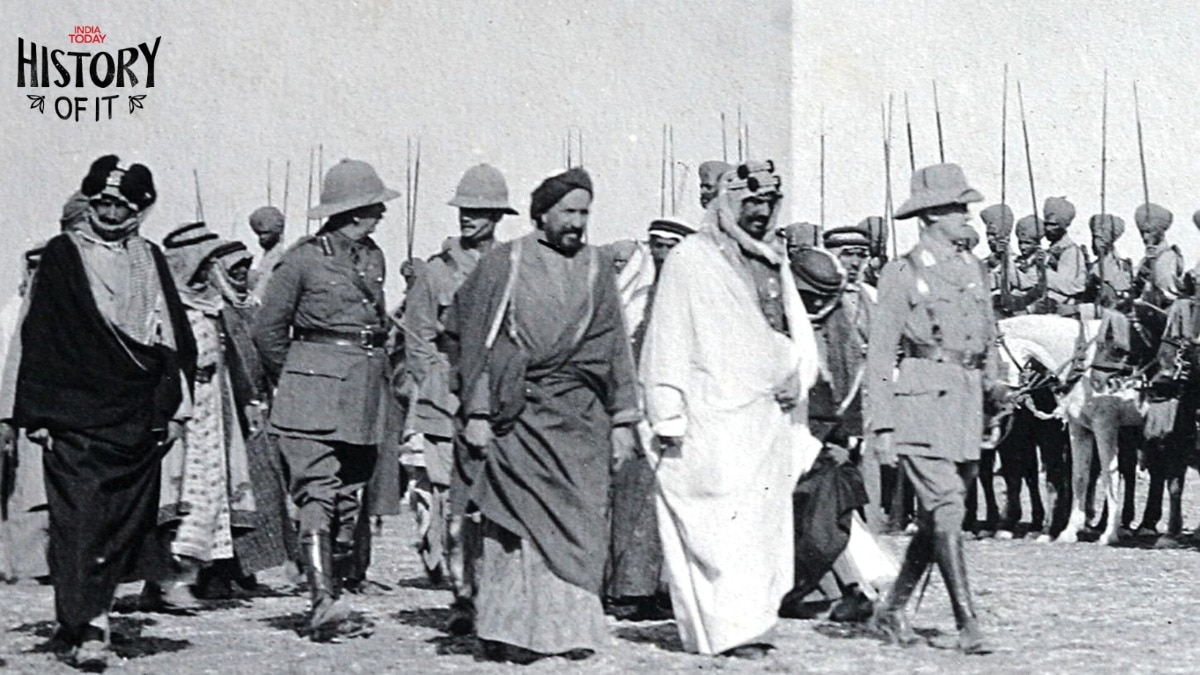
It was September 1924, six years after the Allied powers had defeated Ottoman Turkey. The victorious side was now reshaping the Arab lands the Turks had once ruled. Sharif of Mecca and King of Hejaz, Hussein bin Ali, a Hashemite descendant of Prophet Muhammad, was now facing a threat closer to home. The neighbouring Najd region's ruler, Abdulaziz Ibn Saud's Ikhwan forces, a religious-military militia, had stormed into Hejaz, captured Taif city. They were closing in on Mecca, threatening Hussein's rule over Islam's holiest cities — Mecca and Medina.
With his position crumbling, Hussein turned to its ally that had armed and financed his Arab Revolt against the Ottomans just eight years ago. It was Great Britain. He asked Britain for help against an advancing Ibn Saud. But London refused.
It was a bitter irony. Britain had cultivated both Arabian rivals, signing a treaty with Najdi ruler Ibn Saud in 1915, paying him 20,000 pounds, supplying 1,000 rifles, and subsequently providing a 5,000-pound monthly subsidy, wrote American author-journalist James Wynbrandt in his book, A Brief History of Saudi Arabia. Similarly, Hashemite king Sharif Hussein had also received 125,000 pounds a month in British gold, along with weapons and military advisers.
By the end of 1925, Mecca, Medina and Jeddah came under Ibn Saud's control. It was Ibn Saud who conquered the region to establish what is now Saudi Arabia, and founded the House of Sauds, which rules the oil-rich kingdom.
Hussein's Hashemite dynasty, however, did not disappear. His sons were fitted into Britain's post-Ottoman order farther north, with Hashemite Prince Faisal bin Hussein taking Iraq, and Hashemite Prince Abdullah bin Hussein emerging as ruler of Transjordan — the territory across the Jordan River that is now Jordan.
The century-old story needs to be recalled and retold because of the conflict in the Middle East. On September 15, the Kingdom of Saudi Arabia, founded by Ibn Saud and ruled by his descendants, said its air defences intercepted a Houthi drone south of Mecca before it could enter the holy city's restricted airspace, an allegation Iranian proxy Houthis have denied.
The Saudi-led Coalition to Restore Legitimacy in Yemen's spokesperson, Major General Turki al-Malki, called the security of the two holy Mosques and pilgrims a "red line". The Saudi-dominated Organisation of Islamic Cooperation (OIC) condemned what it described as an attack violating the sanctity of holy sites. Pakistan, which has signed the Mecca Defence Agreement with Saudi Arabia, also invoked the kingdom's custodianship of Islam's holiest sites.
Mecca houses the Grand Mosque and Kaaba, while Medina, to where Prophet Muhammad migrated, is home to the Prophet's Mosque, making the two Islam's holiest cities. Saudi Arabia's king today holds the title of the "Custodian of the Two Holy Mosques", or the "Khadim al-Haramayn al-Sharifayn". King Fahd bin Abdulaziz officially adopted the title in 1986, decades after his father Ibn Saud had conquered Hejaz.
Saudi's role of the Custodian of the Two Holy Mosques was invoked in an attempt to rally support around the sanctity and protection of Islam's holiest sites. But how did a dynasty based in Riyadh come to control Mecca and Medina, which were in Hejaz? How did the Hashemites, Prophet Muhammad's descendants and the former rulers of Mecca, end up in Jordan?
The answer is in war and conquest, and also in British money, treaties, broken wartime expectations, and London's attempt to construct a new Middle Eastern order from the ashes of the Ottoman Empire that it dismantled at the end of World War I.BEFORE THE SAUDS, PROPHET MUHAMMAD'S DESCENDENTS, THE HASHEMITES, RULED MECCA
Long before Saudi Arabia's founder Abdulaziz Ibn Saud controlled Mecca, the holy city had its own Sharif. American Middle East historian Mary C Wilson wrote in her book, King Abdullah, Britain and the Making of Jordan, that the office of Sharif of Mecca "predated the Ottoman conquest of the Hejaz in the 16th century".
Under Ottoman rule, the Sharif retained considerable local authority, while the Ottoman sultan claimed the status of Khadim al-Haramayn, meaning servant or custodian of the two holy mosques.
The Hashemites' connection to Mecca was deeper than holding its highest political office. Sharif Hussein bin Ali, who was the King of Hejaz, belonged to the Hashemite family that traced its descent from Prophet Muhammad. Sharif Hussein bin Ali's son, the future Jordanian ruler, Abdullah bin Hussein, was born in Mecca in 1882 into this Sharifian lineage. Historian Mary C Wilson noted that both Abdullah's parents bore the title Sharif, which denoted descent from the Prophet. The family that would eventually rule Jordan was, therefore, still deeply rooted in Mecca at the time.
The House of Saud, meanwhile, was centred in Najd in central Arabia. The two houses would become rivals for power in the peninsula.
In central Arabia, Najdi ruler Abdulaziz Ibn Saud was steadily expanding and consolidating his power, while Sharif Hussein bin Ali controlled the Hejaz and its holy cities, Mecca and Medina. Their competing ambitions had already erupted into open conflict by 1918-19, when Ibn Saud's forces defeated a Hashemite army led by Hussein's son Prince Abdullah at Turabah.
The defeat weakened the Hashemites and strengthened Ibn Saud. However, British intervention at the time stopped Ibn Saud's forces from pushing deeper into the Hejaz towards Mecca.BRITAIN COURTED BOTH ARABIAN RIVALS
World War I transformed this Arabian power struggle by drawing both rival houses into Britain's wartime strategy against the Ottoman Empire, though in different roles and through separate deals.
When the Ottoman Empire joined Germany's side, British War Secretary Lord Kitchener approached Sharif Hussein about supporting Britain. According to Wynbrandt's book, A Brief History of Saudi Arabia, Britain offered to recognise Hussein as Sharif and support an independent Arab kingdom if he sided with London.
In June 1916, Sharif Hussein launched the Arab Revolt against Ottoman rule. His sons, Prince Abdullah and Prince Faisal, commanded Arab forces, while British naval power, weapons, money and advisers supported the rebellion.
But Britain was simultaneously cultivating Najdi ruler Ibn Saud (Sharif Hussein's rival) in the Central Arabian Peninsula.
Wynbrandt wrote that the December 1915 Treaty of Darin "recognised Najd and the eastern provinces of Qatif and Jubail as Ibn Saud's territory", while restricting Najdi ruler Abdulaziz Ibn Saud from making agreements with other powers without British advice or attacking coastal emirates (the sheikhdoms that later formed the UAE) under British protection. In return, Wynbrandt wrote, "He received £20,000 and 1,000 rifles from the British," while London agreed to provide Najd another 5,000 pounds every month, beginning in 1916.
This was pre-World War I, and Britain then, wasn't paying the two Arabian rulers to fight each other. The funding for Sharif Hussein was primarily meant to sustain the revolt against the Ottomans. But London had established consequential relationships with both houses that would compete for Arabia after Ottoman power collapsed and disappeared.HOW BRITAIN SENT PROPHET'S DESCENDENTS TO IRAQ, JORDAN
The Ottoman defeat in World War I did not deliver the vast independent Arab kingdom that Hejaz King Hussein bin Ali had hoped would emerge from the former Ottoman lands in the peninsula.
Instead, Britain and France established mandates and spheres of control across much of the region. Meanwhile, London turned to what historian Timothy J Paris called the "Sherifian Solution" of backing Hussein in Hejaz, his son Prince Faisal bin Hussein as ruler of British-mandated Iraq, and another son, Prince Abdullah bin Hussein, as ruler of Transjordan. Paris wrote that the arrangement was intended to "reconcile the demands of Arab nationalists with Britain's strategic and economic interests in the region".
British officials were quite open about what they wanted. Wilson recorded that while British officials earlier considered Prince Abdullah for Iraq, British Secretary of State for India Edwin Montagu said that if the unflattering assessments of Abdullah were correct, he would be an "ideal man" because he would leave the British administrator to govern. Another British discussion sought a ruler for an Arab state "whose prince would not govern".
Ultimately, Hashemite princes Faisal and Abdullah got Iraq and Transjordan, respectively.HOW PROPHET'S DESCENDENT MADE HIS JOURNEY TO JORDAN
The story of how Mecca's Hashemites came to rule Jordan began with Abdullah leaving the holy city.
On September 27, 1920, Hashemite Prince Abdullah bin Hussein left Mecca by camel caravan with between 500 and 1,000 tribesmen, according to Wilson. Travelling through Medina, he reached Ma'an city, from where he hoped to challenge French control of Syria and restore Hashemite fortunes.
Britain had other concerns. It did not want French control extending south towards Palestine and the approaches to the Suez Canal. The political accommodation that followed eventually made the Mecca-born Hashemite prince ruler of Transjordan under British auspices.
Wilson captured the transition as sharply as he could. Abdullah, born in Mecca into its Sharifian elite, became a "British protege" after accepting leadership of Transjordan under the British mandate, he noted in his book. The ancestor of Jordan's present Hashemite monarchy had moved from the holy city in present-day Saudi Arabia to a newly-made state.BRITAIN STOOD ASIDE AS IBN SAUD ADVANCED TOWARDS MECCA, MEDINA
Back in Arabia, King Hussein's position was deteriorating. His relationship with Britain frayed and Najdi ruler Abdulaziz Ibn Saud grew militarily stronger.
American author-journalist James Wynbrandt wrote that "relations between Sharif Hussein and the British deteriorated between 1922 and 1925", citing Hussein's "military weakness", "repeated demands for assistance in his battles with the Saud's forces" and his reluctance to sign a post-war treaty acknowledging "British hegemony in Palestine and Iraq". Together, he writes, these factors "led to a loss of British support" for the ruler Britain had backed during the Arab Revolt.
Now back to where we started the story in 1924. Najdi ruler Abdulaziz Ibn Saud launched his campaign westwards from central Arabia into the Hejaz, sending his forces towards Taif city and then Mecca.
After Ibn Saud's Ikhwan fighters and followers of the strict Wahhabi religious movement seized Taif, reports of killings sent fear through Mecca. Wynbrandt wrote that the fighters went on a "rampage, looting and killing hundreds of inhabitants", while word of the killings "caused many Meccans to flee and paralysed the city's administration".
Hussein appealed to Britain. It refused assistance. A British government archive catalogued as dealing with the 1924 invasion described London's position as one of "complete neutrality regarding the future of the Holy Cities" as Wahhabi forces under Ibn Saud invaded the Hejaz kingdom.
Britain did not hand Mecca and Medina to Ibn Saud, nor did British troops conquer them for him. Saud's forces conquered Hejaz. But Britain, after years of aiding its Hashemite ally, chose not to support it when the decisive confrontation came.
Middle Eastern historian Joshua Teitelbaum, in his paper, The Rise and Fall of the Hashemite Kingdom of Arabia, noted the British abandonment of its former wartime ally, saying, "They abandoned him when Ibn Saud invaded."SAUDIS GOT MECCA, HASHEMITES GOT JORDAN
King Hussein abdicated on October 6, 1924. Mecca surrendered later that month, and Ibn Saud entered the city in December. By the end of 1925, Medina and Jeddah had also fallen, leaving Ibn Saud, in Wynbrandt's words, the "protector of the holy cities of Mecca and Medina".
In January 1926, Meccan notables pledged allegiance to Sultan of Najd, Abdulaziz Ibn Saud, who became King of Hejaz (which housed Mecca, Medina, Jeddah and the western Red Sea region). Six years later, his territories were unified as the Kingdom of Saudi Arabia.
The religious title, which was made familiar now amid the alleged Houthi attack on Mecca, came later. Saudi King Fahd formally replaced "His Majesty" with "Custodian of the Two Holy Mosques" in 1986, and King Salman bin Abdulaziz, the current Saudi monarch, continues to bear it.
The monarchy of Hashemites, Prophet Muhammad's descendants, in Iraq was overthrown in 1958, but King Abdullah's family continues to rule Jordan to this day.
Today's Jordanian King Abdullah II is the great-grandson of Prince Abdullah bin Hussein, who left Mecca for Transjordan in 1920 and went on to establish the Hashemite monarchy that his family still rules today.
So, the story began with two rival families in the Arabian Peninsula, and ended with both surviving, but in different parts of the world. The Sauds took Mecca and Medina and built Saudi Arabia around their Arabian conquests. The Hashemites, the descendants of Prophet Muhammad, lost the holy cities. But Prince Abdullah's journey north planted a dynasty in Jordan that his great-grandson leads today.- EndsPublished By: Sushim MukulPublished On: Sep 18, 2026 12:28 IST

