How Marcelo del Pilar’s descendant sees the man behind the hero - Rappler
Already have Rappler+? Sign in to listen to groundbreaking journalism.
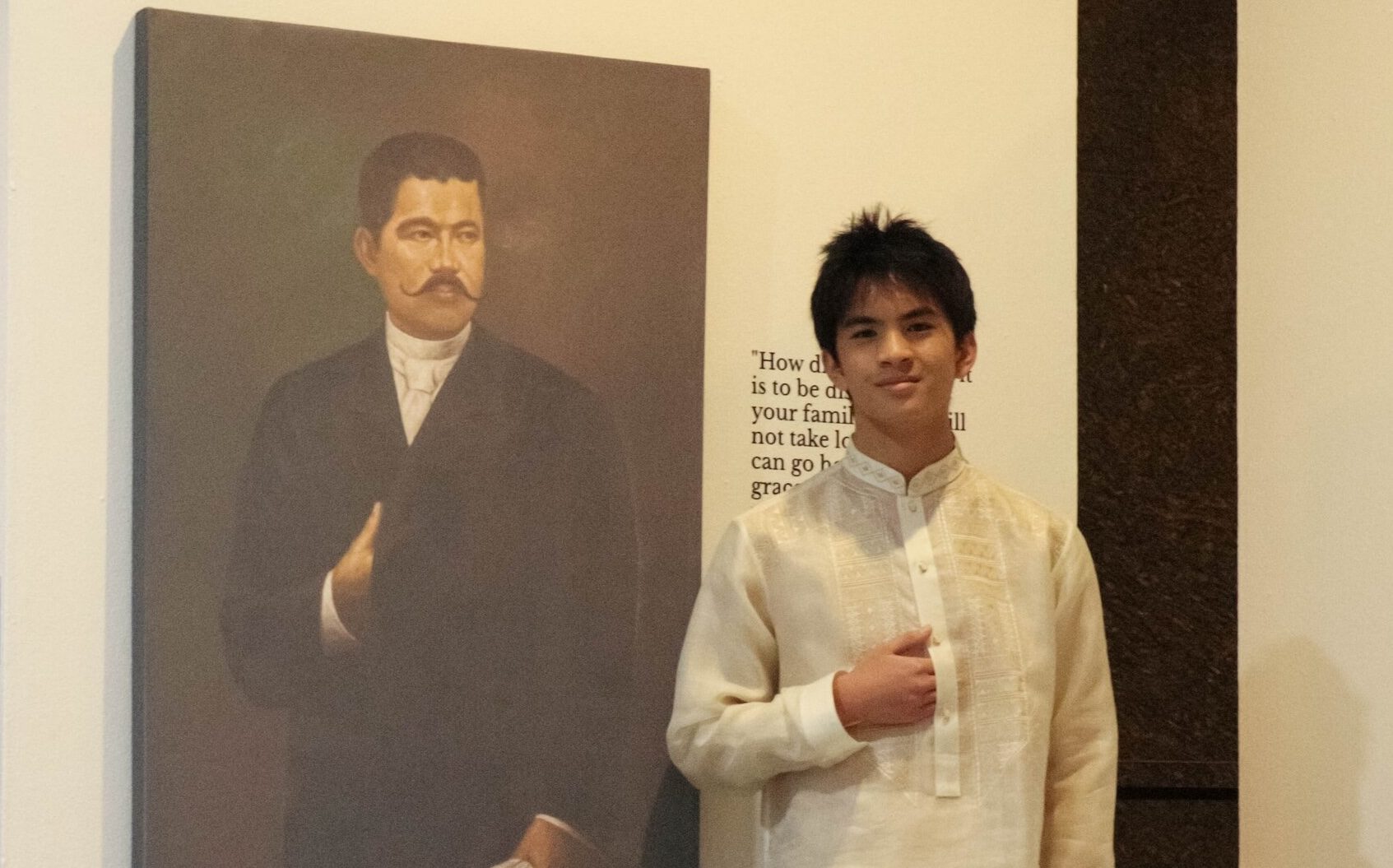
LOLO MARCELO. Pax Pineda poses beside a portrait of his great-great-great grandfather, Marcelo H. del Pilar, at the exhibit 'Lolo Marcelo: The Man Behind the Hero.'
This is AI-generated. Read the article for full context. Report any errors.
Marcelo H. del Pilar may be remembered by some Filipinos as a journalist, lawyer, reformist, and propagandist who died in exile in Spain. But for his great-great-great-grandson Pax Pineda, the national hero with the pen name “Plaridel” has always just been “Lolo Marcelo.”
Pax, a 17-year-old senior high school student studying in Hong Kong where he also grew up, learned about the life and times of Plaridel from his family over the years.
At a young age, Pax made it a personal habit to study and tell his friends about his Lolo Marcelo’s story.
“My friends in Hong Kong and all my classmates in Hong Kong are very, very interested in who Lolo Marcelo was and they think it’s a really cool story. So I’m very pleased to have shared that legacy and that story with them,” he said.
Pax knows that many Filipinos encounter well-known figures like Del Pilar through history lessons in school, where they learn about their contributions to the Philippines. But rarely do students see them beyond their heroism.
For the young teen, history should be more than names and dates.
“I think the perceived disinterest among the youth regarding Marcelo and other historical figures is based off what they learn in the textbooks,” said Pax.
“It just doesn’t really capture the person these people were. It just turns them into a distant figure that lacks human qualities.”
Pax shared how Del Pilar’s preserved letters, written when he was in Spain, were documentations of how he expressed love for his family.
“I think even though he did have to leave his family in order to pursue his goals for Philippine independence and pursue trying to fulfill a better country…he still loves his two daughters [Sofia and Anita] and [his wife] Chanay very, very much,” Pax said.
“These artifacts [also show] the man as how he was, not in the exact things he did, but in how he felt, his feelings towards his family, his feelings towards the people of the Philippines.”
This inspired Pax to curate an exhibit for his Lolo Marcelo.
“This exhibition is not about a distant monument, it’s about a human character,” Pax said of his debut exhibit, Lolo Marcelo: The Man Behind the Hero, running until October 18 at the Ayala Museum in Makati City.
“His story has always told us to love our nation no matter what and to love our families no matter what.”
Ericsson Dublas, curator of the Museo ni Marcelo H. Del Pilar in Bulacan — the national hero’s home province — also noted how Plaridel wrote about missing his children, often asking them how they were in Epistolario 1 and 2, the two volumes of the hero’s compiled correspondence.
“He mentioned nag-fade na daw ‘yung larawan ng kaniyang mag-iina na palagi niyang hinihimas dahil sa sobrang pagkamiss,” Dublas shared.
(He mentioned that the photo of his family had faded because he constantly caresses it because he misses them so much).
On December 15, 1889, Del Pilar became the editor of the La Solidaridad newspaper, which was deemed the principal organ of the Filipino Propaganda Movement.
Unlike his nephew, Gregorio del Pilar, who was known as a general and died in battle, Plaridel used pen and paper as a weapon to fight against injustice amid the Spanish colonization.
“The way he wrote in La Solidaridad was very different,” said Patricio “Blums” Pineda III, Pax’s father. “It was more intellectual, much more about the position because he’s writing for a Spanish audience.”
Del Pilar turned La Solidaridad into the voice of the public, the voice of the Filipino Propaganda Movement in Spain.
At the time, though, it was difficult to sustain the operations of La Solidaridad. But Plaridel used money out of his own pocket.
“That sheer drive he had to get his message out there is an inspiring tale for all journalists everywhere to not let organizations pressure them,” said Pax. “And also just do what you do, always tell the truth, get the truth out there, no matter what, with integrity.”
In 1888, Spanish Augustinian priest published a pamphlet, Caiñgat Cayo! (Beware), which warned Catholics against reading Rizal’s Noli Me Tangere. In response, Del Pilar wrote a satirical essay titled “Kaiingat Kayo,” which criticized the teachings of the Spanish friars. This was only one of Plaridel’s ways to counter censorship.
Pax shared that many also didn’t know that his Lolo Marcelo was a feminist.
“He wrote constantly about how women should be educated, how women should be almost equal to men,” he said.
Pax and his family feel grateful to all those helping keep his Lolo Marcelo’s story alive.
Aside from his own exhibit, the Museo ni Marcelo H. Del Pilar in Bulakan, Bulacan highlights Plaridel’s heroic deeds and contributions to Philippine history.
“In Bulacan, they conducted various projects to evolve this kind of historical knowledge about Del Pilar,” Dublas shared.
“For example, their tourism office, they created or they drafted modules intended for grade schools, specifically learning the Bulacan heroes, specifically headed by Marcelo H. Del Pilar.”
Last July, Del Pilar and other historical figures were also featured in HistoEx 2026 at the SM Mall of Asia.
“Some other collections were digitized from the provincial government of Bulacan, which is already part of the National Memory Project,” Dublas said.
“We have to innovate our ways in order to pass knowledge of our past heritage, including the legacy and works of our heroes, such as the great Marcelo H. Del Pilar.”
Personally, Pax plans to major in history at the University of California after he graduates senior high school.
Del Pilar’s story continues to fascinate Pax, and if only he could talk to his great-great-great-grandfather, he would like to tell his Lolo Marcelo that he’s “not alone.”
After fleeing to Spain in 1888 to avoid persecution by the Spanish authorities, Del Pilar died in 1896 due to tuberculosis without having the chance to see his family again.
“I know that it must seem difficult and you might feel alone, but you’re not alone,” Pax said, musing what he would have told his lolo.
“We all love you. We all feel for you and we all believe in what you are, and who you are, and what you’re doing. And you will be a massive part in creating something so great for the country of the Philippines.” – Rappler.com
Angel Camille Dio is a Rappler intern studying BA Journalism at Polytechnic University of the Philippines.