I visited Kalamazoo to find out why people in Michigan wanted to celebrate Canada. - Toronto Star
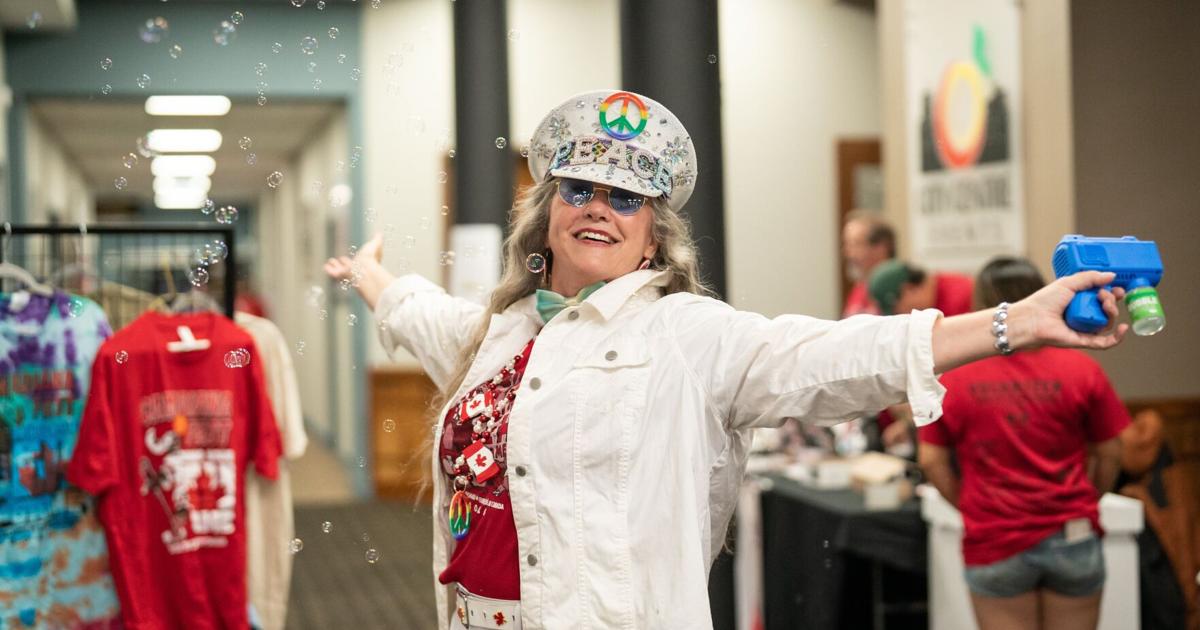
In Kalamazoo, Mich., locals are countering Donald Trump's insulting rhetoric with a festival celebrating Canada.
Channon Russette-Mondoux, organizer of the fourth annual Can-Am Peace Jam in Kalamazoo, Mich., this weekend, calls herself a “peace officer.” “Many Americans are heartbroken at what’s happening right now,” says Russette-Mondoux.
KALAMAZOO, MICH. — While U.S. President Donald Trump was insulting Canadians, a Kalamazoo woman in white work boots with red maple leaves on the toes was feverishly plotting to celebrate them, which is why, on one of the last nights of summer, Rush lyrics could be heard slipping down the stairs of a live music venue onto the treed pedestrian mall of this Midwestern city.
Upstairs, locals were rocking out to a local band, Rock RX, along with organizers of the fourth annual Can-Am Peace Jam, a celebration of Canadian culture meant to repair the fraying bonds of friendship between two countries that have been kindred neighbours for more than 150 years, north and south of a border that used to feel nominal.
Many of the people in this town of roughly 73,000, like Channon Russette-Mondoux, the woman in the maple leaf work boots, have strong connections to Canada, often through marriage. Russette-Mondoux was born in Windsor, where she met her husband, an American, and followed him to Kalamazoo for work when their children were young.
She became an American citizen in 2015 in order to exercise her right to vote, and still has family in Canada. Her three adult children have made lives for themselves in the U.S.
Lorraine Hirt of Grand Rapids and Ed Soba of Kalamazoo dance at the peace jam. “We‘re all on team Canada,” says Soba.
“Many Americans are heartbroken at what’s happening right now. They apologize to me all the time,” says Russette-Mondoux, who teaches culinary arts at Western Michigan University. “I mean, there’s still people, don’t get me wrong, that are hateful, and they drink everything that is said by the current administration, but the vast majority of people are just mortified at what’s going on right now.”
Russette-Mondoux began throwing Canadiana Fest in Kalamazoo in 2023 as a way of sharing her culture with her adopted home. Attendance grew each year, hitting a high of 2,500 in 2025.
This year, amid the combative rhetoric about Canada pouring from the White House, including the renaming of Lake Ontario to “Lake America,” Russette-Mondoux felt the need to tweak the name of the festival to reflect the bonds that the two countries share, especially in this place, home to First Nations; a waterway for French coureurs de bois of the 17th century, and the adopted home for French-speaking Acadians expelled from what is now Nova Scotia, in the 18th century.
A visitor shows some Canadian spirit at the peace jam.
The event featured Canadian bands and local bands playing Canadian hits, from Rush to Bryan Adams, Alanis Morissette, the Barenaked Ladies, Avril Lavigne, Tom Cochrane and Nickelback.
It also featured a curling demonstration, arts and crafts by local vendors, Canadiana merchandise — and a genealogist to help festival goers trace their Canadian heritage.
Food trucks, which were going to participate in a poutine cook-off, had to cancel, after the event was moved indoors due to weather.
Besides being a punchline for a joke about the middle of nowhere, Kalamazoo is a university town, a blue dot in a sea of red, where proud Democrats feel woefully embarrassed by Trump and his statements about Canadians being clowns, spoiled and difficult.
When asked about Trump and Canada, answers here are often preceded by a pause and a sorrowful shake of the head.
“Relations with other countries will outlast Donald Trump,” says Drew Duncan, the vice-mayor of Kalamazoo, pressed into service as a judge for the best butter-tart contest at the festival.
“And while he is our president and many of us are embarrassed by how he’s conducted himself in office, our relationship with Canada, particularly Canada and Kalamazoo, continues to be strong, and we want to continue to grow that relationship and nurture that relationship regardless of who is in the White House or in office.”
Down the hall, Gloria Baldwin-Wilson, general co-ordinator for Indivisible Greater Kalamazoo, has a message for Canadians.
“We’re sorry. Have patience. We’re trying to get rid of this administration,” says Baldwin-Wilson, whose organization focuses on civic engagement and resisting authoritarianism. The group is working to get people to vote early in the upcoming midterm elections, which could determine how effectively Trump can continue to govern.
Gloria Baldwin-Wilson with Indivisible Greater Kalamazoo, a grassroots progressive advocacy organization affiliated with the national Indivisible movement. “Michigan and Canada are good neighbours and trading partners,” says Baldwin-Wilson.
In November, voters will decide on all 435 seats in the U.S. House of Representatives and about one-third of the U.S. Senate. A shift to a Democratic majority could result in blocked legislative agendas for Trump, stalled judicial appointments and intense congressional oversight.
“We’re a democracy, and we’re fighting for democracy. The vote is bedrock to that,” says Baldwin-Wilson.
Immigration lawyer Emilia Coto, who staffed a booth at the festival, says applications for Canadian citizenship are up, in the wake of recent changes that make it easier for older residents and for claimants based on ancestry to move to Canada.
“People say: ‘I don’t feel that my values are being represented by the current government, and I want to be in a place that reflects that,” says Coto.
Janine Guimont Cotugno, originally from Canada, displays her family genealogy chart. Cotugno has recorded 2,000 Canadian ancestors over nine generations, going back to the late 1600s.
“I’ve also had people that are worried about their children being drafted into potential wars.”
Kalamazoo is also an industrial Midwestern hub, proud headquarters to S&P heavyweights like Stryker, a titan in the health-care sector, with a market capitalization of $105 billion, and Pfizer’s massive global supply manufacturing facility, which both operate out of nearby Portage, a contiguous suburb.
The local economy is packed with hidden factories that build parts for the transnational auto industry and the office furniture industry, which rely on tightly integrated supply chains that frequently cross borders. Tariffs on steel, aluminum and advanced components hit West Michigan uniquely hard.
Studies have pegged the cost of those tariffs at about $3,200 a year to the average Michigan household in higher prices and business expenses.
The tariffs have created a climate of instability for businesses, says Duncan, speaking generally, and not about a specific business.
“If I went from having something that I could get at a fixed cost one month, and then the next week and the next week and the next week, it’s a different cost, it’s really hard to stabilize my finances as a business,” says Duncan.
Russette-Mondoux is so committed to the festival that she kept it moving despite three location changes this year — the last one driven by weather — pouring rain and threats of thunderstorms. She managed the last venue change in four days, persuading a local businessman, Harvin Sandhu Singh, to loan them his events centre, and persuading as many participants as possible to show up.
Tristan Bentz, left, and Aidan Dutcher of Detroit curling at the Kalamazoo festival. Bentz said that they go to Canada all the time for sporting events. “I wish the situation wasn’t so dramatic,” says Dutcher.
The event started at 1 p.m. and at 10 p.m., Mélisande, a Quebec-based group that blends traditional Québecois and Acadian folk music with modern electronic beats and synthesizers, had everyone on their feet — even bone-tired organizers — as the festival drew to a close at 11 p.m.
Music stopped pouring down the stairs to the street.
The lyrics for Rush’s anthem to independent thought, “Tom Sawyer,” faded out too.
Francine Kopun is a Toronto Star journalist and senior writer, based in Toronto. Follow her on Twitter: @KopunF