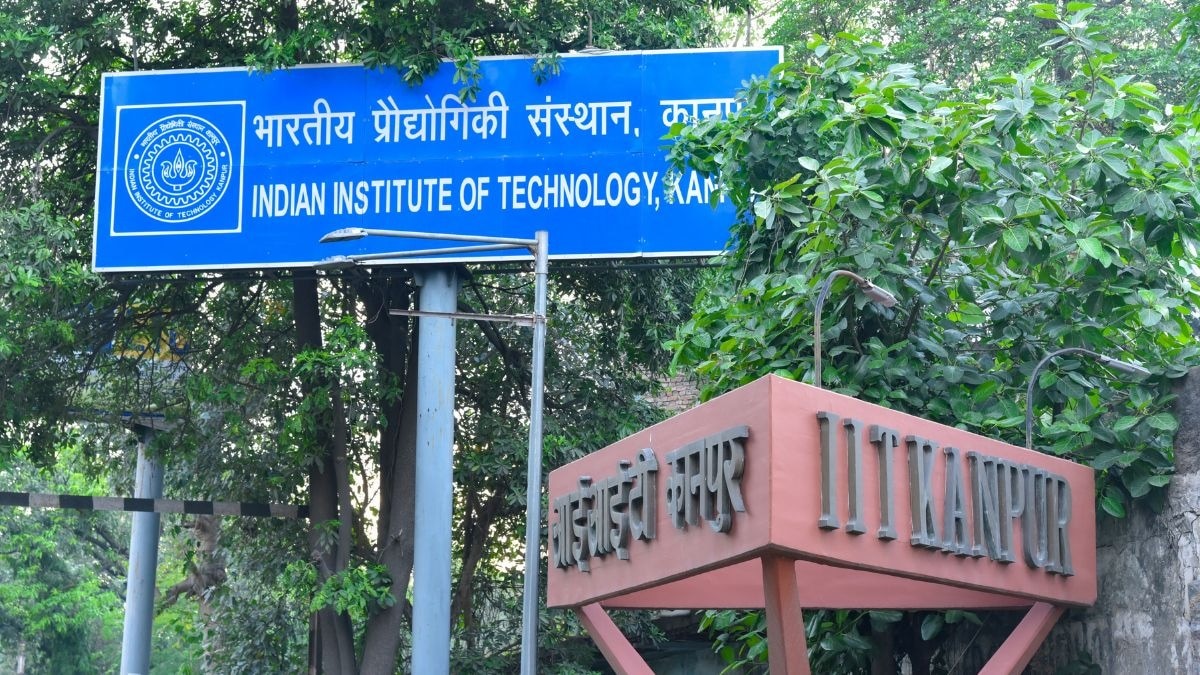
IIT Kanpur will soon offer super-speciality medical degrees. MBBS will have to wait
Autumn arrives at any IIT mostly in the footsteps of engineering students, in the sound of hostel gates swinging open before eight, of cycles rattling over speed breakers, of new intakes finding their way to labs they will spend the next four years inside. It is not, on the face of it, a season built for the sound of a stethoscope, or the particular hush of a hospital corridor.
And yet at IIT Kanpur this year, on a stretch of land running down towards the Ganga, a hospital is rising in stages, cranes standing against a sky just beginning to clear after the monsoon, workers laying brick for wards that do not yet have a single patient inside them. Those wards will one day belong to doctors trained the way no doctors in India currently are, and the institute has just confirmed, for the first time on record, exactly which degrees will fill them first.
Not the MBBS (Bachelor of Medicine, Bachelor of Surgery) most Indians grow up associating with becoming a doctor, but higher medical degrees, the kind pursued after basic medical training to become a specialist, alongside the super-speciality degrees known as DM (Doctorate of Medicine) and MCh (Master of Chirurgiae, or Master of Surgery).
The MBBS itself, IIT Kanpur has told India Today Digital, is still three to four years away.
The man responsible for that plan, and for filling the campus around those wards with an entirely new kind of doctor, spoke to India Today Digital about exactly how he intends to do it.
Professor Anil K. Lalwani does not sound like a man about to upend Indian medical education. He has the unhurried manner of a physician who has sat beside thousands of patients waiting for news, and the precise, economical hands of a surgeon who has spent a career working inside spaces smaller than a grain of rice, the delicate architecture of the human inner ear. Dean Anil Lalwani, who spoke to India Today Digital about IIT Kanpur's plans for the Gangwal School of Medical Sciences and Technology, where India's newest medical degree programme is quietly taking shape. (Photo: IIT Kanpur)
For nearly three decades at Columbia University, he held two titles at once, professor of otolaryngology and professor of mechanical engineering, an unlikely marriage that most institutions would never have permitted under one roof. Otolaryngology is a medical and surgical specialty that focuses on the diagnosis and treatment of conditions affecting the ear, nose, throat, and related areas of the head and neck.
Professor Lalwani is, in other words, the rare kind of person who has already lived the answer to the question India is now asking him to solve at scale. Can a doctor and an engineer be trained to think inside the same skull?
He has just been named dean of the Gangwal School of Medical Sciences and Technology at IIT Kanpur, and somewhere inside that title sits a story that will matter far longer than any single headline about him.THE DEGREES EVERYONE IS WAITING FOR, AND THE ONE THAT WILL COME FIRST
IIT Kanpur intends to grant medical degrees. Dean Lalwani laid out a concrete timeline for us.
What will not come first is the MBBS degree.
Before a single undergraduate is ever handed a white coat, he said, the school intends to build upward rather than outward, launching higher medical degrees and the super-speciality degrees, the years of training that turn a general physician into a cardiologist or a neurosurgeon, alongside transdisciplinary research programmes sitting at the exact seam where medicine meets engineering.
The MBBS, he said, sits three to four years further down that road, waiting patiently for the hospital beds, the faculty and the clinical depth it will need beneath it before it can stand at all.
IIT Kanpur wants the specialists before the beginners. The roof built downward instead of the ground floor rushed upward, as though the safest way to teach a country’s next physicians to build things is to first make certain there is something solid enough to stand on.A HOSPITAL THAT IS ALREADY COUNTING DOWN
The Yadupati Singhania Super-speciality Hospital, a 500-bed structure rising beside the Gangwal School, will be inaugurated by the end of this year and will receive its first patient by March 2027, Dean Lalwani told India Today Digital.
Beside it, a 50-bed Cancer Care and Research Centre is taking shape, the two buildings positioned close enough to the laboratories that a problem observed at a bedside could, in theory, walk down the corridor and land on an engineer’s desk that same afternoon.
To carry this into being, IIT Kanpur has secured initial approval to bring on 60 new faculty members, spanning clinical medicine and research, the largest expansion of its kind the institute has ever attempted.advertisementWHY THIS DEAN KEPT HIS OWN SPECIALITY OUT OF THE SPOTLIGHTThere is a detail here I found unexpectedly moving, and I want to give it room to breathe, because it says more about how this school intends to run than any organisational chart ever could.
Hearing loss is Dean Lalwani’s own life’s work, the field in which he has spent his career, restoring, through gene therapy and through the cochlear implant, the sense most bound up with human connection and with language itself. IIT Kanpur Professor Lalwani has told India Today Digital the institute's actual medical degree roadmap, higher medical degrees first, MBBS three to four years away, alongside a hospital opening its doors by March 2027.
Colleagues, he told India Today Digital, urged him to make it the school’s flagship area, the natural showcase for a new dean’s own expertise. He said no, and the reason has stayed with me since. He did not want Gangwal School's very first chapter to read as one man's pet project.
It is a small refusal, but a telling one, from someone who has spent a career at the edge of something quietly extraordinary: the exact moment a cochlear implant is switched on and a patient, sometimes for the very first time, hears a human voice.
I have not forgotten how he described that moment to India Today Digital, the way an entire room can seem to hold its breath around a single sound. It is that instinct, to build for the patient rather than for the credit, that he now hopes to hand down to engineers who may spend their whole careers never once sitting in a clinic.THE QUIET RACE NO ONE IS CALLING A RACE
IIT Kanpur is not building this model in isolation, and it would be dishonest to pretend otherwise. IIT Madras Director Professor V Kamakoti has confirmed, to India Today Digital, the institute's own path toward offering medical degrees.
IIT Kharagpur moved earlier still. Dean Lalwani offered a prediction that every IIT will, in time, arrive at its own version of a medical school, an entirely new institutional category, reshaping Indian higher education the way the IITs once reshaped engineering itself.
Whether that counts as coordination or coincidence hardly matters. What matters is the shape of the bet each institution is placing, and Kanpur's bet, patient, sequenced, specialists before beginners, hospital before headline, is a wager that the country does not need another medical college so much as it needs a different kind of physician altogether, one who has spent as much time beside an engineer's workbench as beside a patient's bed.THE HOSPITAL THAT WILL OUTLAST THE HEADLINE
The timeline itself, March 2027, is a date that will arrive whether or not anyone remembers this article, whether or not the MBBS follows on schedule.
A university, unlike a headline, does not get to announce itself into existence. It has to be poured, brick by brick and bed by bed, by people patient enough to build the roof before the applause arrives.
What emerges from these conversations is a man who has spent a career listening for the smallest, most fragile signals the human body can produce, now asking his own new institution to do something remarkably similar, to build quietly, to specialise before it generalises, and to let the sound of what it has actually made, eventually, speak for itself.- EndsPublished By: Radifah KabirPublished On: Sep 17, 2026 11:33 IST