In conversation with Gulzar: The home Partition took, the city that gave him another - The Indian Express
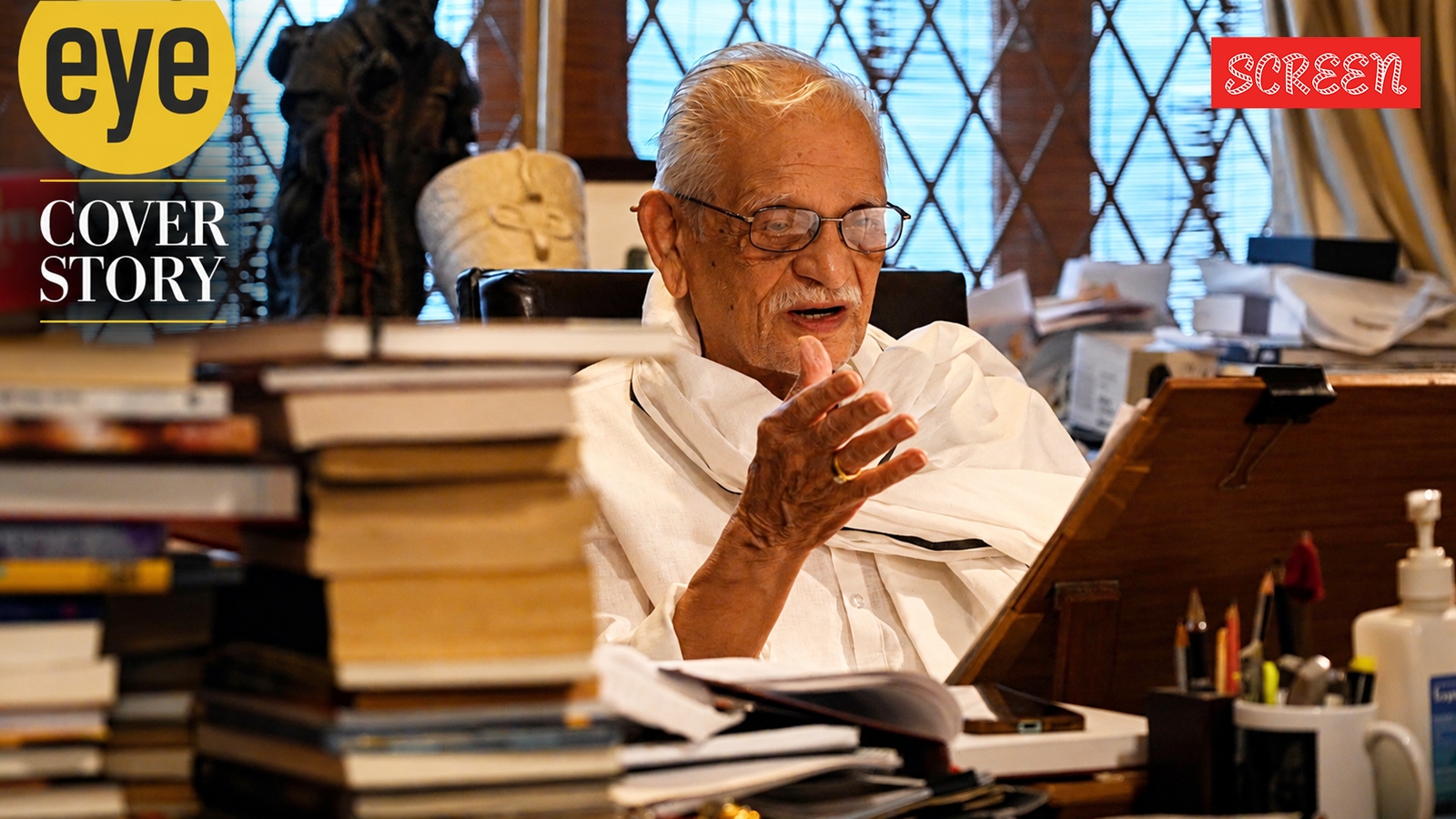
On a day of pelting rain in Mumbai, when the highrises fade into grey silhouettes, a small slope on Nargis Dutt Road in the ritzy Pali Hill leads us to the storied home of one of India’s most definitive modern poets.
Boskyana, 92-year-old poet and filmmaker Gulzar’s home, sits as a quiet haven amid glass and concrete reaching the sky. The raised road, reminder of a city that has been built several times over, has led the quaint white bungalow to live in a somewhat sunken space, somewhat tucked in the past and uninterested in the vertical growth of the frantic world above.
As is well known, Boskyana is named after the poet’s daughter, Bosky (filmmaker Meghna Gulzar). What is little known is that she is named after boski, a prized Chinese silk variety known for being soft and delicate. The idea, however, is from another time and place. Gulzar’s father was a textile trader in Pakistan’s Dina, an unassuming village located along the Grand Trunk Road in the heart of Pakistan’s Jhelum district. The poet once joked that if he’d had a son, he would have named him Lattha (crisp white budget-friendly cotton).
It is the warp and weft of this metaphorical silk that runs through Gulzar’s life, with decades spent spinning language into an artform; making the ordinary feel just as fine, weaving those pashmina-like phrases of love and loss: Geeli hansi, waqt ke paanv, khwabo ki pudiya, seeli hawa and chand ki bindi wali ratiya, which continue to linger.
A large bust of Mirza Ghalib carved in white marble stands guard at one end of the book-lined, exposed-stone wall in the poet’s living room. A screen divides the study from it. The poet’s voice drifts in from his book-drowned study — a discussion on the matter of his current iPad. He arrives on the other side in his trademark white, starched kurta pyjama, the frame frailer now, hair a shade greyer. But just as he speaks in that familiar, deep voice, the years seem to melt away. “I’ve just changed my iPad. And this old cover didn’t fit. So a new one needs to be bought,” he says, settling on an ottoman.
For a writer who has spent decades measuring the weight of ink on paper, it is striking how technology seems to fit seamlessly into this otherwise handcrafted world. Like Online, one of his newer stories, where 11-year-old Suhani is telling her grandfather, Mr Syal, to play ‘Patience’ on the iPad and not step out during COVID. There is a hint of Gulzar in it. He may be steeped in the rhythms of the past but has embraced the new phases with curiosity.
Sitting in Gulzar’s home that is about half a century old, four days before his 92nd birthday and clutching his latest book Aamchi Mumbai: My City in Stories and Poems (Harper Collins, Rs 3,999), with English translation by Rakhshanda Jalil, ‘home’ becomes an obvious subject to open with: one that is built and another that is left somewhere and preserved in memory.
Gulzar’s story also has these two homes, ones that have shaped him and his oeuvre, while getting infused into the syntax and cadence of his work. There is one that he left behind in Dina during a bloody Partition, the home that has been a constant refrain in his writing, including Raavi Paar and Footprints on Zero Line: Writings on the Partition, among others. It is also a home he didn’t revisit for a long time. He couldn’t get himself to.
His friend Paul Mahindra, who also assisted “Bimal da” (Bimal Roy), told him not to go back. “He said something which remained with me. ‘Woh badla huya hoga (It would have changed) and those images which you are retaining in your head… when you won’t find them, toh bohot taqleef hogi. So I did not go. I was about 70 when I went back for the first time,” says Gulzar, whose visit was prompted by the hospitalisation of Pakistani poet and journalist Ahmad Nadeem Qasmi. Gulzar often refers to Qasmi as his guru.
“When I went to Lahore, my friends and I drove to Jhelum… I found my gali (bylane) soon and it was the same as it was. I visited the primary school where we sat on durries and studied. And suddenly I saw a block named after me. The inscription read: ‘Sampooran Singh Kalra urf Gulzar’. It was next to another named after Fatima Jinnah. The farmland was gone but someone said of a tree – ‘Ye ped murjha gaya hai, par ye ped abhi tak aapka hai’ (the tree has wilted but it is still yours),” says Gulzar, recipient of the Jnanpith Award and Sahitya Akademi fellowship, among numerous other accolades.
After Gulzar’s family moved to Delhi and he was admitted to United Christian School, their house became almost like a refugee camp. “People would keep coming from our village. Then my father would keep searching the camps to find anyone of his own. He was affected a lot,” says the poet who was packed off on the Frontier Mail to Mumbai that would become “the longest home I know,” he writes in Aamchi Mumbai.
“What a strange city this is, and how strangely it rears those who come here. It fights and quarrels. It beats and bruises you. But it also gives you the fondness and affection of a friend…” Gulzar writes in Aamchi Mumbai, comprising his impressions about Mumbai — from its Irani hotels, monsoon rain and ocean to its footpaths and people who live on them.
When Saleem Sinai, the protagonist of Salman Rushdie’s Midnight’s Children, returns to Bombay, he says, “Yes, it was my Bombay, but also not mine”, capturing a city transformed by time. Does Gulzar, who has spent seven decades in what Rushdie calls “the most Indian of Indian cities”, feel the same from the time he alighted from the train, a frightened young boy?
He sees the change through an unlikely lens: the disappearance of Irani hotels from everyday Bombay. “Once my toothpaste got over and my elder brother said, go get it from the Irani restaurant. I told him, I need toothpaste, not a pastry. So he told me, for any general store items, go to the Irani hotel,” says Gulzar. The leitmotif reappears through his writing on Mumbai. “Irani hotel was a complete culture in itself. You could go anywhere in the city and find an Irani restaurant. The North has always had places to drink water: a pyau (water kiosk) or communal tap. In Bombay, Irani hotels put out free drinking water. Then, in chaar aana, I could have my lunch: keema pav and tea was a full meal. That is what the Iranis were doing here,” says Gulzar, who noticed how leftover food, paid for but untouched, was kept for fakirs, for the poor who would queue up at night for what was called the Irani biryani. “Bhookha koi nahi rehta tha (No one went hungry). As times changed, all of it got lost somewhere. These hotels and that culture are gone. That is what I miss,” says the poet, who adds that in this city, if one is able bodied, they will survive. “Aur kuch nahi toh smandar ke kinaare seepiyaan bun kar bhi log guzara karte rahe hain (If nothing else, people have managed to sustain themselves simply by gathering seashells along the coastline”
He recalls the time when Morarji Desai was chief minister and amid prohibition, the clandestine, underground bars emerged. “Illicit liquor was available at Pascal ka Adda and Aunty Bars, where alcohol was served with salt to be licked along,” says the poet. Characters drinking this illicit liquor often appear in his stories, including in Mez ke Upar, Mez ke Neeche. “The way people lived in jhopadpattis, it was full of life. Poverty was there but you never felt ashamed of it. There was a pride and dignity of life to it,” says Gulzar.
The conversation pauses when old friends Sukhwinder and Jyoti arrive unannounced to wish him ahead of his birthday. The room changes colour, with almost a childlike happiness that takes over Gulzar. Not all of it is to do with the bottle of scotch they’ve brought as a present. “Aye meri dhee hai, meri maangi huyi beti (she is my daughter, my asked-for daughter)” he introduces Jyoti, also his tennis partner. Giddy, with the rare chance to speak in Punjabi with everyone in the room, he introduces us. “This girl is also from Punjab… te Punjabi bol lendi hai (she can speak in Punjabi),” he tells Jyoti.
Like the shade of an old tree, Punjabi occupies a prized place in Gulzar’s literary life. It is not just his ma boli (mother tongue), but one he was encouraged to return to even as he moved through Urdu’s literary world as a young poet in the Bombay of ’50s and ’60s.
Filmmaker and writer Balraj Sahni, who had also spent time in Santiniketan, would urge him to attend the meetings of the Punjabi Sahit Sabha. “Balraj saab told me, ‘Gurudev ne kaya si mainu, madri zubaan ch likh (Gurudev had told me to write in the mother tongue),” he says.
Once in Mumbai, Gulzar lived with his elder brother before moving out and making ends meet by working in a motor garage. The two had their differences. “The best part of that motor garage job was that in the time that the paint dried, I could sit and read,” says Gulzar, who still regrets having to leave his education at Delhi’s St Stephen’s College, where he studied for a few months before joining Khalsa College in Mumbai. “But they didn’t have Urdu and I didn’t want to study Hindi,” says Gulzar, who soon moved to National College.
Gulzar ended up living in Coover Lodge in Andheri’s Chaar Bangla, where distinguished writer Krishan Chander lived in the main house. Sahir Ludhianvi rented the first floor and he rented the outhouse for Rs 18 a month. The Progressive Writers’ meetings were held on Sundays, while the Punjabi Sahit Sabha met on Saturdays. It was at these meetings that literature on social inequality, religious hypocrisy and marginalisation was discussed. “Both these associations were very well-knit. Most of the Leftists were there. Poet and lyricist Shailendra was a unionist since he worked in the Railways. As for films, they were never the aim of any of these writers,” says Gulzar, who was pushed into films by Shailendra. “He would say, achhe khaase writer ho, jaate kyun nahi (You are such a competent writer, why don’t you go?”
“All these big writers — Ali Sardar Jafri, Krishan Chander, Rajinder Singh Bedi, Sahir Ludhianvi — inki kitaabein padhi huyi hain and then seeing them in person as a young boy was huge,” says Gulzar.
Another space he frequented was the Bombay Youth Choir. This is how he met composer Salil Chowdhury, founder of the orchestra, who later collaborated with Gulzar on Hrishikesh Mukherjee’s Anand (1971), among many others. The choir was interwoven with a certain cultural awakening in post-Independence India.
In National College, his batchmate was writer Sagar Sarhadi and soon literature became a passion. “At that time, if you carried a book on the Russian Revolution, you were considered an intellectual,” he says with a chuckle. The two were surrounded by Punjabi writers like Sukhbir, “a committed communist”, Harnam Singh Naaz, among others. “This is when Sagar and I took an oath of sorts: we will not take up a job; we will only write. Aur nahi hai isme kamai toh dekhenge,” says Gulzar.
That is how the journey began. “People ask me if I was fond of writing since childhood. It’s all a myth. Life takes its own time… to adapt your talents and aptitude,” he says.
He fondly remembers his literary life in Bombay’s trams. How all of his young writer friends would settle on the upper deck of a tram and continue discussions and recitations as the city rolled past. A one-anna ticket allowed them to ride through the day, so if the discussion continued, so did the journey. “From Charni Road to Dadar, hum afsaane sunaate the (we’d narrate stories)… People turned to listen in; conductors began to recognise us, knew we would turn up on Sunday. It became so interesting. So this is the city I have spent more than 60 years in,” says Gulzar.
When American writer Howard Fast’s The Naked God came out, explaining why he had left the Communist Party, there was a commotion in our world: “Howard Fast was the only conversation then. When Faiz would write a nazm from jail, ek leher si daud jaati thi. We’d say, ‘Faiz saab is a very optimistic man, how can he write this’… everything was discussed in great detail,” he says.
Eventually Gulzar found his way into Bimal Roy’s world. His first screenwriting and lyrics credit came with Bandini (1963). He would go on to make his directorial debut with Mere Apne (1971), about the growing disillusionment among unemployed youth. Decades later, in 2026, its central theme remains relatable. The films that followed — Parichay, Aandhi, Maachis, among others — brought the same literary sensibility to stories of a changing India. As for the songs, his were away from familiar tropes. Gulzar was expanding the vocabulary.
Not far from Ghalib is a harmonium that RD Burman once brought to Boskyana so that he and Gulzar could experiment with music late at night. The kind of partnership where Gulzar would bring abstract, free-verse poetry, and Burman would somehow compose those into brilliant tunes. The non-rhyming, prose-like lyrics of Mera kuch samaan, tumhaare paas pada hai (Ijaazat, 1987) are a fine example of that partnership. “Tomorrow you will bring a copy of the newspaper and ask me to make a tune out of it,” Burman had told Gulzar before creating one of his most minimalist and haunting melodies. In the poet’s six-decade career as a lyricist, that song remains a masterpiece that broke every known rule in songwriting. Then there was the equation of the material and non-material — Sawan ke kuch bheege bheege din, khat mein lipti raat… are the belongings a beloved is asking back from her companion.
A couple of months ago, he wrote a song for India: Ek akela Hindustani, do mile toh Hindustan, a “quami tarana” (a patriotic song) for today’s generation. The song invokes Hindustan, a term that belongs to an older, more layered vocabulary of the nation.
“Main ‘sa’ ki umr mein tha, aur main ‘ni’ se bhi aage nikal gaya hoon. Ab main upar ka ‘sa’ ho gaya hoon,” he told a few young music students in Kolkata. At 92, Gulzar now has his own musical analogy for age, using ascending notes of the alankaar to describe life. But this ‘upar ka sa’ may just be the beginning of another octave. After all, he keeps finding words for a changing world. The world where AI may generate Gulzar-like poetry in seconds. But can it live inside those words, or the spaces in between? For that, we’ll always need Gulzar.
Suanshu Khurana is an award-winning journalist and music critic currently serving as a Senior Assistant Editor at The Indian Express. She is best known for her nuanced writing on Indian culture, with a specific focus on classical music, cinema, and the arts. Expertise & Focus Areas Khurana specializes in the intersection of culture and society. Her beat involves deep-dive reporting on: Indian Classical Music: She is regarded as a definitive voice in documenting the lineages (Gharanas) and evolution of Hindustani classical music. Cinema & Theatre: Her critiques extend beyond reviews to analyze the socio-political narratives within Indian cinema and theater. Cultural Heritage: She frequently profiles legendary artists and unearths stories about India’s tangible and intangible cultural heritage. Professional Experience At The Indian Express, Khurana is responsible for curating and writing features for the Arts and Culture pages. Her work is characterized by long-form journalism that offers intimate portraits of artists and rigorous analysis of cultural trends. She has been instrumental in bringing the stories of both stalwarts and upcoming artistes to the forefront of mainstream media. Find all stories by Suanshu Khurana here ... Read More