
India beat Iran again in kabaddi final that felt like a rematch - The Indian Express
Hiramatsu Hisamoto had come to watch manga come alive.
The 16-year-old Nagoya resident had discovered kabaddi through the pages of Burning Kabaddi, the award-winning Japanese graphic novel. Forty minutes later, after watching India and Iran turn the mat into a blur of flying limbs, twisting bodies and desperate escapes, he left with a new urge, to try kabaddi himself.
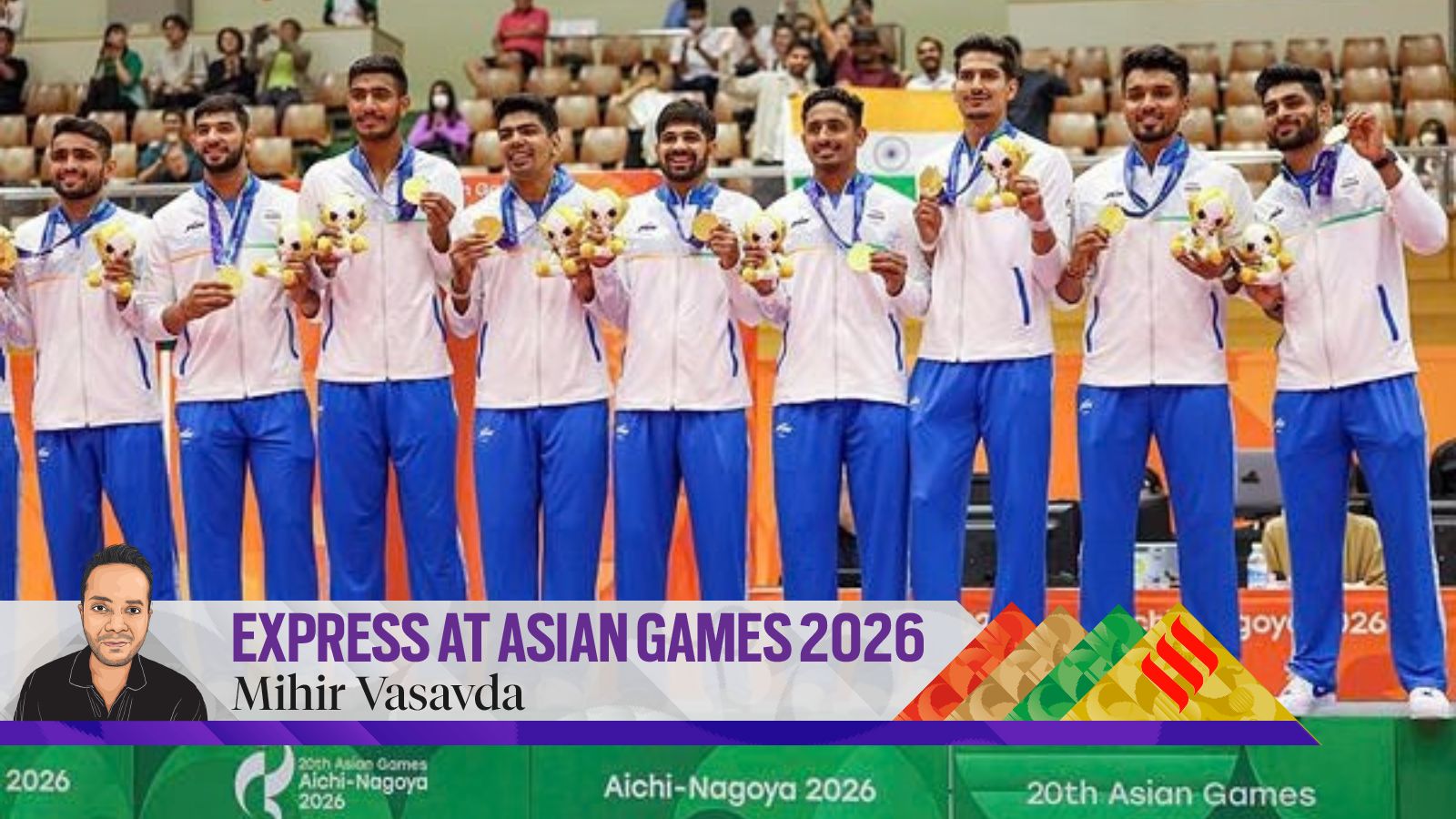
It was India who left with the gold. The 40-33 victory gave them their second kabaddi gold of the Asian Games and fourth overall, pushing them into the top 10 of the medal table. For those who had discovered the sport through drawings, the live version was considerably more visceral: raiders twisting away from ankle holds, defenders launching themselves at legs, a hand stretching for the line while the rest of the body seemed to be travelling in another direction. At times, the acrobatics looked straight out of manga. “I feel like trying it now,” said Konsei Kani.
There is history between these two teams, and there is memory too. Iran ended India’s run of seven successive men’s Asian Games golds in 2018, beating them in the semi-final. India waited five years to reclaim the title, and when they did, it was against Iran again, a 33-29 victory in Hangzhou in 2023, in a final that descended into arguments, protests and an hour-long stoppage with the scores locked at 28-28. So this was never going to be just another final. There was a needle, too. “When Iran travelled to Pakistan before the Asian Games to prepare, that time (Mohammadreza) Shadloui said the gold medal will be theirs,” said captain Sunil Kumar. “I just want to remind him they were playing India.”
And so, there were fireworks. Every raid seemed to carry something from the previous encounters. Defenders celebrated tackles in the faces of raiders. Raiders paused, provoked and probed. Players exchanged words after points. The Iranian bench reacted to Indian challenges; the Indian bench reacted right back. There was little routine about the opening 20 minutes, except the sense that neither side wanted merely to beat the other. They wanted to impose themselves. For a while, Iran did.
India’s raiding lacked penetration, while Amirmohammad Zafar Danesh and Ali Samadi kept finding cracks in the defence. Zafar moved laterally, dragging defenders away from position before attacking the space he had created. Devank, India’s principal raider, was swallowed up twice by Fazel Atrachali. Aslam Inamdar once went too deep and couldn’t make his way back. India led 13-10, but Iran turned it around, took an all-out, and went into half-time 18-17 ahead.
*** Then India changed the game, and with it, the mood.
The defence stopped giving Iran the same openings. The raiders stopped offering Iran the same targets. India began moving defenders across the mat, making them commit before attacking the space behind them. Shadloui and Zafar were picked off. Arjun Deshwal got Bastami. Amirhossein Taghipour came on and was immediately caught. Devank, after being frustrated by Atrachali twice, finally got the veteran defender on a raid.
Iran were suddenly chasing. India went from 23-21 to an all-out and 26-23, then stretched the lead further. Sumit’s tackle on Zafar made it 32-25. Devank and Arjun, who alternated raids in the first half, got steadier returns and kept Iran’s defence guessing, while Aslam Inamdar began to turn the clock into another Indian weapon.
With 3:21 left and India 36-29 ahead, Aslam stood almost teasingly close to the line, waiting for the Iranian defenders to come to him. When they did, he slipped through the opening and took two with him. It was a raid that seemed to contain everything kabaddi does best: speed, balance, deception, body control, and the ability to see a gap before it exists.
India had spent the first half trying to break through Iran’s defence. In the second, they made Iran move until it broke itself apart.
And still, the rivalry needed one final scene. On Iran’s last raid, Sunil stood in front of Shadloui, almost taunting him with the certainty that India had had the last word. “I just wanted to remind him that they were playing India and the gold medal is India’s,” Sunil said.
The two had to be separated. Moments later, Sunil and Shadloui hugged. The embrace did not erase what had happened over the previous 40 minutes. It made it mean more. For all the arguments, provocation and old scores carried onto the mat, there was also the recognition between two rivals who keep meeting, keep pushing each other, and keep producing nights like this.
“We will always play fiercely, whether I am facing my own brother or Iran,” said Pawan Sehrawat. “But at the end of it all, there is mutual respect. They are very good players, too.”
The Japanese spectators had come to watch manga come alive. They left wanting to play the game themselves.
Over the course of a 18-year-long career, Mihir Vasavda has covered 2010 FIFA World Cup; the London 2012, Tokyo 2020 and Paris 2024 Olympic Games; Asian Games in 2014 and 2022; Commonwealth Games in 2010 and 2018; Hockey World Cups in 2018 and 2023 and the 2023 ODI Cricket World Cup. ... Read More
