
India heads for driest monsoon in 17 years as El Nino curbs rainfall
Tired of missing our real-time updates? Click here to add us as a Preferred Source on Google. Then tap the "Star" or "Preferred" to keep DW News at the top of your feed.
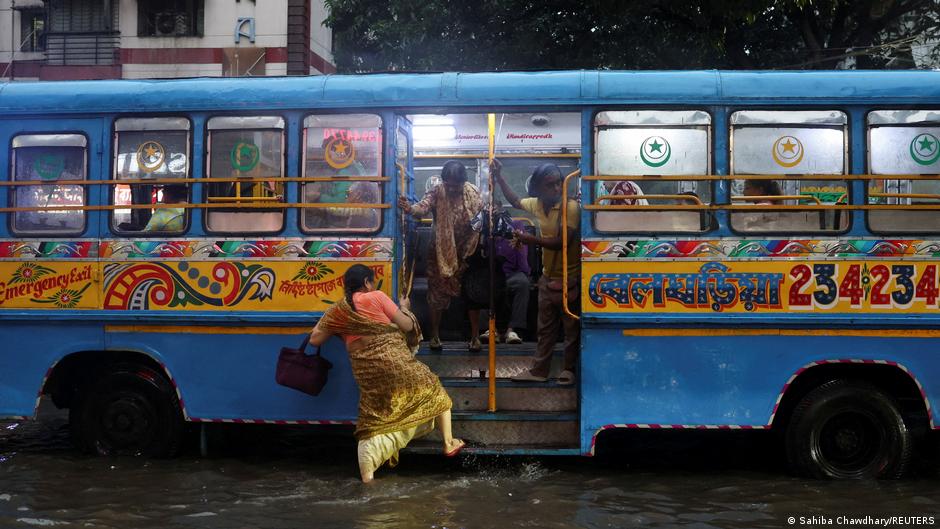
India is expected to experience its weakest monsoon season since 2009, as a strengthening El Nino weather pattern curbs rainfall and raises concerns over crop yields and food inflation.
Cumulative rainfall during the June-to-September monsoon season is currently running 15% below the long-term average, according to the India Meteorological Department, local media reported. The initial forecast was just a 10% shortfall back in May.
If the deficit holds, this would be the weakest monsoon since 2009, when rainfall was 18% below normal.
A potential tropical cyclone could form in the Bay of Bengal in the final week of September, potentially easing the shortfall in eastern and northeastern India, Christian Werner of Global Weather Climate Analytics told Bloomberg.
He said the storm was unlikely to significantly shift the national picture, with the seasonal deficit expected to settle between 13% and 16%.
The lack of rain threatens both current harvests and the next planting cycle, adding pressure on food prices that have already risen for seven straight months, hitting 5.95% in August — the highest level this year, according to the Free Press Journal.
Rice, sugarcane and corn planting are running behind last year's pace, and the government has responded by permitting duty-free sugar imports and selling subsidized onions in some states.
Five infant orangutans, a species found only on the Indonesian island of Sumatra and on Borneo, were found in a forest by rangers patrolling in the Balasore district of India's eastern Odisha state last week.
In recent years, orangutans, rare reptiles and other exotic animals are popping up in India, suggesting the country is becoming a major destination for trafficked wildlife.
Long lines formed outside Apple Stores across India on Friday as the iPhone 18 Pro and Pro Max went on sale — this year's most expensive Pro lineup to date, with prices roughly Rs 30,000 (€270, $310) higher than last year's equivalent models at launch.
The high prices were not a barrier for many buyers, whose wait began before dawn. In Bengaluru, a customer named Rahul told newswire ANI he arrived at the Apple Store around 5 a.m. local time and found people already in line.
Rahul, who said he has bought every iPhone since the iPhone 7, described the ritual as something bigger than a purchase: "I've been purchasing iPhones for a very long time ... But it's like a festival for me. iPhone launch is like a festival. Every year, I try to buy an iPhone."
At the Apple Store in the northern city of Noida, one buyer said he had traveled from the nearby state of Punjab and began his wait at 6 a.m. local time, just to be first through the door: "Mine was the very first booking; I am the first one who has got the phone."
This year's price increase — pushing the iPhone 18 Pro to Rs 164,900 (€1,500, $1,720) and the Pro Max to Rs 179,900 (€1,635, $1,900) at the base storage tier — breaks Apple's recent run of holding launch prices steady in India.
India's GDP per capita stood at $2,702.5 in 2025, according to World Bank figures. The numbers do not account for income inequality.
Hello! This is Seerat at DW's Studio Delhi, starting the day off on a relatively peaceful note, about 6 kilometers (four miles) from all the madness (read: the Apple store on launch day).
Long queues snaked around Apple stores across the country as the new iPhone 18 Pro and 18 Pro Max hit the market in India. These might be some of the most expensive phones in history, but that hasn't deterred die-hard fans.
Meanwhile, in a move that opposition leaders have dubbed the Election Commission of India's "late night birthday gift to Modi ji," the electoral body has barred both factions of the Trinamool Congress from using the name "All India Trinamool Congress" and its symbol, flowers and grass, ahead of upcoming bypolls.
Finally, if 1.4 billion Indians were not enough, the International Cricket Council (ICC) is seeking to create a new fanbase by tapping into Chinese potential.
For this and more, follow our live blog.
