India wins support from 4 European nations for permanent UN Security Council seat
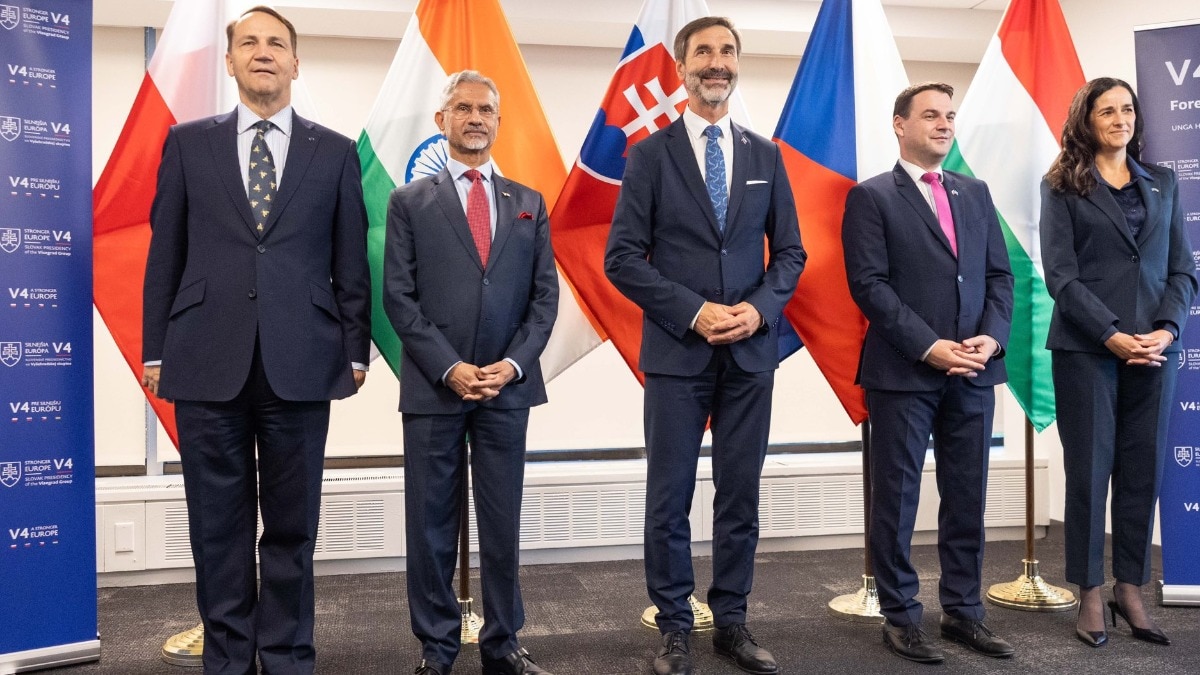
India's bid for a permanent seat at the UN Security Council has won collective support from four Central European countries, adding fresh diplomatic weight to decades-old demand for reform of the global body.
Hungary, Poland, Slovakia and the Czech Republic -- the four members of the Visegrad Group -- voiced their support for India during the first V4-India meeting held on the sidelines of the 81st UN General Assembly in New York.
"We all agree as V4 countries that India as a part of the Global South, upcoming superpower in the Indo-Pacific region, must be at the table as the permanent member of the UN Security Council," Slovak Foreign Minister Juraj Blanar said after meeting External Affairs Minister S Jaishankar.‘We all agree as V4 countries that India as a part of the Global South, upcoming superpower in the Indo-Pacific region, must be at the table as the permanent member of the UN Security Council’- Foreign Minister Juraj Blanr of Slovakia after the first V4 + India FMM #UNGA81 pic.twitter.com/QwFsjlXWYC— Dr. S. Jaishankar (@DrSJaishankar) September 21, 2026WHY INDIA WANTS PERMANENT SEAT AT UNSC
The argument behind India's campaign is straightforward: the world has changed since the Security Council was created, but its permanent membership has not. In 1945, much of Asia and Africa was still under colonial rule. Several countries that now have major populations, economies and diplomatic influence were either not independent or did not exist as sovereign states.
India has served eight times as an elected member of the Security Council, most recently in 2021 and 2022.
Its case rests on several factors -- its population, economic weight, contribution to UN peacekeeping and growing diplomatic influence. India has also played an active role in discussions on counterterrorism, development, maritime security and international peace.
Its priorities paper for the 81st UNGA argues that the UN's inability to respond effectively to conflicts has raised questions about its "efficacy, credibility and legitimacy". For New Delhi, therefore, Security Council reform is not simply about adding India to the permanent membership.
It is about changing the structure of the world's most powerful multilateral security institution so that it better reflects the world of today.INDIA IS NOT PUSHING ALONE
India's campaign has been supported by multiple members of the UN Security Council itself.
France has consistently supported India's claim. The United Kingdom has also backed India's inclusion in an expanded Security Council. The United States has publicly supported India's permanent membership in principle, while Russia has also backed India's bid.
India is also part of the G4 grouping with Brazil, Germany and Japan. The four countries support each other's bids for permanent membership and coordinate their positions during negotiations. The G4 has proposed increasing the size of the Security Council from its current 15 members to 25 or 26.
Under its proposed model, six new permanent seats would be created -- two for Africa, two for the Asia-Pacific region, one for Latin America and the Caribbean and one for Western Europe and Others. The proposal also includes four or five additional non-permanent seats.THE P5 PROBLEM
The five existing permanent members -- the US, Russia, China, France and the UK -- have not agreed on a single model for expanding the Council. There are differences over how many countries should be added, which regions should receive seats, whether new permanent members should have veto powers and how the Council should function after expansion.
China is the sole permanent member of the UN Security Council withholding explicit backing for India's bid for a permanent seat. Beijing employs diplomatic ambiguity by stating it understands and respects India's aspirations while structurally blocking the bid through demands for a broader consensus.
This is why diplomatic support for India's permanent membership does not automatically mean agreement on every aspect of Security Council reform.
The ultimate hurdle is structural. Reform would require amendments to the UN Charter, meaning the process needs broad support while also navigating the interests of the existing permanent members.advertisementTHEN THERE IS THE VETOThe biggest question may be what happens to the veto.
At present, the five permanent members can block substantive Security Council decisions. Elected members do not have that power.
The African Union has argued that the veto should eventually disappear. But as long as it exists, it wants new permanent members to receive the same rights as the existing P5.
India has taken a similar position.
In an April 2026 statement, New Delhi said there could not be a separate category of permanent members in which some countries have veto rights while others do not. India has backed an "all or none" approach, under which existing and new permanent members would have the same privileges and responsibilities.NEW DIPLOMATIC FRONT FOR INDIA
The V4 meeting itself marked a new chapter in India's engagement with the four Central European nations. Jaishankar described it as a "new historic occasion" and thanked Blanar for bringing the countries together.
"We had our first Visegrad Four and India meeting. It was, in a sense, a new historic occasion, and I would like to thank Minister Juraj (Foreign Minister of Slovakia) for convening us today. It was a very, very productive meeting," Jaishankar said.
The meeting was not solely about the Security Council. India and the V4 countries agreed to explore a wider institutional relationship, including an annual business forum and regular meetings between their foreign ministers.
"What we agreed was that since India's relationship with the European Union itself is deepening, with the V4, we would take some special initiatives to create an annual business forum. As foreign ministers, we would meet annually. That was the consensus," Jaishankar said.
Technology and innovation were also discussed, along with defence, space, connectivity and people-to-people ties. The ministers also exchanged views on major global crises, including the Ukraine conflict and developments in the Gulf.WHAT THE V4 BACKING MEANS
The V4 endorsement does not by itself guarantee Security Council reform. The process remains tied to negotiations involving a wide range of countries and, crucially, the existing permanent members.
But it gives India another collective bloc of countries supporting its permanent membership claim.
Jaishankar was also asked whether the V4's growing importance for India had a political dimension.
"We have very good relations with the V4 countries, and we know that these are countries with very strong, very distinctive capability. They are industrial economies, economies with great innovation and technology talent. And I think how the V4 come together is for them to decide. But we certainly welcome the opportunity to work," he said.- EndsPublished By: Satyam SinghPublished On: Sep 22, 2026 01:55 IST