INFRASTRUCTURE: THE LAST STOP
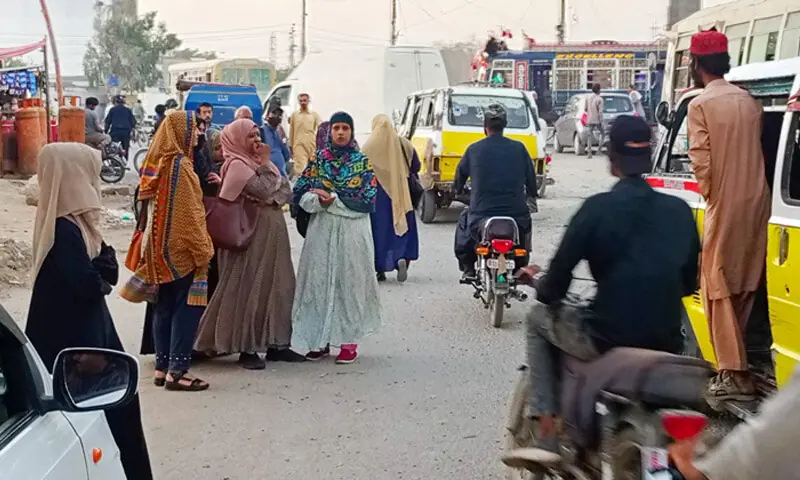
Most days, I leave my office at around 5pm, after which it takes roughly half an hour at the bus stop for my bus to arrive. The bus ride itself takes another hour to ninety minutes. From there, it is a 15-minute walk to my house in the Gulistan-i-Johar area of Karachi. The first challenge is to cross the poorly-lit, forever-under-construction University Road, with cars and motorcycles — often without headlights — racing through the operational service lanes.
At the end of a long and arduous day, walking home from the bus stop, I must not only be wary of speeding vehicles, but also of criminals, opportunistic harassers and serial stalkers. Exacerbating this daily grind are hazards such as flooded roads — after rainfall or otherwise — where speeding vehicles may splash pedestrians, leaving them wet, exposed and helpless. What may seem like a minor inconvenience to a driver can become a deeply uncomfortable and humiliating moment for a pedestrian.
These experiences led me to ask other women about their journeys.
Those who took part in this informal survey use different modes of public transportation, including mini-buses, qingchis, electric buses, and other informal transport services. Their backgrounds and experiences vary, depending on factors such as their occupation, age, income, the areas they travel to and the time of day. They include people working in offices, banks, schools, hospitals, shops and factories, while others are domestic workers employed in private homes.
Their stories reveal how concerns about safety persist throughout the journey — and do not end when women get off public transport.
Long waits, overcrowded buses and unsafe infrastructure are only part of the daily commute for Karachi’s working women. Often, the most difficult stretch for them begins after they get off public transport
WALKING BACK HOME
One recurring concern expressed by women was their safety after getting off public transport and walking from the last stop to their homes. For many women, the walk takes between five and 10 minutes. Although public transport takes them to the last stop, the final walk home often feels unsafe, particularly during the evening or at night.
Two women told me they had been hit by a motorbike without headlights. Another, a physiotherapist, told me she had been robbed of her cellphone while walking from the stop to her home in the Gulshan-i-Iqbal area.
Equally challenging is the prospect of crossing a pedestrian bridge. These bridges are often poorly maintained and not well-lit, making them unsafe, especially after sunset. Some women said they had encountered people who use drugs on or around such bridges, making them feel unsafe. At least one passenger, an employee at a private hospital, told me that she faced harassment while crossing a pedestrian bridge.
In addition, large advertising billboards frequently obstruct visibility, creating hidden spaces where pedestrians cannot easily see who is nearby. As a result, many women avoid pedestrian bridges altogether and choose to cross busy roads, despite the risk of being hit by traffic.
Even walking short distances in extreme heat can be physically exhausting, while heavy rainfall often floods the streets and conceals open manholes and damaged roads. As a result, women fear falling into uncovered manholes or being injured while walking through waterlogged streets.
A woman shared that, while walking to the bus stop to pick up her daughter, she fell into an uncovered manhole, suffering serious injuries. She says the construction site had no warning signs, safety barriers or adequate lighting to alert pedestrians to the danger.
FINDING ALTERNATIVES
A group of women working at a garment packaging factory explained that they are fortunate to live in the same neighbourhood and work at the same factory, allowing them to travel together each day. They use mini-buses for their daily commute, and their homes are about a 20-minute walk from the last stop. Instead of walking, the women collectively hire a rickshaw to cover the final part of their journey.
Another group, also working at a factory, explained that they rarely travel alone after work. Factory transport drops them on main roads and they travel the last leg of their journey by themselves. They leave the factory in groups and often get lifts from Mazda drivers and loaders who live in the same neighbourhood or along the same route. Such informal support networks help reduce transport costs while also providing a greater sense of security during the last stage of their commute.
One university student told me that she uses a bike-hailing service to get home after getting off the bus because it is more affordable than a rickshaw. She explained that this option allows her to reach home while keeping her transportation costs low.
But not everyone can afford this. Women from low-income households say that financial constraints — the additional fare of a rickshaw, for instance — limit their options in the final stage of their daily commute. They get off at the main road and walk the remaining distance to their homes.
Their experiences demonstrate how economic inequality directly influences personal safety and mobility. The inability to afford last-mile transport can force women to choose between financial necessity and personal security.
SAFETY IN NUMBERS
Travelling together allows the women to look out for one another, particularly when walking from the last stop to their homes or passing through poorly lit and isolated areas. It also gives women an opportunity to form unexpected connections.
The same sense of connection emerged during my own daily trips on public transport. I have made quite a few friends, particularly among those using the same route regularly. We gradually became familiar with each other and, over time, repeated encounters gradually turned into friendships, built on familiarity, trust and mutual support.
Most of the women I spoke to describe these friendships as an important source of social and psychological support, helping to reduce feelings of isolation, anxiety and vulnerability while commuting. In this way, the bus stop also becomes more than a waiting space — it also serves as a place where solidarity and community are formed among women navigating the city’s public transport system.
These everyday choices show how closely safety, mobility and economic inequality are intertwined. For many women, the commute does not end when they step off a bus or qingchi; negotiating the final stretch home is itself a daily calculation of cost, safety and convenience.
The writer is a visual artist and works as a research assistant with architect Arif Hasan
Published in Dawn, EOS, September 27th, 2026