Inside Thailand’s toxic river struggle and the fallout from Myanmar's mines - CNA
Contamination linked to mining in Myanmar is raising fears over food safety, shrinking incomes and long-term health risks for people in Thailand who depend on the Mekong’s tributaries, CNA’s Insight finds.
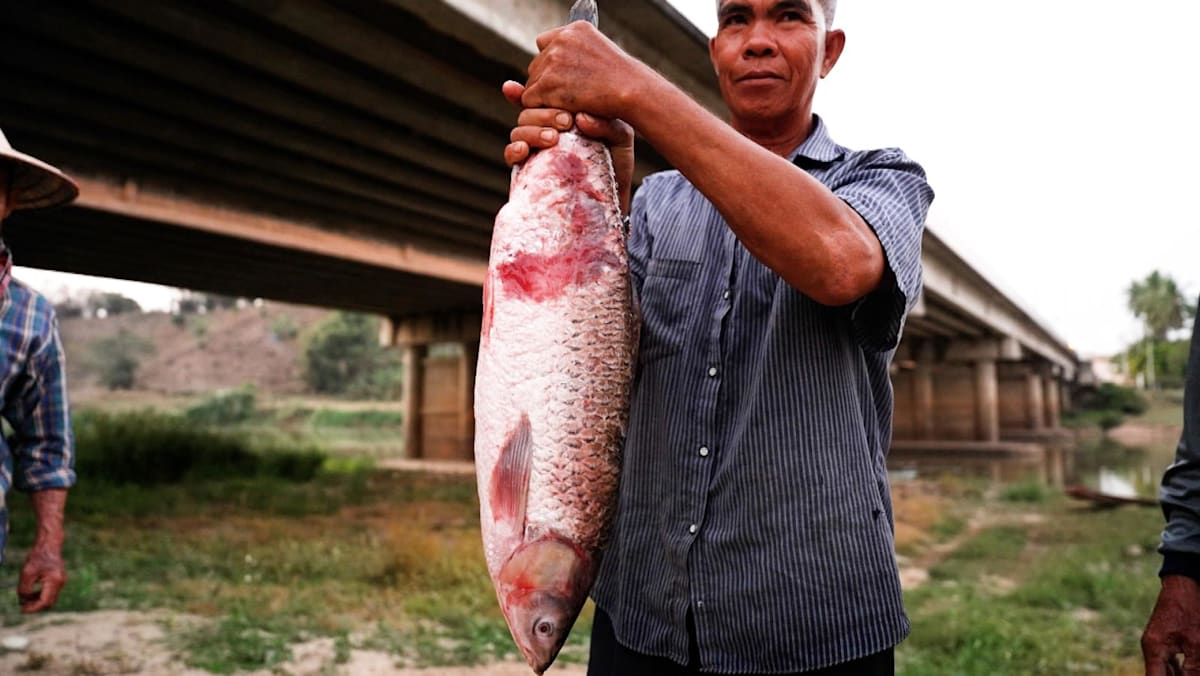
Thai fisherman Boongaew Kamlor with a fish he caught in Chiang Rai that had lesions. New: You can now listen to articles. This audio is generated by an AI tool.
Derrick A Paulo & Pichayada Promchertchoo 12 Jun 2026 06:00AM (Updated: 10 Aug 2026 09:43PM) Bookmark Bookmark Share WhatsApp Telegram Facebook Twitter Email LinkedIn Set CNA as your preferred source on Google Add CNA as a trusted source to help Google better understand and surface our content in search results. Read a summary of this article on FAST. Get bite-sized news via a newcards interface. Give it a try. Click here to return to FAST Tap here to return to FAST FAST CHIANG RAI, Thailand: Thongkham Inprom has been farming for more than six decades, growing jasmine rice and sticky rice in Chiang Rai.
The 71-year-old harvests about 60 tonnes each year and keeps 1 per cent for his family. The rest is sent to a rice mill and eventually sold in central Thailand.
But now he is worried that he might not be able to sell his rice. Government agencies have found arsenic in the soil and water at his farm. It is already affecting his crops.
While his brown rice contains arsenic within the safety limit, his paddy is “right at the safety threshold”, said Somporn Pengkam, the director of the Community-led Health Impact Assessment Platform, who went through the results from tests on the produce.
CNA Games Guess Word Crack the word, one row at a time Buzzword Create words using the given letters Mini Sudoku Tiny puzzle, mighty brain teaser Mini Crossword Small grid, big challenge Word Search Spot as many words as you can Show More Show Less The toxicology results. Thongkham’s polished white rice has less arsenic, but there is still cause for concern.
“Even if the daily intake is within the limit, it still builds up. At first, the body says, ‘I can handle it and flush it out.’ After a week, ‘still manageable’. After a month, it starts to struggle,” said Somporn.
“After six months, ‘I can’t handle this any more’. The kidneys can no longer clear it. That’s when we start detecting it in the body. Arsenic poisoning can eventually cause cancer in many organs, especially the skin and bladder.”
Arsenic has already been found in Thongkham’s urine, with tests done months apart showing that the level has increased to double the acceptable exposure limit.
“I don’t really know what we can do,” he said. “It’s hard to avoid. We eat rice every day.”
It is not only his farm where arsenic — a naturally occurring but toxic chemical element found in soil, water and some minerals — has exceeded the levels expected.
In March, Thailand’s Pollution Control Department detected elevated levels in the sediment of the Mekong River, the lifeblood of a large part of Southeast Asia. More than 65 million people live in the Lower Mekong basin.
The highest reading was 296 milligrams per kilogram of sediment, nine times the 33 mg/kg safety threshold.
In fact, heavy metals including lead and manganese have been detected in the Mekong’s northern tributaries since last year. In some tests, the presence of these substances exceeded Thailand’s safety standards too, with arsenic the prime concern again.
The water that feeds Thongkham’s crops comes from the Sai River. Along with the Kok and Ruak rivers, it begins in Myanmar’s Shan state, across the border. There lies what experts say is the source of the pollution: rare earth mines.
“They’re doing mining without any standards, any laws, spilling all the chemicals and toxins (into) our river system,” said Rivers and Rights Foundation executive director Pianporn Deetes. “These activities are transnational organised crime.”
Myanmar’s civil war and the race for the world’s most critical minerals are at the heart of what is now a looming crisis as pollutants end up in the food Thailand produces, CNA’s Insight finds.
Before arsenic began showing up in rice, fish with unusual growths or lesions were turning up and sparking concern that something was wrong with the rivers.
Sukjai Yana, 75, who has fished in northern Thailand for more than five decades, caught “about four or five” deformed fish last year. When that happens, the fish cannot be sold and must be kept for authorities to examine them.
WATCH: Is your food safe? Inside Thailand’s toxic river crisis (45:54)