Institutions are built by people: FCC CJ
Direct Source Verification:
This story is aggregated from The Express Tribune (tribune.com.pk). Full reporting rights and copyright belong to the primary publisher.
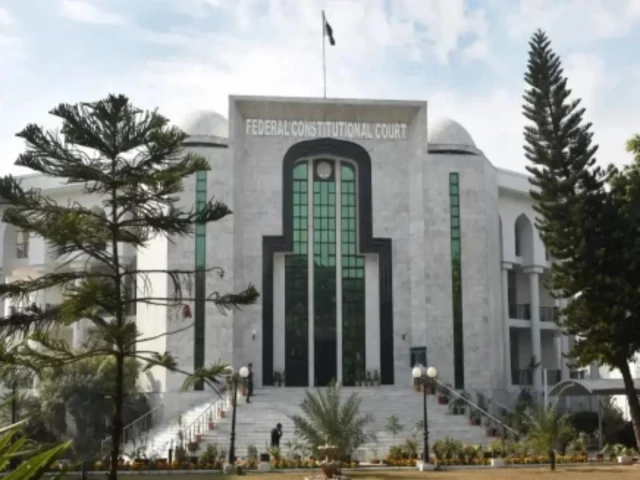
Stresses constitutional principles, institutional capacity
Federal Constitutional Court (FCC) Chief Justice Amin-ud-Din Khan on Tuesday said the judiciary must remain "firmly rooted in constitutional principles" while developing the institutional capacity needed to meet the demands of the modern age.
Speaking at an event in Islamabad, Justice Amin-ud-Din said the FCC had undertaken a "remarkable institutional journey" during its first 10 months, building its judicial and administrative infrastructure while simultaneously discharging its constitutional responsibilities.
"When this court came into existence, the task before us was immense," he said, adding that the court had not inherited a fully developed institutional infrastructure.
"We had to build an institution while simultaneously performing the judicial responsibilities entrusted to us by the Constitution," he said. "In many respects, we began our journey from scratch."
The FCC was established under the 27th Constitutional Amendment in November as a separate forum for constitutional matters. It was given jurisdiction over disputes between governments, constitutional interpretation, enforcement of fundamental rights involving questions of public importance, and challenges to laws on constitutional grounds. The amendment also provided for the transfer of pending cases within the FCC's jurisdiction from the Supreme Court (SC) to the new court.
Justice Amin-ud-Din said three benches of the court had immediately commenced judicial work after the oath-taking process of all its judges was completed. "That moment remains a powerful reminder of the spirit with which this institution was born," he said.
"There was no prolonged period of institutional preparation before justice could begin. The court was established, the judges took their oath, and the constitutional responsibility of adjudication commenced."
The chief justice said the court had initially functioned from the Islamabad High Court (IHC) building before shifting to its present premises by the end of its second month.
He described the transition as a "formidable institutional exercise", noting that the building had been constructed approximately 46 years ago and was originally designed to accommodate around 100 employees.
"Today, however, nearly 400 officials and attached staff of this court are working within these premises," he said.
Justice Amin-ud-Din said limited space had put considerable pressure on the court's facilities, with officers and officials working in "improvised cabins and compact workstations". "Yet, despite these physical limitations, the work has continued," he said.
"And it has continued because institutions are ultimately not built by the concrete and bricks alone," he said. "Institutions are built by people. They are built by commitments."
"They are sustained by discipline. They grow through collective sacrifices and devotion to the purpose larger than individual convenience."
The chief justice acknowledged the dedication of the court's officers and officials, saying they had worked with "exceptional commitment" despite limitations in space and infrastructure. "Their contribution is part of the foundation upon which the future of this court shall stand," he said.
Original Source
https://tribune.com.pk/story/2629544/institutions-are-built-by-people-fcc-cj