Iran war costs $38 billion as CBO warns of higher inflation, depleted weapons
The nonpartisan agency describes the consequences of the war that will persist.
The war with Iran has cost the United States at least $38 billion through the end of July and is expected to further push inflation higher for American households, according to a nonpartisan Congressional Budget Office (CBO) assessment released Tuesday.
The CBO also warned that depleted weapon stocks could take a half decade or longer to rebuild, crippling the Pentagon’s ability to respond to another major conflict.
It also warns that depleted weapon stocks could take a half decade or longer to rebuild, crippling the Pentagon’s ability to respond to another major conflict.
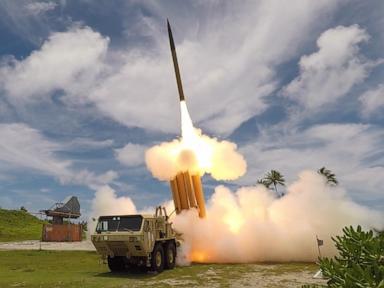
A THAAD interceptor is launched from the Reagan Test Site, Kwajalein Atoll in the Republic of the Marshall Islands, during Flight Test THAAD-23, August 30, 2019.Missile Defense AgencyThe assessment describes the financial and military consequences that will persist beyond the fighting, leaving the Pentagon with fewer weapons available for another major conflict while skyrocketing energy prices put pressure on household budgets.
The report notes that the Pentagon did not cooperate with the analysis or provide information requested by the Congressional Budget Office. The Pentagon did not respond to ABC News' request for comment on the report.
The CBO serves as Congress’ scorekeeper, providing lawmakers with independent estimates of federal spending and the costs of legislation. Its reports noted it relied heavily on public information.
The budget office’s estimate covers direct costs from the U.S. and Israel launching their campaign against Iran on Feb. 28 through Aug. 1, excluding expenses related to U.S. bases devastated by Iranian bombardments.
Munitions account for most of the spending. CBO projects another $2 to $3 billion in monthly costs, but says the bill could climb during sustained fighting.
Americans will also bear what could be mounting costs adding to already inflation rates, with projections estimating the consequences of the war to add roughly a half percentage point to the inflation rate early next year, meaning the costs of goods, housing and food will continue to rise, driven largely by climbing energy prices stemming from supply disruptions in the Middle East.
The war has significantly depleted U.S. inventories of missiles and anti-air defense weapons, leaving fewer munitions available for another major conflict.
“The shortfall would become especially problematic if a conflict arose with an opponent whose arsenal included large numbers of ballistic and cruise missiles,” the CBO said in its report.
Those concerns predate the Iran war. A congressionally mandated commission warned in 2024 that the U.S. could largely exhaust its munitions inventories within three to four weeks of a conflict with China. Some critical weapons, including anti-ship missiles, could run out within days.
“Missile defense interceptors are in short supply because they have been produced at relatively low rates; thus, DoD’s inventory of such missiles was limited,” the CBO said in its report.
A Pentagon inspector general report on Monday came to the same conclusion that the massive expenditure of munitions against Iran has"resulted in strategic inventory shortfalls,” which revealed significant issues with U.S. force’s ability to resupply, as missiles take years to build. Persistent bottlenecks include the complexity and daunting list of materials and the recruitment of skilled labor to build them.
Patriot and SM-6 interceptors, used to shoot down incoming missiles and drones, cost roughly $4 million each, according to the CBO. THAAD interceptors cost about $12 million apiece, while more advanced SM-3 interceptors can cost roughly $28 million each.
The stark warning on munitions shortages comes just days after Adm. Brad Cooper, the war’s top commander, said in an interview on CBS Sunday that he’s not concerned about munitions depletions.
“We’re armed and ready for any contingency,” he said.
President Donald Trump on Monday dismissed the Pentagon IG's report. The administration has maintained the Pentagon can continue fighting with the arsenal it has.
Vessels at the Strait of Hormuz, as seen from Musandam, Oman, September 6, 2026.ReutersCare for casualties, damage to bases will push up costsThe war’s ultimate cost is likely to be far higher once decades of veterans’ disability payments and medical care are included. More than 800 U.S. troops have been wounded, with traumatic brain injuries emerging as the conflict’s signature wound.
“Counting munitions expended while leaving veterans’ care and benefits is not a real war-cost analysis,” Rep. Mark Takano, the ranking Democrat on the House Veterans Affairs Committee said in a statement to ABC News. “It is a bill sent to veterans and taxpayers later.”
CBO’s estimate excludes much of the costs associated with the damage to U.S. bases in the Middle East, including those in Kuwait, Bahrain and Jordan, some of which have been devastated by Iranian bombardments. Pentagon planners have long anticipated shrinking the military’s footprint in the region to shift resources to the Pacific.
The analysis comes as Congress has not enacted funding to cover the costs of the Iran war. In July, the House passed a $95 billion budget blueprint to provide up to $60 billion for military funding. The plan would also provide up to $13 billion for intelligence costs, totaling $73 billion to cover the Iran war.
The Senate has no immediate plans to move on the budget blueprint to provide Iran war funding before the midterm elections. Historically, conflicts have had special supplemental funding as to not eat much into the military’s day-to-day operational needs in its $1 trillion budget.
ABC News was first to report that the Army has dramatically scaled down much of its training this year, partly to accommodate the enormous surprise expense of the conflict.
“Well, not before the election. No, I mean that'll probably be a post-election push,” Senate Majority Leader John Thune told reporters on Tuesday.
House Budget Committee ranking Democrat Brendan Boyle of Pennsylvania said the report “makes clear that the war has also cost American taxpayers tens of billions of dollars and counting, while continuing to drive up costs.”
“Donald Trump and Republicans have spent years telling Americans that we cannot afford to help families here at home, but apparently they can find tens of billions of dollars, and potentially much more, for a reckless war that is leaving Americans to pay the price,” Boyle said in a statement.