Iran’s Revolutionary Guard Corps Pens Open Letter to American Voters - Time Magazine
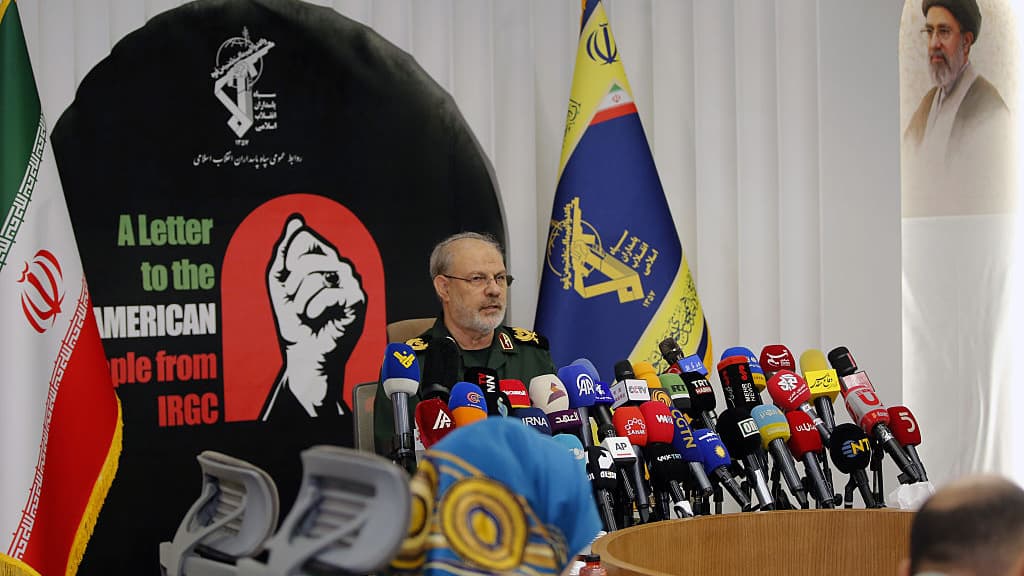
Iran’s Islamic Revolutionary Guard Corps (IRGC) has penned an open letter to Americans, calling on U.S. civilians to “wrest control back from corrupt politicians.”
The letter, published Tuesday, comes weeks before the U.S. midterm elections in November. Addressed to “the honorable people of the United States of America,” the letter accuses the Trump Administration of lying to the American public about the U.S. and Israel’s war against Iran, which has just entered its eighth month, and calls on them to enact change through their votes.
“Americans need to wake up,” the letter reads. “Now is the time, as the American political system is at its weakest.”
IRGC spokesperson Hossein Mohebbi told reporters that the letter is not intended to sway the Trump Administration, but rather appeal to American voters.
Earlier this month, President Donald Trump said the Iranian government was seeking to sabotage the electoral outcome by prolonging the war, which is broadly unpopular with Americans. Energy prices around the world have skyrocketed since Iran disrupted shipping through the Strait of Hormuz in retaliation for the U.S. and Israel’s strikes on Feb. 28, stoking inflation worldwide.
Trump, however, said the Iranian government is nearing collapse and would seek an end to the war immediately after the midterms. He repeated the prediction at the U.N. General Assembly last week, while threatening that he could “annihilate” Iran if no agreement is reached to end the war. After a cease-fire agreement collapsed in July, the two sides have continued to exchange threats and intermittent attacks, while mediators struggle to revive negotiations.
But the IRGC insisted that it has already “won the war,” arguing in the letter that the U.S. has failed to achieve its objectives. It claimed that, despite U.S. claims of victory, Iran has retained control of the Strait of Hormuz and that its nuclear program survived. It also asserted that Iran has gained “cultural influence” around the world. The IRGC claimed that the war has tarnished the U.S.’s global image, citing a U.S. strike that hit an elementary school in Minab, Iran, on Feb. 28, which a U.N. fact-finding mission said earlier this month could constitute a war crime. (The U.S. rejected the mission’s findings. The Pentagon said in March it was investigating the strike.)
The IRGC also accused the U.S. of enabling Israel’s “genocide” in Gaza, which has killed more than 74,000 Palestinians since the Oct. 7, 2023, Hamas attack on southern Israel that killed around 1,200 people and abducted 251 others. In the absence of independent monitoring on the ground, the Gaza Health Ministry is the primary source for casualty data relied upon by humanitarian groups, journalists, and international bodies. Its figures do not differentiate between civilians and combatants and cannot be independently verified by TIME. Data from the Israeli Defense Forces suggests a Palestinian civilian death rate of 83%. Israel has rejected allegations of genocide in Gaza.
The letter also invokes Israel’s bombardment of Lebanon, where more than 4,000 people have been killed since early March, according to the Lebanese Health Ministry.
“The genocide in Palestine and Lebanon and the endless wars in other parts of the world are carried out with your tax dollars,” the letter reads.
Most Americans disapprove of the war against Iran, with 59% disapproving of U.S. military strikes on Iran in a late August Reuters/Ipsos poll. The same survey found that 54% thought military action against Iran had not been worth it, although views were divided along partisan lines. Meanwhile, just 22% of Americans said Israel’s ongoing military operations in Gaza are justified, according to a June AP-NORC poll, with support for Israel declining among Democrats since early 2024.
Lawmakers in both parties have questioned the war’s cost, with some Republicans expressing concern about its potential impact on their electoral prospects. The Reuters/Ipsos poll found that cost of living was voters’ top concern heading into the midterms.
TIME has reached out to the White House for comment.
“People all around the world are looking to Americans to stop their government,” the letter reads. “Americans need to rise up and put an end to this miserable situation that their country, and the world at large, is facing.”
The letter accuses the White House of being “a nonstop factory of lies.”
Specifically, the IRGC said Trump misled Americans in citing his rationale for launching strikes on Iran in February as stopping Iran from obtaining a nuclear weapon. Iran has maintained that it is not seeking a nuclear weapon and that its uranium enrichment program is for civilian purposes. A U.S. intelligence assessment from March 2025 said Iran was not developing a nuclear bomb, although the U.N.’s nuclear watchdog, the International Atomic Energy Agency, reported that Iran had accumulated uranium enriched up to 60% as of June 2025. The agency said in September that it has been unable to verify the stockpile’s status since the U.S. joined Israel in striking Iranian nuclear facilities last year.
The letter points to Trump’s declaration after those strikes that Iran’s nuclear program had been “obliterated.”
“But then, one year later, Trump again attacked Iran with the same hollow excuse,” the letter reads.
The IRGC also pushed back against U.S. claims that Iran’s control of the Strait of Hormuz is waning. “The fact that the Americans might manage, at great expense, considerable trouble and high risk to sneak a small vessel through the Strait of Hormuz under cover of darkness to export, say, 100 or 200 barrels of oil does not mean the Strait is open,” Mohebbi said.
Traffic through the Strait has ticked upwards in recent weeks. This month, crude oil exports from key Middle Eastern producers, including Saudi Arabia and the United Arab Emirates, reached their highest level since the war began, according to data from trade analytics firm Kpler. The rebound followed an increase in shipments through the Strait of Hormuz, as Saudi Arabia diverted its exports after attacks in the Red Sea. Lloyd’s List Intelligence also reported that crossings through the Strait of Hormuz by Saudi vessels in the first three weeks of September exceeded those in any full month since the war began.
The letter argues that the U.S. and Iran “can live together in peaceful coexistence” if the U.S. accedes to certain demands, including ending aid to Israel, avoiding foreign wars, and closing its overseas military bases.
The IRGC said in the letter that its hostility is directed towards the U.S. government, not its people. “‘Death to America’ is a prayer for the eradication of the diabolical ruling elite whose seat of power is the White House,” the letter reads.
The U.S. pulled its remaining troops from Iraq on Wednesday, a move that political observers cautioned could strengthen Iran and Iran-backed militias. The IRGC, however, claimed in its letter that U.S. actions during the 2003 invasion of Iraq had“pushed Iraq solidly into Iran’s sphere of influence.”
The letter argues that, if the U.S. changes course, it can “once again take its place as the world’s leading economy and American [sic] will once again enjoy a prosperous life.”
“If Americans could only come on a short trip to Iran, they would immediately realize that their officials and their media are lying to them about Iran,” the letter reads. Iran requires American tourists be accompanied by a government-licensed guide throughout their visit in the country. The U.S. has maintained a “do not travel” advisory for Iran, citing terrorism, unrest, kidnapping, arbitrary arrest, and wrongful detention.
The letter is not the first time Iran has directly appealed to Americans. In April, Iranian President Masoud Pezeshkian penned an open letter to the American public, asking them to “look beyond” what he said was “the machinery of misinformation” that presented Iran as a threat. Iran-linked media have also circulated AI-generated cartoons in English in an apparent effort to reach Americans with pro-Iran messaging.
Mirroring Trump’s repeated calls to Iranians to stand up to the theocratic regime in Iran, the IRGC appealed to voters to stop the U.S. government.
“You are the ones who empower, with your votes, the government,” the Sept. 29 letter reads, “and allow it to do what it does.”