Is NATO ready to fight? The Ukraine war is raising doubts among military analysts
Direct Source Verification:
This story is aggregated from The Express Tribune (tribune.com.pk). Full reporting rights and copyright belong to the primary publisher.
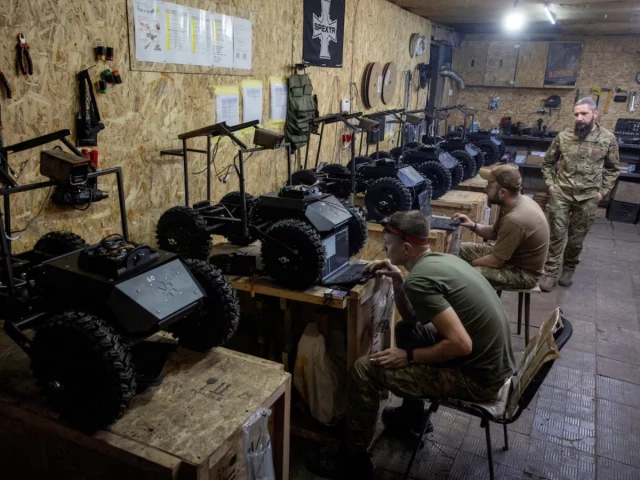
Experts warn developments on battlefield are moving so quickly that some NATO weapons and tactics risk being outdated
Russia’s full-scale invasion of Ukraine has killed hundreds of thousands of people. It has also served as a proving ground for new weapons systems and raised an uncomfortable question for the North Atlantic Treaty Organisation (NATO): Is the alliance prepared for the next war it might have to fight?
Five Ukrainian and Western defence officials told Reuters that developments on the battlefield are moving so quickly that some NATO weapons and tactics risk becoming outdated. While Ukraine — which is not an alliance member — adapts in weeks, NATO buys and develops systems over years, sometimes decades.
The Ukraine war and US President Donald Trump’s haranguing of European allies have prompted many NATO members to dramatically increase their defence spending. The Pentagon is currently reviewing its military presence in European countries, which Trump has accused of sponging off US protection and refusing to help prosecute his unpopular war against Iran.
Denys Shtilerman, the co-owner and chief designer of Fire Point, a leading Ukrainian missile and drone builder, told Reuters that tanks are now “worthless” because a drone costing about $5,000 can destroy one. Yet Europe still spends heavily on tanks — which, say many military analysts, still have a key role to play in future battles.
Read: US drone maker Powerus signs Pakistan Army MOU, gets initial order
Cheap drones have also transformed warfare in other ways. Troops gathering in groups or large vehicle convoys all become far easier targets.
“They are good at storming positions,” Oleksandr Pivnenko, Commander of the National Guard of Ukraine, said of the international troops his units trained with last year. “But if there’s a drone overhead and you don’t even look up, what do you think will happen to your squad?”
In June, Reuters attended a NATO military exercise near Paldiski in Estonia — a small Baltic country now fortifying its 210-mile border with Russia — in which American and European troops treated dozens of simulated casualties at wartime field hospitals. But the exercise took place with the assumption that NATO would command the airspace above the hospitals — no longer a given in the age of cheap, stealthy, long-distance drones.
Rather than simply receiving NATO training and assistance, Ukrainian officials described a growing role for Ukraine in teaching the alliance lessons drawn from the war with Russia. Yet they also said NATO’s military bureaucracy struggles to absorb those lessons. A Ukrainian officer who underwent NATO psychological operations training in Romania told Reuters that some alliance training materials still relied on case studies from World War Two. NATO didn’t respond to questions about the officials’ criticism of its training and bureaucracy.
The Ukraine war has also exposed a vulnerability that NATO officials say is far harder to solve: air and missile defence. Russia’s relentless barrages against Ukrainian cities have highlighted Europe's dependence on sophisticated US anti-missile systems such as the Patriot, first used in the 1991 Gulf War. Ukraine has a critical shortage of Patriot interceptors — the missiles fired to destroy incoming threats.
Fearing that its reliance on Patriots might become a strategic vulnerability, Europe is building non-US alternatives. Ukraine is awaiting delivery of the new French-Italian SAMP/T-NG air-defence system, designed to intercept ballistic missiles. France has promised to accelerate its deployment to Ukraine, and European diplomats previously told Reuters it was expected to arrive by next spring.
Read more: Drones, night vision reshape terrorism
In a statement, the Ukrainian defence ministry said its soldiers and NATO’s had much to learn from each other, hailing Ukraine’s use of drones and radioelectronic warfare as “globally unmatched" and praising European efforts to help tackle Russia’s drone and missile bombardments.
In July, Ukraine and nine European allies launched an air-defence coalition that includes plans to jointly develop a new anti-ballistic missile system. Known as Freyja, the project is a consortium of about a dozen companies with Fire Point as the lead private-sector partner. The goal is to build a system that is cheaper and faster to produce than the Patriot, while ensuring that Europe, not the US, controls its manufacture.
“If you spend $20 billion on your air defence system, you must be independent in your security,” said Fire Point’s Shtilerman.
Original Source
https://tribune.com.pk/story/2629892/is-nato-ready-to-fight-the-ukraine-war-is-raising-doubts-among-military-analysts