ISIS-K member sentenced to 20 years in prison in case tied to Kabul bombing
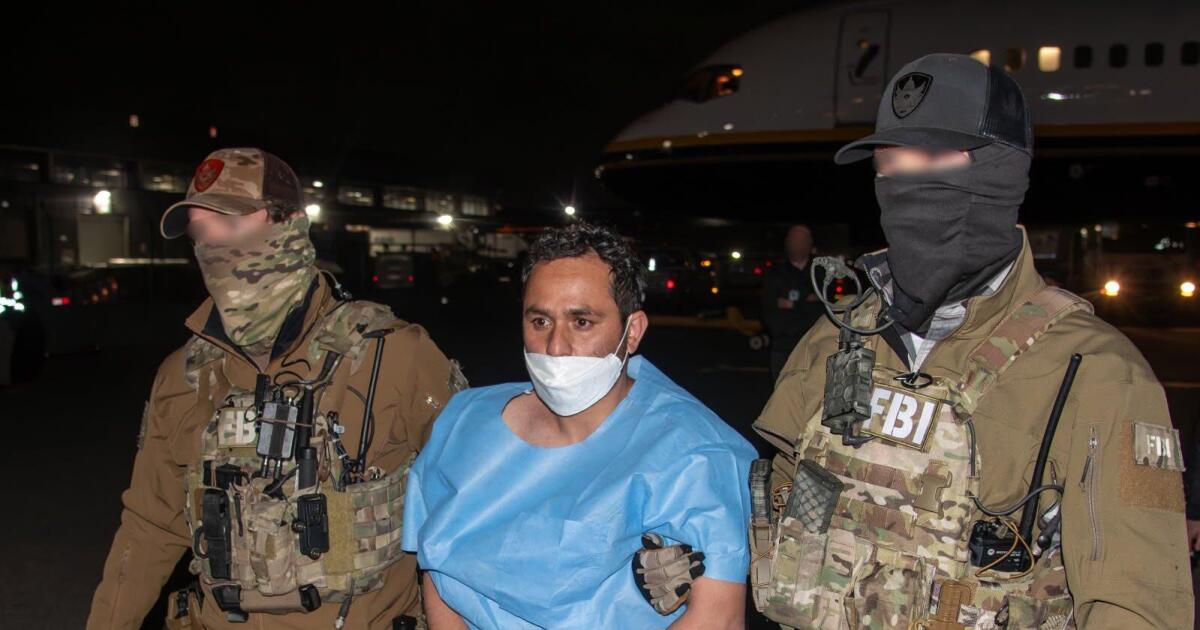
A member of an Islamic State affiliate in Afghanistan was sentenced Wednesday to 20 years in prison for aiding the terrorist organization, which took credit for a suicide bombing that killed 13 U.S. service members and about 160 Afghans at the Kabul airport five years ago during the American military's chaotic withdrawal from the country.
A federal jury in Virginia had convicted Mohammad Sharifullah in April of providing material support to the affiliate, known as ISIS-K. But jurors could not agree whether he bore some responsibility for the airport bombing on Aug. 26, 2021.
U.S. troops were conducting an evacuation operation at the airport when a lone suicide bomber detonated an improvised explosive device near an entry point known as Abbey Gate. Sharifullah's role in the attack was scouting a route to Hamid Karzai International Airport, prosecutors said.
Sharifullah, 28, received the maximum sentence for his one-count conviction in an international terrorism case that President Trump heralded last year during a speech to a joint session of Congress. Sharifullah was captured in early 2025 by Pakistani intelligence and the CIA near Pakistan's border with Afghanistan, and was extradited to the United States.
Sharifullah did not testify at his trial and declined to address the court before U.S. District Judge Anthony Trenga imposed the sentence. The judge said the defendant was a "dedicated terrorist" who expressed no remorse for the "unfathomable" grief and suffering that he had caused.
Trenga heard victim impact statements from several parents of the U.S. service members. From a podium only a few feet from where Sharifullah sat, they took turns paying tribute to their children's sacrifices and describing how the attack has shattered their families. Mark Schmitz of Missouri asked Sharifullah to turn and look at him as he spoke about the life and death of his 20-year-old son, Marine Corps Lance Cpl. Jared Schmitz.
"They may have taken his life, but they'll never take his legacy," Schmitz said. "A bomb killed my son. It did not kill what he stood for."
Paula Knauss-Selph, whose son, Army Staff Sgt. Ryan Knauss, was killed in the Abbey Gate bombing, said the family was "forever changed" by the attack.
"No justice will ever be enough to mend my broken heart," she said.
Sharifullah requested a 17-year prison sentence, while prosecutors sought 20 years. His lawyers say he was never an ISIS-K leader and has not been convicted of any conduct related to the airport suicide bombing.
"He was brought here because the government believed he participated in the Abbey Gate attack, a theory which it was unable to prove at trial," defense attorneys wrote.
Prosecutors said in their sentencing memo that "from his teenage years, when he pledged an oath of allegiance to ISIS-K, Sharifullah's carnage was driven by hate. Hate towards Americans."
Jurors convicted Sharifullah of providing material support to ISIS-K, but did not reach a unanimous decision on whether any deaths at the airport "resulted from" that conspiracy. Sharifullah could have faced a possible life sentence if the jury had decided that question.
In a statement Wednesday, Assistant Attorney General for National Security John Eisenberg said Sharifullah "spent nearly a decade at the heart of a horrific campaign of terror, providing critical support for attacks against civilians around the world and, ultimately, contributed to the deaths of 13 U.S. servicemembers and dozens of others at Abbey Gate."
According to prosecutors, Sharifullah told a journalist that he wanted to "catch and kill the crusaders" from the United States for invading his country after the attacks of Sept. 11, 2001. They said Sharifulla aided in dozens of other attacks, including a March 2024 assault on a Moscow concert hall that killed roughly 140 people, and a 2016 suicide bombing that targeted security guards at the Canadian embassy in Kabul.
His role in those ISIS-K attacks, the Justice Department said, included providing surveillance, transporting suicide bombers or weapons and communicating with attackers.
Ahead of the 2021 Kabul airport bombing, Sharifullah surveilled a route to the airport to watch out for Taliban checkpoints, prosecutors said. He "communicated to ISIS-K leadership that the route was clear," and hours later, an ISIS-K operative named Abdul Rahman al-Logari detonated the suicide bomb, the Justice Department said.
Defense lawyers argued that prosecutors failed to present any evidence tying Sharifullah to the Kabul bombing besides his own words during hours of FBI questioning. His team said Sharifullah told FBI agents what he thought they wanted to hear, possibly because he was afraid of being tortured in Pakistani custody before he was brought to the U.S.
His lawyers also said in a sentencing memo that Sharifullah was not an ISIS-K leader, but was instead a "conduit for messages passed between different actors in the organization."
"No evidence at trial linked Mr. Sharifullah to the [Abbey Gate] attack, besides his own statements made while his family was detained by Pakistani authorities known to torture detainees," his attorneys said.