Islamist politics requires explicit recognition of popular sovereignty: Ali Riaz - Prothom Alo English
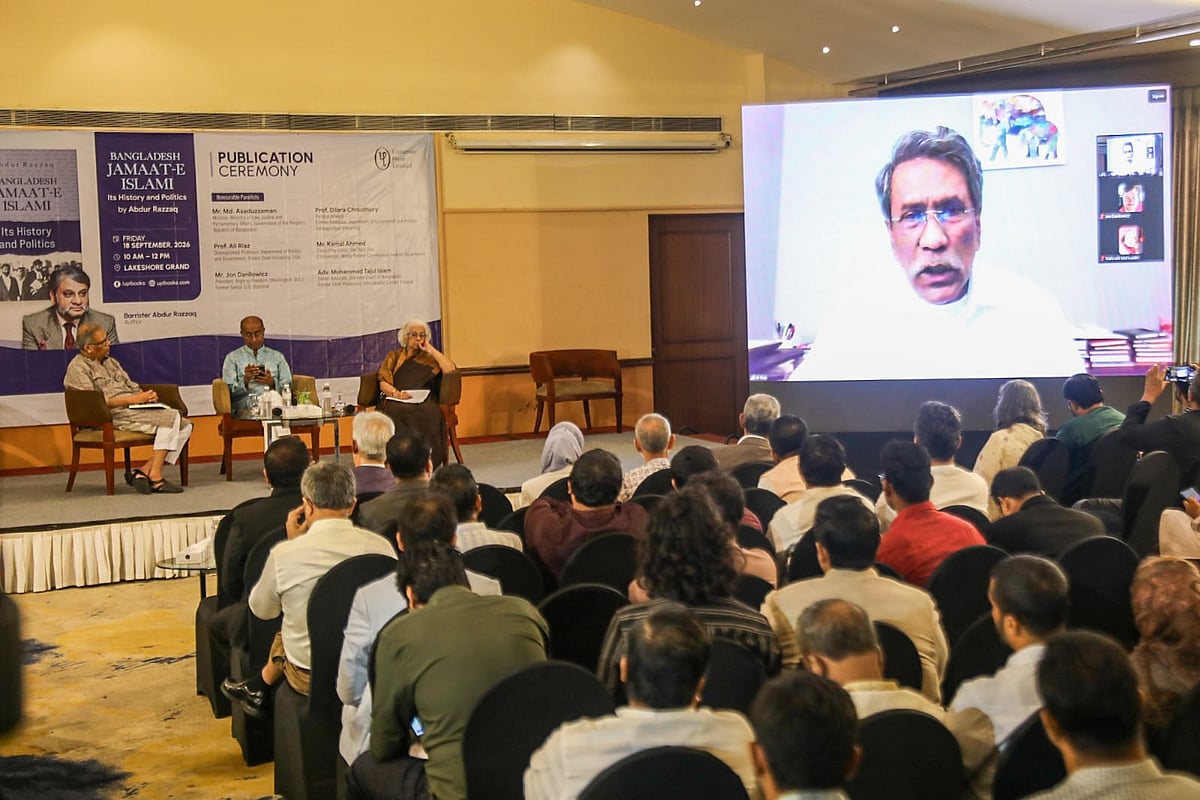
Professor Ali Riaz joins virtually the publication ceremony of the book titled “Bangladesh Jamaat-e-Islami: Its History and Politics”, authored by the late Barrister Abdur Razzaq, a former leader of Jamaat-e-Islami on 18 September 2026Prothom AloTo practice Islamist politics in Bangladesh, one must first contribute to building a democratic state and explicitly recognise popular sovereignty, stated Ali Riaz, Distinguished Professor at Illinois State University in the United States.
Professor Ali Riaz made these remarks on Friday morning while joining virtually the publication ceremony of the book titled “Bangladesh Jamaat-e-Islami: Its History and Politics”, authored by the late Barrister Abdur Razzaq, a former leader of Jamaat-e-Islami.
The event took place at a hotel in Gulshan, Dhaka. The book has been published by The University Press Limited (UPL).
Professor Ali Riaz observed, “If anyone wishes to engage in Islamist politics in Bangladesh, their primary imperative is to build a democratic state. To construct that democratic state, they must proceed by unequivocally recognising the principle of popular sovereignty. Once past mistakes and these foundational issues are addressed, these discussions can reach a fruitful resolution.”
Noting that Barrister Abdur Razzaq had sought to steer Jamaat-e-Islami towards reform, Ali Riaz highlighted that Razzaq repeatedly advocated for a public apology regarding the party’s controversial and adversarial role during the 1971 War of Independence.
Emphasising that resolving this controversy is in Jamaat-e-Islami’s own interest, the political science professor remarked that if Jamaat seeks to strengthen its position as a political party, Barrister Razzaq's book could serve as a roadmap for its leadership.
Touching upon the Liberation War, Ali Riaz asserted that there is no denying that an apology from Jamaat regarding its 1971 role is essential for both the party and the nation.
However, he cautioned that evaluating Abdur Razzaq's book solely through the lens of the 1971 role would do it a disservice. He noted that the fifth, sixth, and seventh chapters address crucial theoretical issues—raising significant questions about Jamaat's ideological stance, as well as state and civic sovereignty.
Furthermore, the author presents profound insights into leadership deficits, intellectual stagnation within the party, and whether its current organisational structure permits the emergence of visionary leadership, he added.
The book was officially unveiled during the event. Other speakers included Law Minister Md. Asaduzzaman, political analyst Professor Dilara Choudhury, former US Deputy Chief of Mission in Dhaka Jon Danilowicz, and The Daily Star Consulting Editor Kamal Ahmed.
Barrister Abdur Razzaq's two sons, well-wishers, and members of civil society were also present.