Justin Ling: On his latest trip overseas, Carney should warn Europe: Trump is coming for you next - Toronto Star
During my own recent Euro trip, I kept meeting people terrified by the U.S. president's autocratic turn yet blithe to the threat he poses to them.
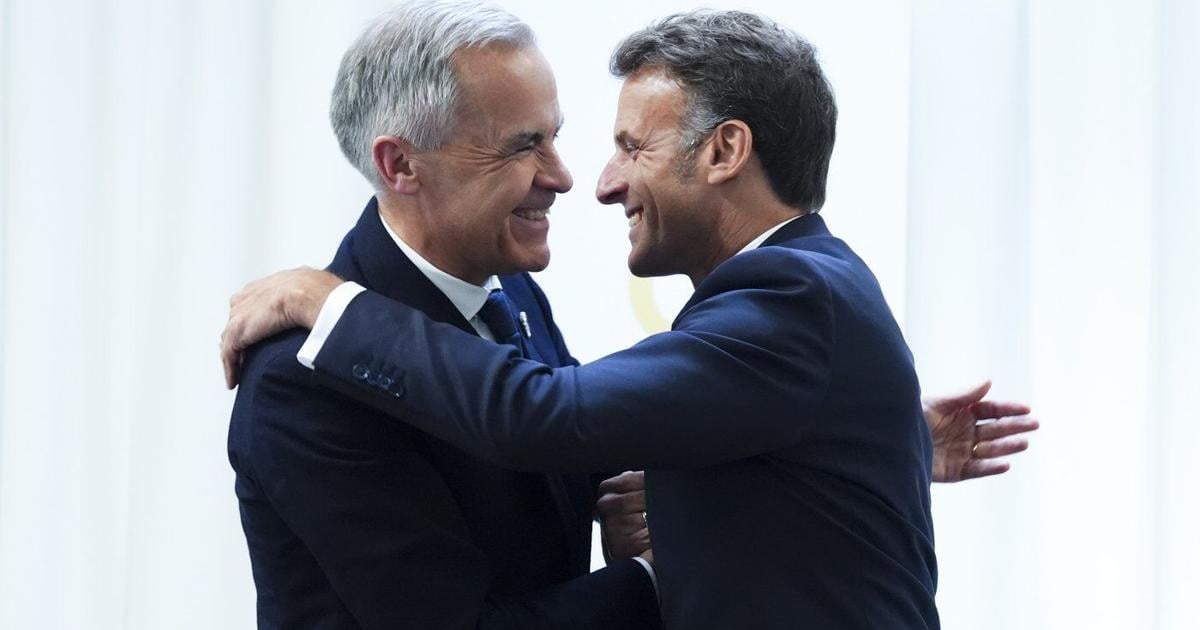
Prime Minister Mark Carney meets with French President Emmanuel Macron during the 8th European Political Community Summit, in Yerevan, Armenia, on May 4, 2026.
Justin Ling is a staff columnist for the Star and an investigative journalist based in Montreal. Reach him by email: jling@thestar.ca
Mark Carney’s latest Euro trip is something of a love-in — a cheery celebration among pals looking for new ways to strengthen their friendship.
But the prime minister’s charm offensive at the European Parliament in Strasbourg should be merely the opening move in a larger mission. Carney needs to be a bringer of bad tidings to the Continent: We were first, but you’re next.
I’ve just been crisscrossing Europe myself; I even got to visit the European Union’s other parliament, in Brussels. I was there on vacation, though I couldn’t dodge talk of the rupture heard around the world.
The Europeans are as bemused as we are by the new levels of disrespect U.S. President Donald Trump has shown Canada — “Lake America?” I heard again and again, in tones of increasing incredulity. The American tourists I met all had the same joke ready to go: “Are you accepting refugees?” And I heard an overwhelming amount of confidence in Carney himself (even if some believe he’s an import from the United Kingdom).
From the cafés of Paris to the bars of Budapest, I kept meeting people chuffed at the prospect of closer ties with Canada, terrified by Trump’s autocratic turn and yet completely blithe to the threat he poses to their nations.
This is only anecdotal, but a scan of European newspapers, politicians’ speeches and voters’ choices brings you to the same inevitable conclusion: the Continent doesn’t seem all that worried about what’s to come from the president. They are readying themselves for America’s withdrawal inward, no doubt, but they don’t seem to think Trump has his sights set on Europe.
The events of recent months have inoculated Canada against such naive optimism. Now we need to share some antibodies with our European friends — because Trump is absolutely making moves that will render Europe less liberal, less united and less democratic, and its leaders need to say so.
Trump, who famously hates spending time outside the United States, actually popped over to Europe this week, mostly to tour his new golf course in Ireland. While there, he offhandedly endorsed Irish unification and said he would be cutting tariffs on the Republic’s whiskey.
“Donald Trump, one of our own,” wrote Fionnán Sheahan, an editor for the Irish Independent, in cautious praise of the president. “Who’d have thought it?”
Now turn to Germany, where the far-right Alternative für Deutschland (AfD) recently scored a shocking electoral upset in the state of Saxony-Anhalt, the party’s best result to date. The AfD has been actively supported by billionaire oligarch Elon Musk and the Trump administration.
Or look north, where the head of the U.S. Arctic Research Commission, Thomas Dans, has become more and more active. Dans is a MAGA influencer with ties to Russian President Vladimir Putin’s government, per reporting from ProPublica. Appointed to his current role in December, he serves on a secret team tasked with taking over Greenland, and he has wasted no time turning his agency into a Trojan horse for Trump’s neocolonialist project.
Or look at Ukraine, a nation Trump has accused of being responsible for America’s energy crisis — an oil shock that was, in fact, brought on by Trump’s war with Iran. The president is removing American troops from European soil and continuing to threaten total withdrawal from NATO, all because the alliance didn’t bail him out of his Middle East misadventure.
Or witness plans for a right-wing media slush fund into which the White House, according to Reuters, intends to pump $4 million of taxpayer money. The U.S. State Department says the money is being used to deepen America’s transatlantic ties, but it’s clearly part of a broader funding package aimed at promoting populism in Europe.
It is easy to get lost in the sauce of this madness, but it’s part of a larger plot. You can connect it all back to an ominous line in Trump’s National Security Strategy, released late last year. It says the “growing influence of patriotic European parties” is viewed by the White House with “great optimism.”
We know what that means: Trump wants to weaken European liberals and establishment politicians and bolster nationalists, extremists and Russian stalking horses. He wants to fund efforts to dismantle the European Union itself.
This isn’t to say that Europe is totally hapless. Far from it: France is recalibrating its nuclear umbrella to cover the entire continent; Denmark and its allies are figuring out new ways to protect Greenland and Arctic waters; the EU has been doing more to make its defence and foreign policies independent of Washington. That’s all great.
But European leaders have utterly failed to explain to the voting public just what is at stake. Irate voters, meanwhile, are turning to Trumpian figures and their magic-bean promises. Right-wing extremist Marine Le Pen is the odds-on favourite to win next year’s election in France, a new far-right party is on the rise in Italy, the AfD is leading the polls in Germany, Nigel Farage’s xenophobic Reform Party is riding high in the U.K. and so on.
Trump’s hoped-for “patriot” surge in Europe is now in full swing. That’s bad news for Canada.
We should not be shy or modest about our role in countering this pan-European malaise. Carney’s visit to Strasbourg, plus the wonderful symbolism of his planned tête-à-tête with French President Emmanuel Macron on Saint Pierre and Miquelon, both signal Canada’s aggressive new strategy to forge a better relationship with Europe.
While there has been some confusion about what, exactly, that means, a source in Carney’s office tells me the scope of what can be achieved is “massive.” A Canadian negotiating team has been discussing possibilities with the Europeans this summer (something Carney never got around to telling the public about, I should note.)
The source mentioned two ideas: undersea cables and the Erasmus Programme.
Undersea cables may not sound terribly sexy, but they could be a remedy for Europe’s energy crisis. A planned energy link between Canada and Europe, the North Atlantic Transmission One Link, will move enormous amounts of clean, cheap Canadian electricity to Europe — electricity we are currently selling to the U.S. Even more modest plans, such as for fibreoptic cables to improve data flow between the continents, could be great news for tech companies on both sides of the Atlantic.
The Erasmus Programme is Europe’s student exchange, and Canadian participation could see tens of thousands of students travelling between Canada and Europe to study, perhaps portending a larger opening of work and study visas that would allow a better flow of smart people coming and going.
There is a long list of things Canada and Europe could do to better integrate our economies, societies and cultures — perhaps involving Canada as an “associate” member of the EU. That, in and of itself, is a helpful illustration of the positive aspects of liberalism and globalism. But establishing deeper ties with Canada should also impel Europeans to focus more on how dangerous the world has become and how foolish it would be to elect more MAGA fellow-travellers.
Canadians, after all, have managed to overcome some pretty rank polarization and cynicism ever since the true nature of Trump’s designs became clear to us.
Carney’s plain-speaking rebuke of America’s outlandish trade demands has been on heavy rotation in Europe, and it has earned high praise. An analyst friend of mine, a staffer in the European Parliament, lamented that leaders on the Continent are too timid to sum up the threat of Trump in a similar way, too afraid to provoke the president and his tariff sword.
But as Canada has learned, flattery and timidity get you nowhere with Trump. And Europeans should not have much faith that their trade deal with the U.S., widely seen as a feckless capitulation to American interests, will protect them.
The deal, signed last year, keeps U.S. sectoral tariffs in place on European steel, aluminium and copper. The EU also promised to buy US$750 billion in gas and energy while investing $600 billion into America by 2028. Brussles says European companies have “closed deals worth €230 billion of energy resources,” but whether the economic bloc will purchase anything close to what it promised is far from certain.
And even if the Europeans gave Trump everything he wanted, there would be no guarantee Trump wouldn’t turn around and extort them for more anyway — just as he did with Canada.
Europe, as chaotic and at cross-purposes with itself as it ever has been, would do much better to ready itself for the rupture now rather than waiting for Trump to come collect.
Error! Sorry, there was an error processing your request.
There was a problem with the recaptcha. Please try again.
You may unsubscribe at any time. By signing up, you agree to our terms of use and privacy policy. This site is protected by reCAPTCHA and the Google privacy policy and terms of service apply.
Opinion articles are based on the author’s interpretations and judgments of facts, data and events. More details
Justin Ling is a staff columnist for the Star and an investigative journalist based in Montreal. Reach him by email: jling@thestar.ca