Kamala Harris Backs Abdul El-Sayed in Michigan as Senate Polling Lead Grows - Newsweek
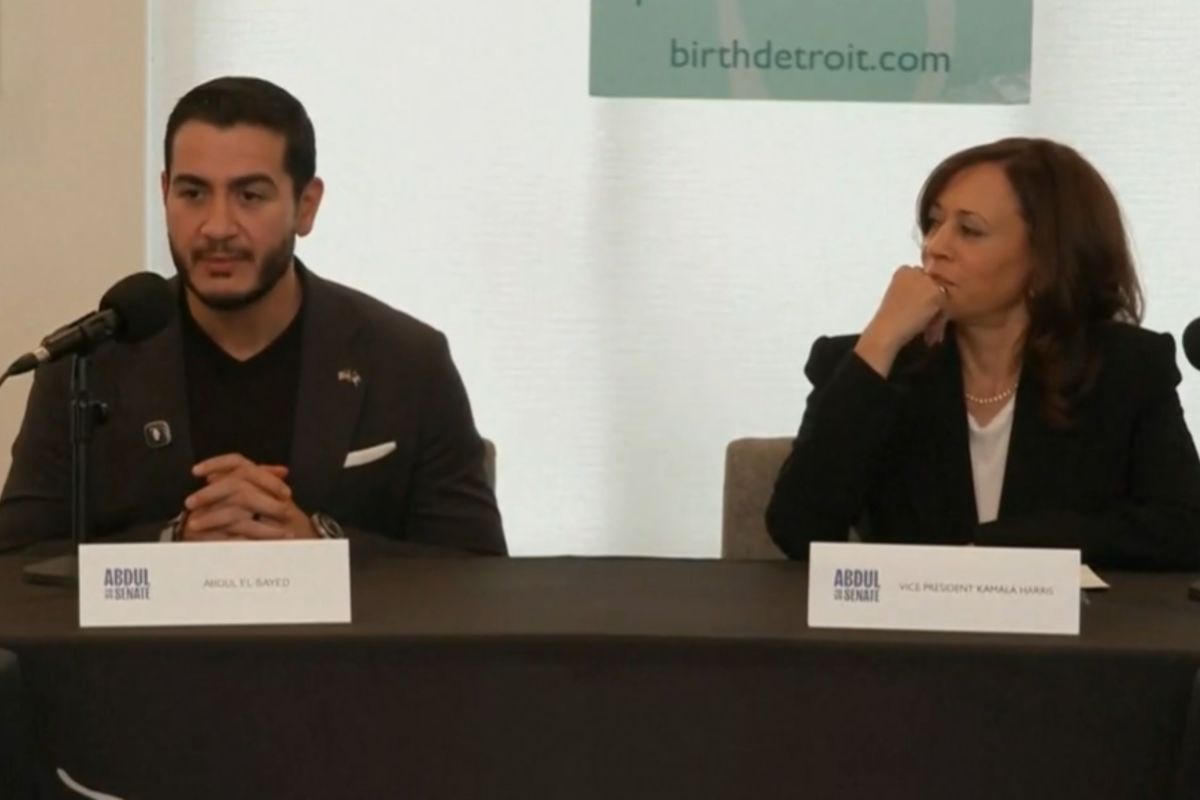
Former Vice President Kamala Harris campaigned with Democratic Senate nominee Abdul El-Sayed at a Detroit birth center Tuesday, the first public appearance together for Harris and El-Sayed since she endorsed him after his August primary win.
Seated at a roundtable on Black maternal health, Harris and El-Sayed made the case that the race against Republican Mike Rogers will determine whether the federal funding cuts hitting maternal care under the Trump administration continue.
"One in 12 women in America lives in a maternal care desert," Harris said. "Black women are three to four times more likely to die in connection with childbirth."
She tied the crisis to Trump administration policy, saying "Medicaid is the largest funder for maternity care in America" and that "Donald Trump cut Medicaid funding by a trillion dollars." Harris said Rogers "supported that cut through that big, bad bill."
El-Sayed made the case personal, recounting that his grandmother lost two infants and that his father watched two siblings die before age five. "Babies shouldn't die," El-Sayed said. "The measure of a society is what we do to empower people at that transition of life."
"We have 42 days left. What we do in those six weeks will make a huge difference," El-Sayed added, before thanking Harris for her visit and her leadership on maternity care.
Harris, who lost the 2024 presidential race to Donald Trump and is seen as a possible 2028 candidate, made the stop at a moment when Michigan is one of a handful of states Democrats see as key to retaining if they want to retake control of the Senate in 2027.
The seat is open after Democratic Senator Gary Peters announced he would not seek reelection.
The state is one of seven Senate races Cook Political Report rates a toss-up, alongside Alaska, Iowa, Maine, New Hampshire, Ohio and Texas, and one of five that Sabato's Crystal Ball and Decision Desk HQ still consider genuinely competitive.
Harris's visit came on the heels of one of El-Sayed's most positive weeks in polling, with a new survey showing his lead over Republican Mike Rogers in Michigan's U.S. Senate race widening six weeks before Election Day.
The poll, released Monday by the Suffolk University Political Research Center, gave El-Sayed a 7-point lead over Rogers, his largest margin in any September poll. Four other candidates combined for 3 percent, while 8 percent of voters remained undecided and 3 percent declined to answer.
The poll surveyed 500 likely voters in Michigan and has a margin of error of plus or minus 4.4 percentage points.
Newsweek has reached out to both campaigns for comment.
The Suffolk poll is the first in September to push El-Sayed's lead into the high single digits, with every other survey released since Labor Day showing him ahead by tighter margins.
David Paleologos, director of the Suffolk University Political Research Center, said El-Sayed's support among independent voters was a major factor in the poll. “Abdul El-Sayed is popular with unaffiliated Michigan voters,” he said in the poll's press release.
Paleologos also pointed to tariffs and data centers as factors in the race. He said dissatisfaction with recent tariffs on Canada and opposition to the possibility of new data centers in Michigan had helped shift independent voters toward Democrats compared with 2024.
“That, in addition to the unpopularity of recent tariffs imposed on Canada and voter unhappiness over the possibility of data centers in Michigan, has caused a massive shift to Democratic candidates among independents compared to 2024.”
The partisan split is almost absolute. Among voters who backed Donald Trump in 2024, Rogers leads El-Sayed 85 percent to 5 percent. Among Harris voters, El-Sayed leads 83 percent to 3 percent. The numbers closely track Michigan's 2024 presidential vote, when Trump narrowly carried the state.
Independents are a different story. El-Sayed leads Rogers 51 percent to 35 percent among them, making the bloc a key part of the race. There is also a sharp gender divide: Rogers leads among men 50 percent to 37 percent, while El-Sayed leads among women 56 percent to 31 percent.
The fault lines continue on union membership and gun ownership. El-Sayed leads 53 percent to 31 percent among union households, while the race is nearly even among non-union households, 45 percent to 44 percent. Among gun-owning households, Rogers leads 53 percent to 35 percent. In households without a gun, El-Sayed leads 63 percent to 22 percent.
Earlier polls from The Washington Post and George Mason University's Schar School of Policy and Government, as well as CNN and SSRS, gave El-Sayed 3-point leads. Emerson College, InsiderAdvantage and the Republican-aligned Trafalgar Group each found a tighter 2-point race.
Only one poll this month has put Rogers ahead. The Glengariff Group gave him a 1-point lead in a late-August survey conducted for The Detroit News and WDIV-TV.
Michigan is one of a handful of states Democrats see as central to retaking control of the Senate in 2027, and the seat is open after Senator Gary Peters announced he would not seek reelection.
Republicans are defending a 53-47 Senate majority this November, while Democrats need to flip at least four Republican-held seats without losing any of their own, making Michigan one of the cycle's most closely watched contests.
Ad spending reflects the stakes. More money has been spent in Michigan — almost $125 million since the August 4 primary — than in any other state where Republicans have a chance at gaining a seat, according to the advertising-tracking firm AdImpact. That is spending by El-Sayed, Rogers and allied groups.
El-Sayed, who ran for Michigan governor in 2018 and later led the state's health department under Governor Gretchen Whitmer, has positioned himself as part of a newer generation of Democrats willing to break with the party's establishment on economic messaging.
Rogers, who represented Michigan in Congress for 14 years before joining the FBI, has leaned on his federal law enforcement background and an endorsement from Trump to make the case that he can hold the seat in Republican hands.
El-Sayed has tried to draw a clear line between himself and Hasan Piker without fully cutting ties to the streamer, who hosted him nearly 100 times and campaigned with him during the primary.
"He disavowed it. So yes, America didn't deserve 9/11, but you know, to sit here and play gotcha politics with a dumb thing somebody said out of context that they disavowed themselves," El-Sayed said on NBC's "Meet the Press," referring to Piker's 2019 comment. "Of course it was a dumb statement and of course I think Hasan himself would say that was a dumb statement," he added.
Piker, for his part, has downplayed the political fallout from campaigning with El-Sayed. "I've already had the guy on, like, a hundred times on the broadcast. You know, I've fundraised for him. I like him a lot. I have my disagreements with him, too, of course," Piker said, adding that he had not anticipated how much scrutiny a joint appearance would draw.
"I had no idea that in the mindset of, you know, people in D.C., in the mindset of like, establishment media, doing a rally with a politician was apparently far more consequential than flying out to Dearborn and, like, working out with him."
The controversy comes as El-Sayed tries to unite Democrats after a bruising primary against Haley Stevens, which exposed divisions within the party over Piker, Israel and progressive economic policies.
Rogers is also reaching out to Democratic voters in Michigan. He has campaigned in Detroit, promoting a literacy nonprofit and a plan to build housing downtown. His campaign sees an opening in Wayne County, where about three-quarters of the population is Black. In this year's Democratic primary, Haley Stevens defeated El-Sayed in the county, which Rogers' campaign sees as evidence that some Democratic voters could be open to his campaign.
Rogers has also sought support from Jewish Democrats who oppose El-Sayed's criticism of Israel's military campaign in Gaza and have objected to comments he made after the March attack on Temple Israel. El-Sayed later apologized. Within 10 days of the August primary, Rogers headlined a fundraiser hosted by a prominent Detroit-area Jewish family that drew about 130 people, most of them Democrats.
Michigan Democratic Party Chair Curtis Hertel has dismissed Rogers' outreach to Black voters, saying he lacks ties to those communities. Rogers lost his 2024 Senate race by about 19,000 votes out of more than 5.5 million cast. His campaign is again looking to pick up support among Democrats and independents.
Michigan is going to be closely watched over the coming weeks and months ahead of the November 3 midterms due to its status as an evenly divided battleground. The Senate race is classified as a tossup by the Cook Political Report and Sabato’s Crystal Ball, while both forecasters put the governor’s race in the Leans Democratic column.