Kosovo's former President Thaçi convicted of war crimes at Hague court
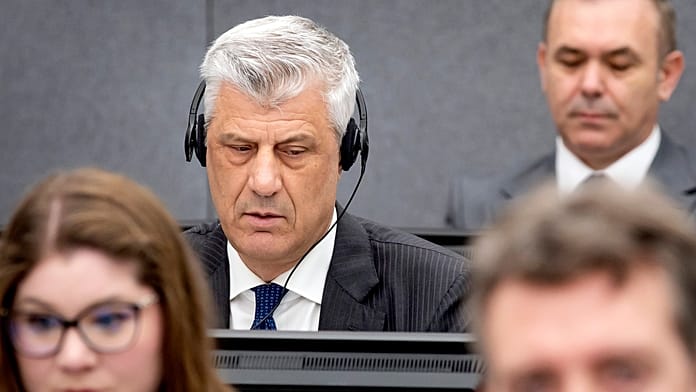
The Kosovo Specialist Chambers on Wednesday convicted former Kosovo President Hashim Thaçi to 25 years in jail on four counts of war crimes committed during his country’s war for independence from Serbia.
Thaçi, who was tried along with three other former guerrilla leaders, was convicted by a panel of judges in The Hague of murder, torture, cruel treatment and arbitrary detention.
Wearing a suit and tie, Thaçi stood in silence as Presiding Judge Charles Smith read out the sentence.
Judge Smith said Thaçi “used his position, leadership, authority and standing” to encourage the crimes, including the targeting of political opponents and civilians perceived as collaborators and traitors during their time in the Kosovo Liberation Army (KLA).
However, the presiding judge also stressed that the trial was “not about the legitimacy" of the KLA or its ultimate goal of securing independence for Kosovo, which at the time was a province in Serbia.
The long-awaited verdict came after a three-year trial of four former KLA figures: Thaçi, Jakup Krasniqi, Rexhep Selimi and Kadri Veseli. Prosecutors had requested 45-year prison sentences for each.
All four had pleaded not guilty. Krasniqi was sentenced to 25 years, Selimi to 13 years, and Veseli to 18 years in prison.
All four were determined to be criminally responsible for the arbitrary detention and torture of hundreds of people and 96 murders, according to the court.
The court also said Thaçi, Veseli, Selimi and Krasniqi had "contributed significantly" to a common criminal purpose targeting perceived opponents of the KLA's political and military goals.
The four were acquitted on six charges of crimes against humanity because the judges said the prosecutors failed to prove that crimes were committed as part of a widespread and systematic attack on civilians. They can appeal Wednesday's ruling.
“Throughout my life, I stood with the people of Kosovo defending freedom, life and dignity. I was always guided by the Western ideals of democracy, equality and justice,” Thaçi told judges in February at the end of his trial.
He told a Kosovo outlet in late August he expected a full acquittal.
The 58-year-old — who also served more than seven years as prime minister, followed by a two-year stint as foreign minister — saw his popularity soar when he helped oversee Kosovo's declaration of independence in 2008.
During a visit to the White House, then US Vice President Joe Biden hailed him as the "George Washington of Kosovo".
But his image was tarnished by a 2010 Council of Europe report alleging links to organised crime and serious abuses committed during and immediately after the war.
Critics also accused the former leader and his party of corruption and concentrating power among political allies.
But it was the wartime allegations that abruptly ended his presidency and left him detained in The Hague.
Throughout the trial, Thaçi's images have appeared on huge billboards across the country, and his supporters have regularly organised rallies in Prishtina.
Despite the seriousness of the charges, which include killings, torture, and other abuses, supporters of Thaçi expected him and his co-accused to be released, with preparations for a possible return already under way prior to the sentencing.
Countdown clocks were set up in city squares, ticking down to the verdict due to be delivered at 10 am in The Hague, while thousands gathered in Prishtina's main square to watch proceedings on a livestream.
Kosovo police prepared to secure large gatherings, while the US embassy in Prishtina has advised its personnel "to avoid all unnecessary travel in the vicinity of the demonstrations".
But once it became clear on Wednesday that the former president would remain in detention, the square was almost deserted within minutes.
"A terrible judgment for Kosovo, for our liberation war. It is a sad, unjust, undeserved decision," Kosovo Foreign Minister Glauk Konjufca told media outside the court.
The Kosovo Specialist Chambers (KSC), although based in the Netherlands and staffed by international judges, was established under Kosovo law specifically to prosecute crimes committed by KLA members during the war.
Before the court was established, earlier cases in Kosovo largely failed because of alleged witness intimidation and political interference.
Deeply unpopular from its foundation, the court's use of evidence supplied by Belgrade, which still refuses to recognise Kosovo's independence, has further inflamed accusations of political bias.
The staff at the EU-backed court are largely international due to fears about witness safety and security. In 2022, the court convicted two leaders of a Kosovo war veterans’ association for intimidating witnesses by publicising leaked confidential documents.
The four defendants stood trial for crimes committed against prisoners held at KLA detention facilities in Kosovo and neighbouring Albania, as well as the politically motivated murders of Serb, Albanian and Roma civilians.
The indictment spanned crimes committed during and just after the Kosovo war, which claimed some 13,000 lives and ended in a NATO intervention that pushed Serbian forces out in 1999.
Throughout the trial, prosecutors have tried to distinguish between the country's independence struggle and the men on trial.
In response, the men's lawyers have argued that the KLA lacked a strict command structure and the senior figures could not control or be held responsible for fighters who committed crimes.
Thaçi still faces a second trial on charges of obstruction of justice.
Thaçi resigned as president and surrendered to the court after his 2020 indictment. He has remained in detention in The Hague ever since, which will count as time served.