‘Lalaza’: The mysterious R5 substance giving schoolchildren a high — and explosive diarrhoea - IOL
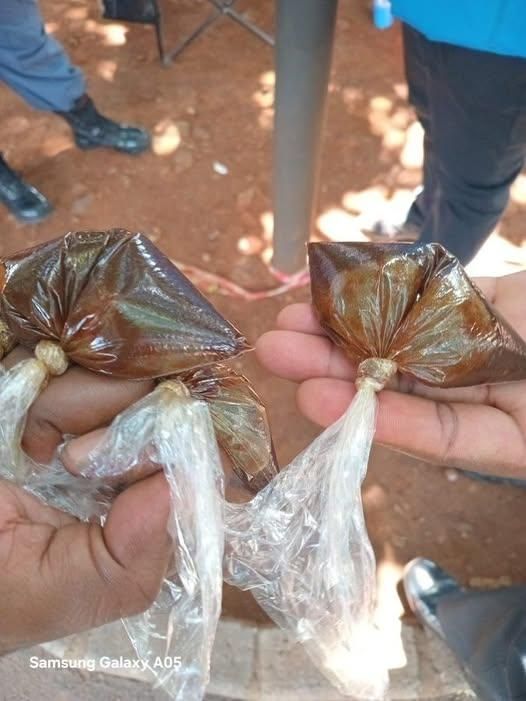
A mystery substance that schoolchildren are buying in R5 sachets and mixing into their school lunches — leaving some of them hallucinating and others with explosive diarrhoea — is believed by police to be nothing more than old cooking oil and leftover sauce.
The substance, known as "lalaza", is sometimes packed in small clear plastic bags tied at the top.
Residents in the south of Gauteng became concerned after children were reported to have behaved strangely after eating it.
They experienced hallucinations and sleepiness, while swallowing oil could also have a laxative effect, causing loose stools.
"Lalaza is a suspicious gravy-like substance sold in small plastic sachets to school kids," Gauteng police spokesperson Colonel Dimakatso Nevhuhulwi told IOL.
"Community members call it a drug because apparently kids act strange after consuming it, but had not been forensically classified as drug.
"Though no one has been arrested, the use and selling of this substance has decreased since the police, together with the education and environmental health departments conducted awareness campaigns and gave warnings in that regard."
Thirty items initially suspected to be “oil spice” were seized when police searched six schools in the Sedibeng region in southern Gauteng earlier this month.
The raids took place at Sehopotso Secondary and Botebo-Tsebo Secondary in Sebokeng, Residentia Secondary in Vanderbijlpark, Sapphire Secondary in Bophelong, and Mahareng Secondary and Lekoa Shandu Secondary in Sharpeville.
The education department said pupils were using the substance to get high.
Gauteng education spokesperson Onwabile Lubhelwana said police had taken a sample to establish what the substance was made of and how it was being distributed.
Lalaza first came to police attention in Sebokeng in February, when packets were confiscated from pupils at Boiketlong Primary School.
In March, pupils in Sebokeng reportedly experienced hallucinations, sleepiness and diarrhoea after eating it, prompting their parents to report the matter to police.
The substance was later found to be sold at high schools in Finetown and Lenasia, south of Johannesburg, where pupils allegedly mixed it into their school meals for flavour.
Health-e News reported that vendors bought 10 litres of leftover fast-food oil for R250 to R280 before repackaging it into small plastic bags and selling each for R5.
Candice Lambert, of the Wellness Dialogue Group, said it was important not to describe the practice as children experimenting with a "potent drug" while the ingredients were still being investigated.
"Until we know exactly what these children have consumed, we cannot assume that a psychoactive substance is responsible," she told IOL.
"In the case of lalaza, those rewards appear to be very tangible.
"It is inexpensive, accessible, reportedly makes otherwise plain school meals taste better, and for some learners selling it provides an opportunity to earn money.
"We therefore need to consider socioeconomic circumstances, food insecurity, accessibility and the school/community environment alongside adolescent development."
Lambert said adolescents responded strongly to novelty and immediate reward while the part of the brain governing impulse control and long-term consequences was still developing, and that seeing others consume something repeatedly without obvious harm gradually lowered their sense of the danger.
"For this reason, I would be cautious about framing the issue as children simply making 'bad choices'," she said.
"A more useful question is: what has made this behaviour so normal, accessible and rewarding that the potential danger no longer feels significant to them?"
The Gauteng education department said in June that its schools had recorded more than 4,600 violent incidents, over 4,100 cases of vandalism, close to 400 incidents of sexual misconduct and nearly 1,400 search and seizure cases over five years.
"These numbers are a concern as they indicate schools are under threat," the department said.
A study the department commissioned from the Matthew Goniwe School of Leadership and Governance profiled more than 1,300 schools and flagged 245 as high-risk, with substance abuse named among the main threats.
Parliament's portfolio committee on social development moved last month to rebuild the board of the Central Drug Authority, the body that oversees the country's National Drug Master Plan, after the previous board's term expired in March.
Committee chairperson Bridget Masango said an opinion from Parliament's legal services had found the minister had no power to extend the board's term once it had expired.
Basic education minister Siviwe Gwarube told Parliament in a written reply that the entire public school system had 761 social services professionals, and that appointing counsellors and psychologists was mainly a provincial responsibility dependent on provincial budgets.
In a written reply on June 24, Gwarube said schools should deal with drug incidents and refer affected pupils for treatment and psychosocial support.
Any searches, seizures or drug testing at schools had to be done lawfully and with regard for the rights, dignity and safety of pupils.
Gwarube said 32,367 officials, teachers, school governing body members and teacher assistants had completed national school safety training between April 2025 and March 2026.
"Learner safety cannot be achieved by schools alone," Gwarube said.