Life in the village on the edge of Russia where locals fear the next hybrid attack
Want to bookmark your favourite articles and stories to read or reference later? Start your Independent Membership today.
Residents across a Polish border community received three emergency phone alerts in a single day, warning that a missile or drone could enter from Ukraine.
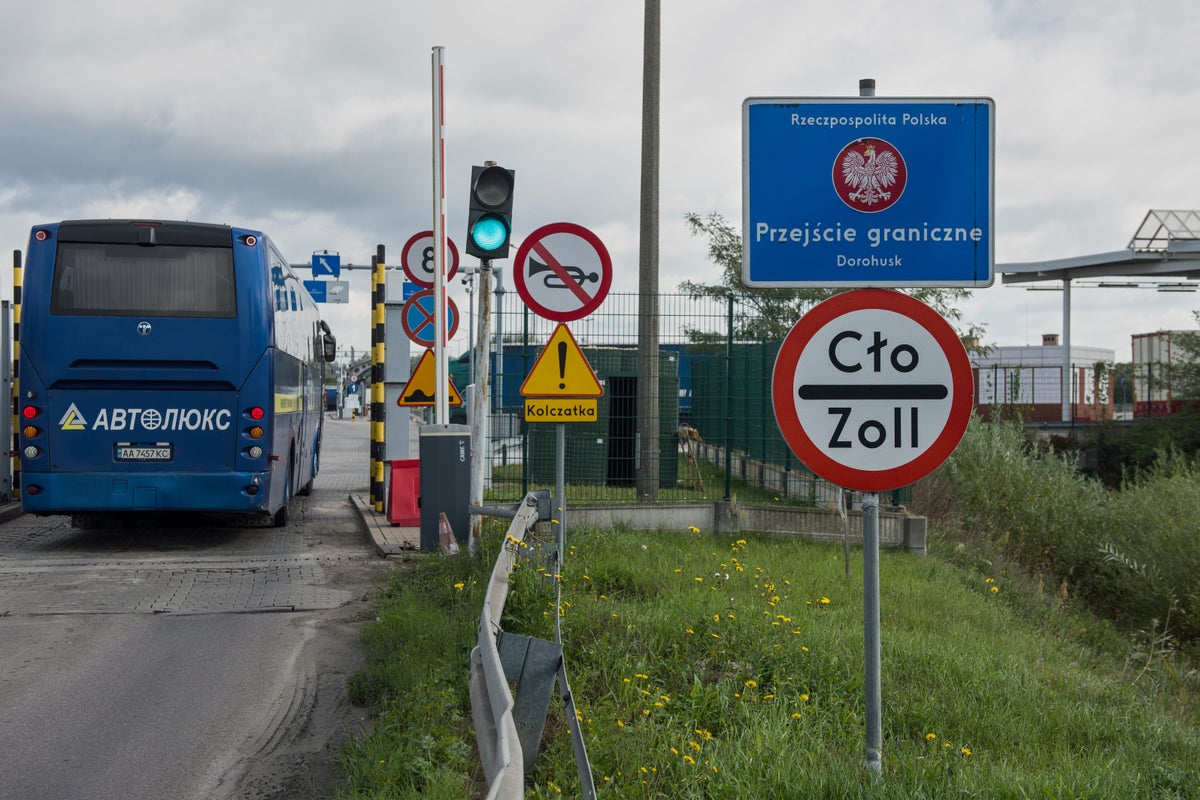
Above the eastern village of Dorohusk, vapour trails carved through the pale blue sky while military helicopters rumbled overhead. Just two kilometres (1.24 miles) away, traffic at the border crossing into Ukraine was halted three times, with personnel evacuated from the checkpoint on one occasion.
Thursday’s alerts and operational stoppages highlight an uneasy reality along Poland’s eastern frontier, where the war in Ukraine — now four and a half years old — feels increasingly immediate.
Apprehension had already mounted after two Russian drones detonated on the Ukrainian side of the Dorohusk-Yahodyn border post during the early hours of 13 September, causing explosions that were plainly audible inside Dorohusk.
“There is new restlessness and fear because you could hear those explosions very well on that night in our village,” said Wojciech Sawa, the Dorohusk mayor. “We had never had something like that before. This was the first time the sirens wailed.”
Polish Prime Minister Donald Tusk warned on Sept. 17 that Russia was planning hybrid strikes with drones or rockets on European countries supporting Ukraine, among them Poland, and regions bordering Ukraine would be especially vulnerable in the coming months. Other European leaders and intelligence services have shared his warnings.
In Dorohusk, people have lived in the shadow of the war for years. They watched Ukrainian refugees flee across the frontier in the early days of Russia’s 2022 invasion and, this July, had a Russian missile pass through airspace in eastern Poland before crashing some 90 kilometers (56 miles) inside the country.
But the recent drone attacks and the Polish government's efforts to prepare the population for further serious incidents have brought a new sense of apprehension — and also confusion — among locals.
Jarosław Wójcicki, the Dorohusk school’s director, said staff, including the school psychologist, now discuss with students “practically every day” how to stay safe.
The school had to be evacuated once so far and Wójcicki showed the two rooms in the basement of the school building where the kids took cover. Windows had been boarded up to avoid glass shards hurting anyone in case of an explosion.
“The older children had no problem at all, without showing any particular emotion,” the director said. "You could see a little fear among the younger children, but they were well looked after by their teachers.”
Wójcicki is responsible for the safety of hundreds of children who travel from nearby villages to attend school in Dorohusk, and his voice wavered as he described the enormity of the task.
Poland's Defense Minister Władysław Kosiniak-Kamysz visited the Dorohusk-Yahodyn border crossing on Sept. 22 and announced new air defense elements were being brought to the border region. He added that Patriot batteries were deployed in the two Polish regions bordering Ukraine, including the one where Dorohusk is located.
While the government’s warnings are stark, even communities closest to Ukraine are still catching up on civil defense preparedness.
“We are at the beginning of the process of building civil resilience and the resilience of the state to threats," said Mirosław Sokal, head of resident safety for the city of Lublin, 90 km west of Dorohusk. “We have to remember that over the past 40 years we thought we would be living in peace.”
He said, given the lack of more solid infrastructure, Poles should respect one minimal rule when there's an air threat: get inside and put two walls between them and any window.
Sawa, the Dorohusk mayor, said villagers typically live in individual homes with basements and that is the obvious place to hide in case of air threats. “If I don’t have a basement myself, my neighbor likely does,” he said.
But people on the streets of Dorohusk seemed more confused about their options in case of a real attack.
“For now, I sleep well at night, so I don’t really hear it," said Irena Popek, a woman in her 80s. If planes are coming, she said, her basement was not an option as it was flooded. "I simply have nowhere to hide, and that’s it.”
Renata Pastuszo, a local shop employee, said she continued working through the recent siren alarm because it's better to keep a positive spirit in front of the Russian threat.
Krzysztof Rulka, another resident, complained that alerts were now coming too often, leaving people confused about their meaning.
“If someone told me that a drone was going to explode in the center of Dorohusk, then I would know what to do,” he said. "But this kind of confusion — there's an air attack somewhere in Ukraine — well, what am I supposed to do now? Run to Germany?”