Lithuania plans key substation near Russia, fortified against explosive drones
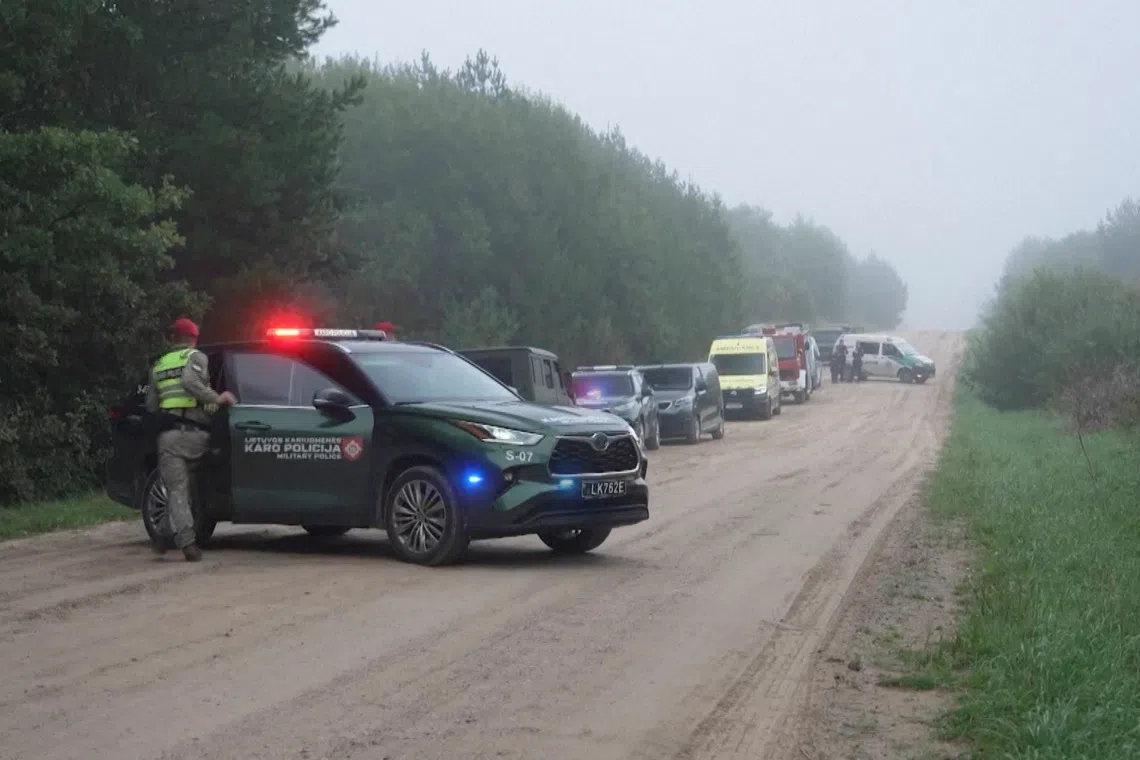
Military police and response vehicles stand parked near the site where, according to the Lithuanian national crisis management centre, a NATO fighter jet shot down a drone near Pratkunai village, Lithuania, September 15, 2026, in this screengrab from a handout video. Lithuanian Army/Handout via REUTERS
VILNIUS/WARSAW, Sept 22 - Lithuania is planning defences against military drones at a key future power grid substation linking the Baltic states with western Europe in an area that intelligence sources say Russia could target with a false flag attack.
The construction plans include fencing strong enough to resist an explosives-laden truck, sensors searching for possible tunnels dug by hostile actors, and concrete "sarcophagi" for transformers to withstand any drone attack, Litgrid CEO Andrius Semeskevicius told Reuters.
"Previously, when designing our grid, we planned for natural disasters. Now, we think about all possible hybrid and non-hybrid threats", he said in an interview.
The Gizai substation, to be built some 30 km (19 miles) west of the Russian exclave of Kaliningrad, will be the first new installation in the region since Russia launched its full-blown invasion of Ukraine in 2022. It will be part of a key grid section being built to ensure steady power supply to the Baltic states in case of a wider conflict.
Its route through a section of Poland and Lithuania squeezed between Russia and its ally Belarus -- the so-called Suwalki Gap -- has long caused security concerns within the NATO military alliance, of which Warsaw and Vilnius are both members.
Such concerns increased this month after a series of sabotage attacks against Germany's electricity grid that Berlin blamed on Moscow. Russia denied any involvement.
Intelligence sources told Reuters last month the region is worried about a false flag drone attack by Russia to test NATO unity. A false flag attack is an operation designed to deceive people about who is actually responsible for carrying it out.
The Gizai substation will be the crucial node of the interconnection with Poland called Harmony Link, which completes the connection of the Baltic grids with the rest of the European Union after they decoupled from Russia's grid last year.
"For Lithuania, this line is absolutely crucial, it's their lifeline if the system collapses," an official from a grid company in the region told Reuters, speaking on condition of anonymity. "The timing of this decision is linked to increasing tensions in the region and rising threats of sabotage."
The substation will be spread across a 35-hectare site, so a single hit from a military drone would only harm a limited amount of equipment, Semeskevicius said.
The distance of buildings from the fence means protection "in case someone throws a Molotov cocktail inside", he added.
"We are designing Gizai for a new reality... we are protecting ourselves from multiple Shahed drones, which could crash-land with 100 kilograms of explosives", he said.
Russia uses low-cost, long-range Shahed attack drones, designed by Iran, to wreak havoc on Ukrainian military infrastructure, cities and energy facilities, depriving millions of people of heating and lighting.
"We cannot use simple concrete, it needs to be custom-made, for stronger resistance", said Semeskevicius. The right concrete has threads of plastic to reinforce it and prevent it from crumbling, he said.
The substation includes several duplicate units of key equipment, for example, so it can keep operating if one is damaged or destroyed. Replacing the bespoke equipment could take years.
"You cannot down a Shahed drone, or a drone with optical cable attached. So we need reinforced-concrete sarcophagi around equipment", said Semeskevicius.
The equipment needs to be artificially cooled down inside the sarcophagi, which adds to the cost.
"Without all this, we might not have power at all", he said.
Lithuania's military is advising Litgrid on physically securing critical energy infrastructure and resistance to modern threats, officials told Reuters.
Later this month, Lithuania will ask the EU to cover at least half of the Gizai costs, Energy Minister Lukas Savickas told Reuters.
Litgrid says the secured substation will cost at least €48 million more than planned earlier. The price could increase further if "geopolitical circumstances" worsen.
"Our consistent position is... these costs should not fall solely on our shoulders," Savickas said.
A senior Polish official echoed that view, saying countries that border Russia risk losing competitiveness if their companies are stuck with the bill for additional security.
Harmony Link cannot become "the most costly interconnection in Europe", Wojciech Wrochna, Poland's deputy energy minister in charge of strategic energy infrastructure, said, calling for the EU to boost financing of the grid security measures.
"Our European partners need to change their mindset," Wrochna told Reuters. "The issue extends beyond Harmony Link. It affects the entire energy system."
Last year the Baltic states and Poland asked the EU for €382 million to help secure key parts of the existing grid but only €112 million was granted.
The European Commission did not reply to Reuters' request for comment. REUTERS