Macklemore Responds After Ed Sheeran Tour Drops Him: Controversy Explained - Newsweek
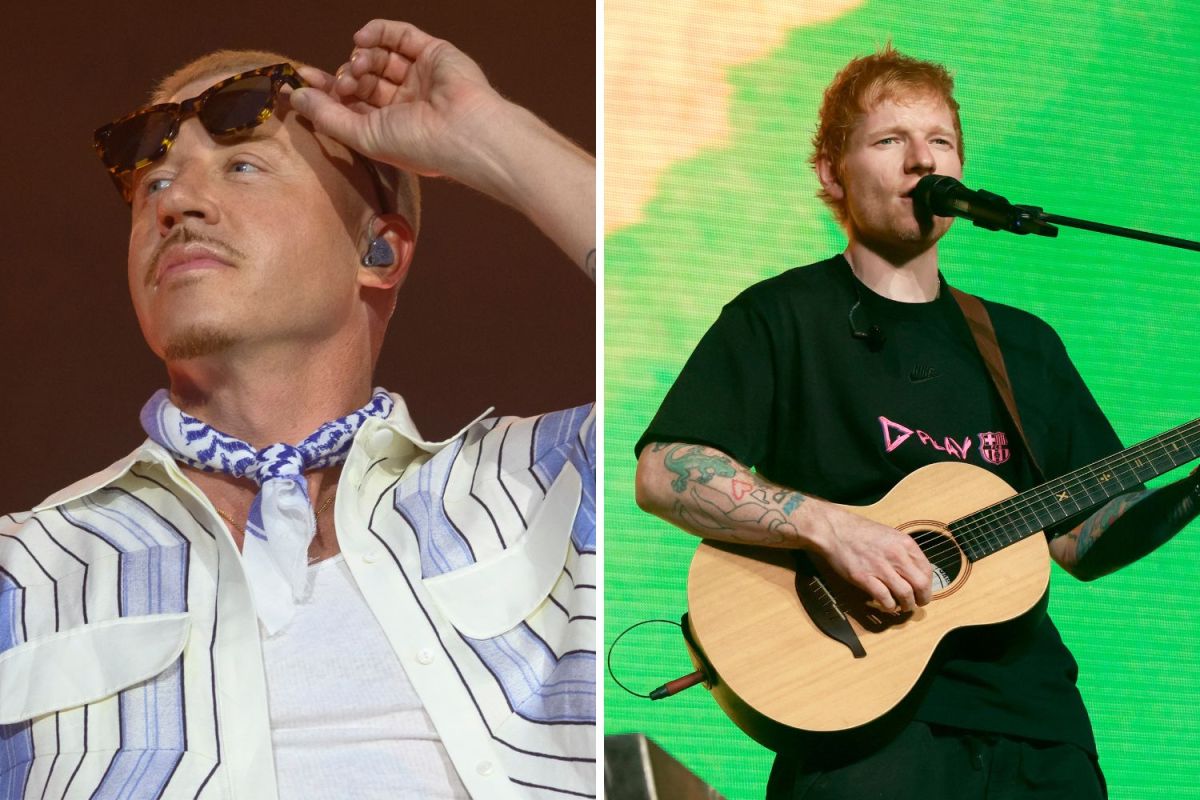
Rapper Macklemore is speaking out after being removed from the remaining U.S. dates of Ed Sheeran's Loop Tour, a decision that followed days of backlash over pro-Palestinian remarks he made onstage.
In a lengthy Instagram statement, the rapper pointed to New England Patriots owner Robert Kraft as the driving force behind his exit, alleging Kraft pressured other stadium owners into refusing to host him, rather than attributing the decision solely to Sheeran or to Pink, who had separately criticized his comments.
"I'm not sure how to start this. So I'm going to speak from the heart and share the truth. Ed Sheeran and his team have made the decision to remove me from The Loop tour," Macklemore wrote.
Macklemore, whose legal name is Ben Haggerty, said Sheeran told him Kraft had called to say he would be barred from Gillette Stadium, which Kraft's company owns and where the tour is set to stop later this month, and that Kraft had then brought other stadium owners into an ultimatum against keeping Haggerty on the bill.
"Ed told me that Kraft said I would not be allowed to perform in his stadium. Ed also told me that Kraft had rallied some of the other stadium owners and collectively they gave him an ultimatum: if Macklemore stays on the tour, you will not be allowed to play in our venues," he wrote.
Macklemore also detailed private talks with Sheeran, calling him a friend. He said Sheeran cited feedback that the words "Free Palestine" and the Palestinian flag had upset people he'd spoken with, while publicly maintaining a neutral stance. Macklemore said he pushed back on that neutrality and clarified he does not view himself, Sheeran or Pink as victims in the dispute, while expressing hope the friendship endures.
"I hope this isn't the end of my relationship with Ed. Thirteen years of friendship doesn't disappear because of one painful disagreement," he added.
Kraft addressed Macklemore's account directly in a statement Monday, confirming his role in the decision but framing it as a response to antisemitism rather than to Macklemore's advocacy.
He said Gillette Stadium has "a longstanding commitment to providing a welcoming environment for all guests" and does not allow itself to be "a platform for hate speech." Citing what he called a "broader history of antisemitic rhetoric and imagery" from Macklemore, Kraft said he determined the rapper's participation in the September 25 and 26 shows would cross that line.
Kraft said the decision was "not about diminishing the suffering of innocent Palestinians or denying anyone the right to advocate on their behalf," and said he agreed with Macklemore that too many lives had been lost. But he argued that advocacy "should not come at the expense of the Jewish community" or obscure the role of Hamas, which he described as a designated terrorist organization in the U.S. and other countries.
He also pointed to his own history of directing resources to Palestinians as evidence that support for Palestinians and opposition to Hamas and antisemitism "should not be mutually exclusive."
Kraft also said he has spent much of the past decade focused on combating antisemitism and felt a responsibility to act when he believed that line had been crossed. He said he has "tremendous respect" for Sheeran and his music, and closed by saying he would welcome the chance to sit down with Macklemore to discuss "the facts," adding that their shared goal was "peace for all people, an end to suffering, and an end to all hate."
Macklemore made the remarks September 4 while opening for Sheeran at MetLife Stadium in New Jersey. "Two words that are very near and dear to my heart: Free Palestine," he told the crowd, adding calls for Cuba, Congo, Sudan and Iran, and calling U.S. Immigration and Customs Enforcement (ICE) a "terrorist organization."
He performed "Hind's Hall," a 2024 song about pro-Palestinian protesters who occupied a building at Columbia University, as images from Gaza played on screen.
The Israeli‑American Council (IAC), representing more than 150,000 Israeli‑Americans, launched a petition calling Macklemore’s performance “a one‑sided political agenda” and demanding Sheeran clarify whether the political content was approved.
The singer publicly addressed the backlash over her repost criticizing Macklemore’s pro-Palestinian remarks at Ed Sheeran’s MetLife Stadium shows, issuing a lengthy statement clarifying her views on Israel, Gaza and why she believes her earlier posts were misinterpreted.
Her initial repost, a post from StopAntisemitism that accused Macklemore of spreading “anti-Israel propaganda” and said Jewish fans were “owed apologies” and refunds, along with what she called “snarky memes,” ignited accusations of prejudice and calls for boycotts across social media.
Pink said she was not calling for Macklemore to be fired. She said his comments, delivered in front of families as images of the war were displayed onstage, left her “scared” as a Jewish mother and that she should be able to say so “without being told our fear is just propaganda.”
Macklemore has called Sheeran a friend of 13 years and "a brother."
In his statement, he said the two spoke by phone multiple times before his removal, and that the conversations were difficult but "rooted in love and respect." He said Sheeran told him "Free Palestine" and the Palestinian flag had been described to him as hurtful, while Sheeran kept a public "I don't take sides" stance.
Macklemore said he hopes the friendship survives.
I'm not sure how to start this. So I'm going to speak from the heart and share the truth. Ed Sheeran and his team have made the decision to remove me from The Loop tour.
But before I get into it, I want to say something that should be obvious. In this moment I think it matters. I am not a victim. Ed Sheeran is not a victim. Pink is not a victim. We have careers, money, opportunities, safety and audiences around the world. Whatever consequences any of us face for what we say, we get to go home to our families.
Ed is my friend. I've known him for 13 years. We've shared late nights, studio sessions and stages. He has this infectious magic about him that I've grown to love. I consider him a brother. And because of that, we've had some difficult conversations this past week. The type of talks rooted in love and respect for one another that still end in a place of fundamental disagreement. Nothing I'm writing here is out of spite or because I want to tear down his character. But as I told Ed multiple times on the phone, our friendship can't change my responsibility to tell the truth about what happened.
What I said at MetLife I have been saying on stages around the world for almost three years. So why is it an issue now? Because now I'm sharing a stage with one of the biggest artists in the world, in some of the biggest stadiums in America. At a certain level of exposure, "Free Palestine" becomes too much of a risk. If I kept doing the shows, saying Free Palestine, with Ed implicitly supporting it, the crowd getting loud and showing undeniable support for Palestinian liberation, what artist might speak out next? The stage becomes resistance. Maybe that's why this time it became so important to silence me.
Ed was in a f***** up position. He knew it. His typical apolitical stance was being challenged in a way it never had been before. He told me that the words "Free Palestine" and the image of the Palestinian flag were hurtful to a lot of people he spoke with. I told him that if those words were more offensive than tens of thousands of Palestinian children being killed by Israel, then there was a fundamental disconnect between where those people stood and where I stood. But he couldn't get past his public facing, "I don't take sides."
Last Monday, in the middle of all the media attention surrounding Pink and what I said at MetLife, Ed told me that Robert Kraft called him. We were scheduled to play Gillette Stadium later this month, which is owned by the Kraft Group. Ed told me that Kraft said I would not be allowed to perform in his stadium. Ed also told me that Kraft had rallied some of the other stadium owners and collectively they gave him an ultimatum: if Macklemore stays on the tour, you will not be allowed to play in our venues.
And I get why people don't. Taking a side can cost you. Money, brand deals, sponsorships, festivals, private shows, relationships and access. I've lost all of those things. But there is no neutral position between the oppressor and the oppressed. When one side has the bombs and bottomless financial and military support from America, refusing to take a side doesn't leave you in the middle.
The victims are the Palestinian people. The men, women and children who have been killed, starved, displaced and forced to live through unimaginable violence. More than 20,000 children have been killed in Gaza alone. People are being killed today, and people will be killed tomorrow. I want to make sure that as I tell this story, we don't lose sight of that.
Who is winning the internet, who is getting canceled, who gets to play the stadium and who doesn't, all of it becomes so small when held against what we are actually witnessing in Gaza and the West Bank. An entire people being displaced, starved and killed while the world debates which words we are allowed to use to describe it, how those words make us feel, and whether our discomfort matters more than the people living through a genocide.
And one of the most effective ways to enforce that silence has been to weaponize the accusation of antisemitism. Antisemitism is real. And that is exactly why the word matters too much to be used as a shield against criticism of the Israeli state. When criticizing Israel, opposing Zionism or saying "Free Palestine" gets conflated with hatred of Jewish people, it doesn't protect Jewish people. It protects Israel from accountability.
When my brother Omar was doing the subtitles for the video I posted from MetLife, I thanked him. He told me there's a phrase in Arabic: لا شكر على واجب
"La shukra ala wajeb." There is no thanks for a duty.
That stayed with me. Because that's what this has become for me and millions of others around the world. A duty. Not something deserving of praise or gratitude. Not brave. Human.
I didn't need 10 shows from Ed. I needed 2. Two chances to stand in front of 90,000 people and say the words that somehow became too dangerous to say.
But if those words cost me the stage, while turning the conversation back to Palestine, then it was the most successful tour I've ever been on.
I hope this isn't the end of my relationship with Ed. Thirteen years of friendship doesn't disappear because of one painful disagreement. I hope we both continue listening, studying what is happening in Palestine and wrestling with what neutrality means in a moment like this. My door will always be open to continuing that conversation.
Contact Newsweek editors on this story: Jenna deJong and Sam Wilson.