Map of Districts Where Democrats Are Bullish About Flipping GOP House Seats - Newsweek
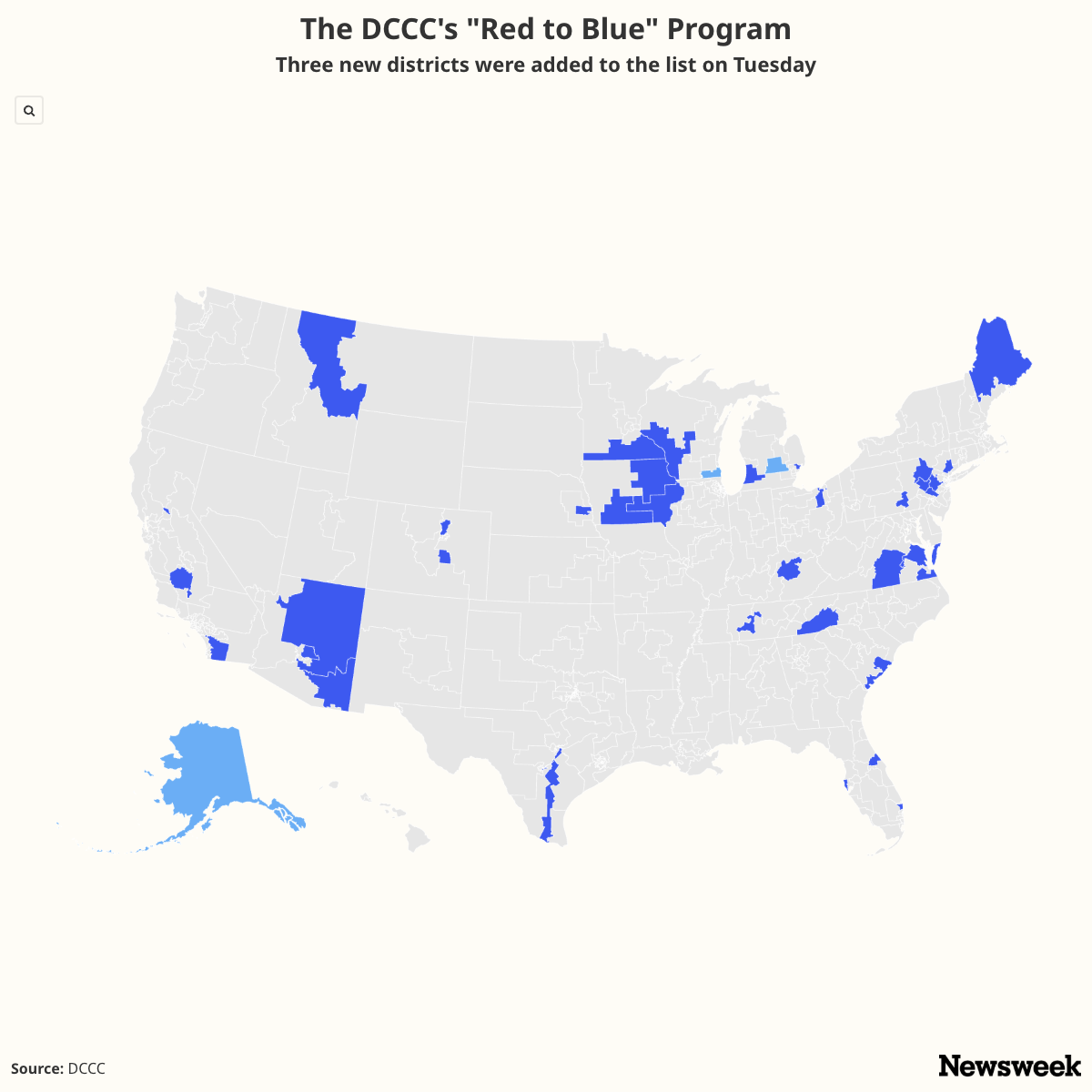
Democrats on Tuesday expanded their battlefield in the fight for control of the House, with the Democratic Congressional Campaign Committee (DCCC) adding three more GOP-held districts to its battleground “Red to Blue” program.
The move comes amid growing confidence among party strategists that favorable political conditions and strong candidates have created new opportunities to flip Republican seats. The expansion broadens the party's map of targeted pickups, revealing growing optimism among Democrats about their chances in districts previously not considered to be top-tier battlegrounds. Democrats need to add just four seats to take the majority in the lower chamber.
Kyle Kondik, managing editor of Sabato’s Crystal Ball, told Newsweek in an email, “Overall, Democrats could win the House without any of these [three new] districts, and we continue to favor them to win the majority in November.”
"These three additions show Democrats playing defense on hostile turf, not building a wave," Matt Klink, owner and president of Klink Campaigns, told Newsweek. He continued, "Adding them to the program pumps more national money into these races, an indicator that they need 'extra' attention."
Midterm elections are often a test of the party in power and the president's party has traditionally lost seats. Democrats rode a blue wave to pick up 41 seats in 2018, during the midterms of President Donald Trump's first White House term. Republicans currently hold a narrow majority in both the House and Senate, and Democrats hope to flip both chambers.
Ultimately, a small number of competitive districts will likely decide control of the House. A party needs to hold 218 seats to have control of the chamber.
“The three candidates added to our Red to Blue program today represent the very best of their communities—unbought, practical leaders who know what it takes to win in tough districts,” DCCC Chair Representative Suzan DelBene, said in a press release. The program provides candidates with organizational and fundraising support.
According to the DCCC, “Candidates earn a spot in the program by surpassing aggressive goals for grassroots engagement, local support, campaign organization, and fundraising.”
The latest additions to the Red to Blue program are Alaska's at-large district, Michigan's 7th District and Wisconsin's 1st District.
In Alaska, the DCCC is backing independent candidate Bill Hill, a Dena’ina Athabascan commercial fisherman, union construction worker, and educator. Democrats are trying to flip the seat currently held by incumbent Republican Nick Begich III.
The Cook Political Report and Sabato’s Crystal Ball rate the race as likely Republican.
Kondik told Newsweek in an email that the Alaska race is a “longer-shot Democratic target,” and noted that Hill is running as an independent.
In Michigan, which also features a pivotal Senate race this cycle, Democrats added William Lawrence to the Red to Blue program. Lawrence, a co-founder of the Sunrise Movement, is challenging Republican Representative Tom Barrett in the 7th District.
His candidacy initially raised concerns and hesitancy among some Democrats due to his progressive stances and now-deleted social media posts. The Congressional Black Caucus's PAC said in a July X post that "Anyone supporting William Lawrence (@WeWill2026) should denounce his hateful remarks and withdraw their support. Michiganders deserve better."
Kondik said, “MI-7 is one of the most closely-divided districts in the country, but it also features one of the Democrats’ most left-wing nominees in a key race this year, William Lawrence.”
Kondik continued, “National Democrats surely would have preferred a different nominee, and the fact that it took a while for him to be added to this list is a testament to that.”
The National Republican Congressional Committee (NRCC) spokesperson Mike Marinella focused on Lawrence in his reply to Newsweek, saying “The DCCC endorsing a socialist felon who wants to defund the police, ban fracking, and raise your taxes tells you everything you need to know about the state of House Democrats.” Lawrence was arrested in at a 2013 protest at an Enbridge Energy pipeline worksite, where he and others attached themselves to a piece of equipment and were later removed by the police.
"I stand by the righteousness of that action," Lawrence told reporters in August. "I'm proud to have taken that stand."
Marinella continued, “The DCCC is scraping the absolute bottom of the barrel with radical activist candidates who couldn’t win a student council race, let alone a seat in Congress.”
Klink added, "Establishment Democrats spent the primary running from Will Lawrence's Sunrise Movement resume and his arrest record, then rushed him the DCCC's blessing the moment he won. Scrubbing hundreds of old posts calling for abolishing the police and prisons isn't distancing, it's witness protection. This shows that Democrats will embrace anyone who isn't a Republican - socialists, anti-public safety independents...anyone."
Alex Patton, owner of Ozean Media, told Newsweek in reference to Lawrence and his prior record, "to win control as a party, you go where the numbers take you and if they lead to imperfect candidates so be it. You push your chips in."
Sabato’s Crystal Ball and the Cook Political Report both rate the race as a toss-up.
Mitchell Berman, an emergency room nurse, is challenging four-term Republican Representative Bryan Steil. The southeastern Wisconsin district, once represented by former Republican House Speaker Paul Ryan, has long favored the GOP, but Democrats believe the race is more competitive this year.
Sabato’s Crystal Ball and the Cook Political Report both rate the race as likely Republican.
Democrats' chances of taking the majority in the House have improved among prognosticators with the election now less than 50 days away. Earlier this month, the updated Fox News Power Rankings show Democrats favored in 212 districts, up one from July, compared with 206 for Republicans, leaving 17 toss-up races that could ultimately decide control of the House.
Several aggregators put Democrats in the lead for the House, with the Silver Bulletin showing Democrats with a 49.1 percent to 41.7 percent advantage over Republicans.
Patton added, "One would expect new opportunities to open up given the troubles in the Gulf, inflation, and historic low Presidential approval ratings. These issues are anchors around the GOP's neck."
An Economist/YouGov poll of 1,461 registered voters found that 44 percent would back the Democratic candidate in their district, while 39 percent would back the Republican candidate. Ten percent were unsure, 3 percent would back someone else, and 4 percent said they would not vote. The poll was conducted between September 11 and September 14 and has a margin of error of plus or minus 3.3 percentage points.
A New York Times/Siena poll of 1,503 voters found that a majority, 51 percent, said they would vote for the Democratic candidate in their district, while 43 percent said they would vote for the Republican candidate. The poll, which found Democrats with a 9-point lead, was conducted between September 8 and September 13 and has a margin of error of plus or minus 2.9 percentage points.
A Reuters/Ipsos poll of 1,167 adults conducted August 28 to August 31 found that more Democrats are enthusiastic about voting in the elections, which could boost turnout for the party, while among independents, 36 percent said they would vote Democratic and 22 percent Republican in the midterms. The poll’s margin of error was plus or minus 3.3 percentage points.
An August YouGov/Economist survey showed that in a generic congressional vote, 36 percent of U.S. adults would pick the Democratic candidate compared to 31 percent who would pick the Republican candidate. One percent said other, 8 percent said not sure, and 23 percent said they would not vote. The poll surveyed 1,592 U.S. adults from August 28 to August 31 and had a margin of error of plus or minus 3.5 percentage points.
Democrats are also favored to win the House in prediction markets. As of Tuesday, Kalshi gave Democrats an 85 percent chance of controlling the chamber, compared with 15 percent for Republicans, while Polymarket gave Democrats an 88 percent chance and Republicans 12 percent.
Despite Democratic optimism, Republicans contend they remain well positioned to hold the House and expand their majority. The NRCC has broadened its "MAGA Majority" program, which similarly backs candidates in battleground districts, in recent weeks.
“House Republicans have an incredible bench of proven leaders who are ready to take the fight to the radical socialists. These candidates have what it takes to win, deliver for their communities, and help us keep America on the path to prosperity and security,” NRCC Chairman Richard Hudson said.
Contact Newsweek editors on this story: Jason Lemon, Geoffrey Rowland, Gray R. Thomas.