
Map Shows Donald Trump’s Approval Rating in Midterm Campaign Stops - Newsweek
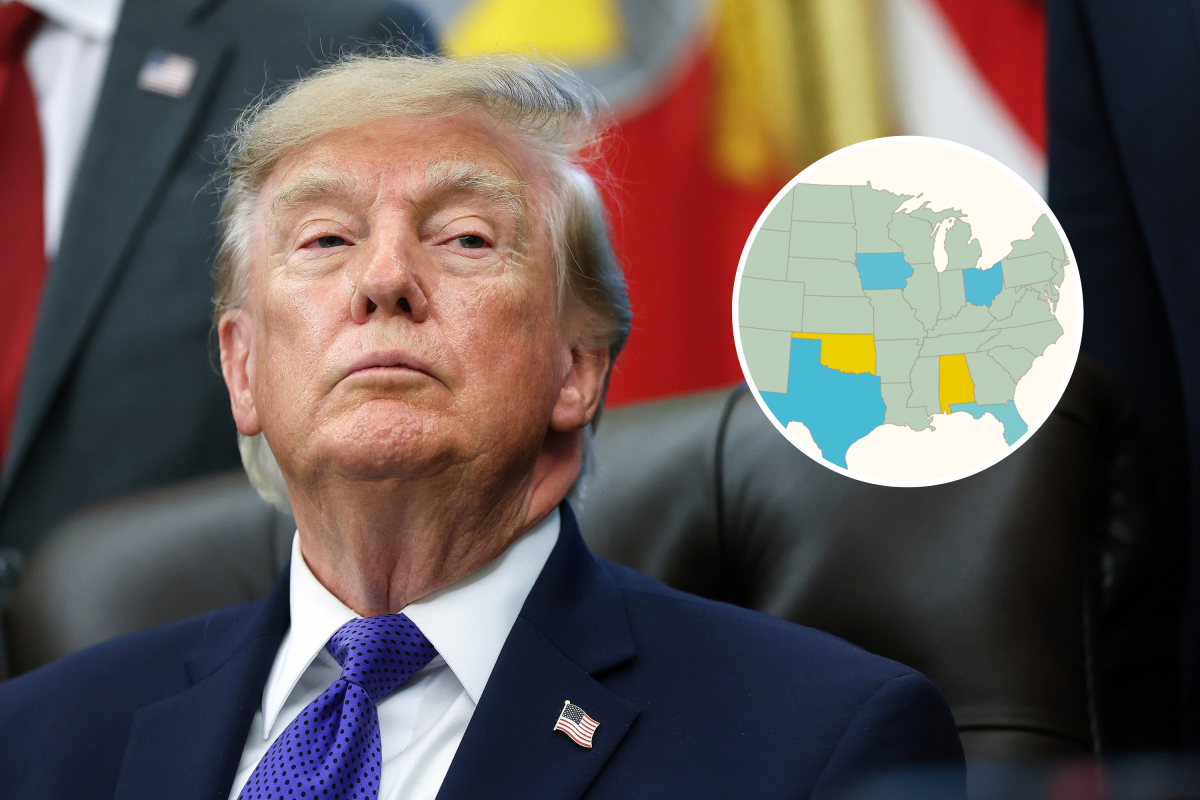
President Donald Trump is preparing to campaign before November’s midterms across seven states where his net approval rating has fallen sharply since the beginning of his second term and currently ranges from plus 5 to minus 20, according to national polling data.
The president is set to visit Alabama, Alaska, Florida, Iowa, Ohio, Oklahoma and Texas, according to reporting by POLITICO and The Associated Press, as Republicans seek to boost turnout and defend increasingly competitive territory in the campaign’s closing stretch.
Trump is expected to hold a rally in Durant, Oklahoma, on October 1, to support his endorsed Republican gubernatorial nominee Mike Mazzei, who faces Democratic state House Minority Leader Cyndi Munson in the race to succeed term-limited Governor Kevin Stitt.
He is then expected to visit Mobile, Alabama, the following day, POLITICO reports, with an event aimed at boosting Republican Rhett Marques; travel to Vandalia, Ohio, on October 3 to support Senator Jon Husted; campaign for Ken Paxton in Texas and Senator Dan Sullivan in Alaska; and make further appearances in Iowa and Florida, where details have not yet been made public.
It points to a broader push into Republican territory as the party grows more concerned about defending once-reliable states in the closing weeks of the midterms.
Five of the reported stops on the president’s midterm campaign tour are in states where more registered voters disapprove than approve of his performance, Civiqs rolling tracker data shows, complicating his effort to help Republican candidates in places he carried comfortably in 2024.
Civiqs’ rolling tracker shows that, as of September 28, Trump remained above water in only Alabama and Oklahoma among those seven states he plans to visit.
Although presidential approval does not predict the outcome of an individual race, because candidate quality, turnout and local issues can outweigh national opinion, the comparison does show that Trump will be campaigning in states offering a markedly less favorable environment than when he returned to office.
Trump said earlier in September that he planned to campaign in 35 competitive races before Election Day.
His emerging itinerary shows Republicans defending far more than the traditional battlegrounds.
Closely watched Republican Senate, House, and gubernatorial campaigns could benefit from Trump’s turnout operation while inheriting the political liabilities reflected in his ratings.
Trump has asked voters to "pretend that I’m on the ballot," but his low approval ratings make that a risky wager, potentially energizing opponents as much as his Republican base.
The campaign swing is expected to begin October 1 in Durant, Oklahoma. Tentative appearances in Mobile, Alabama, and Vandalia, Ohio, would follow, with Iowa, Florida, Texas and Alaska also included in plans whose dates and locations have not all been announced.
The route brings together two different political tasks. Alabama and Oklahoma offer favorable territory for mobilizing Republican voters. Elsewhere, Trump will be campaigning with negative ratings as GOP candidates navigate races that have become unexpectedly close.
Civiqs puts Trump at 48 percent approval and 44 percent disapproval in Oklahoma, producing a net rating of plus 4.
The Durant rally provides a friendly opening to the tour and an opportunity to motivate dependable Republican voters before the president moves into less comfortable states.
Durant sits in deeply Republican Bryan County, where Trump won more than 78 percent of the 2024 vote.
The rally will reunite him with Mazzei, who won a bruising primary runoff by just over 2,000 votes and now faces Munson in the race to succeed term-limited Governor Stitt.
Alabama is Trump’s strongest stop, according to the Civiqs data, with 48 percent approving, 43 percent disapproving, and 9 percent taking neither position. His net rating is plus 5.
A tentative October 2 rally in Mobile could also help Republican Marques, who is challenging Democratic Representative Shomari Figures in the 2nd Congressional District.
Mobile, however, is outside that district. Republican allies Barry Moore and Tommy Tuberville are running for Senate and governor, respectively.
Ohio presents a much harder picture.
Only 37 percent approve of Trump’s performance, while 56 percent disapprove and 7 percent choose neither, leaving him 19 points underwater.
Husted is facing former Democratic Senator Sherrod Brown in a contest viewed as important to Senate control.
Ohio’s Senate race puts Husted in a delicate position: he has Trump’s endorsement but is calling for a rapid end to the Iran war as gasoline averages about $4.45 a gallon in the state, and a crypto-backed super PAC plans to spend at least $30 million opposing Brown.
In Iowa, Trump has 36 percent approval and 54 percent disapproval, for a net rating of minus 18.
Republican Representative Ashley Hinson is running against Democratic state Representative Josh Turek for the Senate.
A Co/efficient poll conducted September 14 to 16 among 831 likely voters put Hinson ahead, 46 percent to 42 percent, with 9 percent undecided and a margin of error of plus or minus 3.39 percentage points.
But a more recent Marist poll of 1,050 registered voters, conducted September 17 to 20 with a margin of error of plus or minus 4.4 percentage points, placed Turek ahead by 50 percent to 42 percent.
Hinson is navigating a difficult balance in Iowa’s open Senate race: she retains Trump’s endorsement but has called for an immediate end to the Iran war, arguing that Iowans should not bear its cost "at the pump or the checkout line."
However, on Monday, Hinson was handed a potential economic boost when Trump unveiled plans for a $15 billion Iowa steel mill projected by the White House to create 5,000 to 6,000 temporary construction jobs and 1,750 permanent positions.
The announcement lets the Republican emphasize jobs and domestic manufacturing as she fights a tight Senate race against Turek.
Florida gives the president a minus-15 net rating, with 40 percent approving and 55 percent disapproving. Another 5 percent select neither.
That matters in a gubernatorial election that has become closer than Florida’s recent Republican trend might suggest.
A St. Pete Polls survey of 913 likely voters, conducted September 15 to 17, found Republican Byron Donalds leading Democrat David Jolly by 44 percent to 43 percent. The margin of error was plus or minus 3.2 percentage points.
Last week, Donalds appeared to reduce Trump’s prominence on his campaign homepage, but his campaign rejected suggestions that he was distancing himself from the president as "FAKE NEWS" and stressed that he remains proud of Trump’s endorsement.
Texas is Trump’s weakest planned stop.
Civiqs places him at 37 percent approval, 57 percent disapproval and 6 percent neither, giving him a net rating of minus 20.
The Senate race between Republican Attorney General Ken Paxton and Democratic state Representative Talarico for the seat held by John Cornyn, whom Paxton defeated in a bruising Republican primary with Trump’s backing, has also tested the state’s usual partisan assumptions.
Money is pouring into the contest. Candidate and outside-group advertising had topped $153 million by mid-September, with AdImpact projecting spending could reach $440 million by Election Day; Talarico initially dominated the airwaves before Republican super PACs launched a major effort to support Paxton.
An Emerson College Polling survey conducted September 12 to 14 put Talarico ahead, 47 percent to 46 percent, within its 3-point credibility interval.
Alaska gives Trump a minus-15 rating in the Civiqs tracker: 39 percent approve, 54 percent disapprove, and 7 percent choose neither.
Separate polling has pointed to similar difficulty. An AARP survey conducted September 8 to 11 among 800 likely voters found 45 percent approving and 53 percent disapproving.
Fabrizio Ward and Impact Research conducted the poll, which had a margin of error of plus or minus 3.5 percentage points.
That survey placed Democrat Mary Peltola ahead of Republican Senator Dan Sullivan, 46 percent to 41 percent initially and 53 percent to 47 percent after ranked-choice reallocations.
White House spokesman Davis Ingle told Newsweek in a previous emailed statement that "the doomers and naysayers" had consistently underestimated Trump, pointing to the administration’s record on prescription-drug prices, border security, wages, taxes on tips, trade and manufacturing.
He argued that Trump had "consistently proven his doubters wrong" and would, with continued public support, "keep delivering real results."
Newsweek reached out to the White House for further comment via email on Tuesday morning.
Newsweek’s reporters and editors used Martyn, our AI assistant, to help produce this story. Learn more about Martyn here.
Update, 09/29/2026 6:39 a.m. ET: this article was updated with additional information.
