Map Shows Trump’s Approval Rating in States Republicans Are Turning From Him - Newsweek
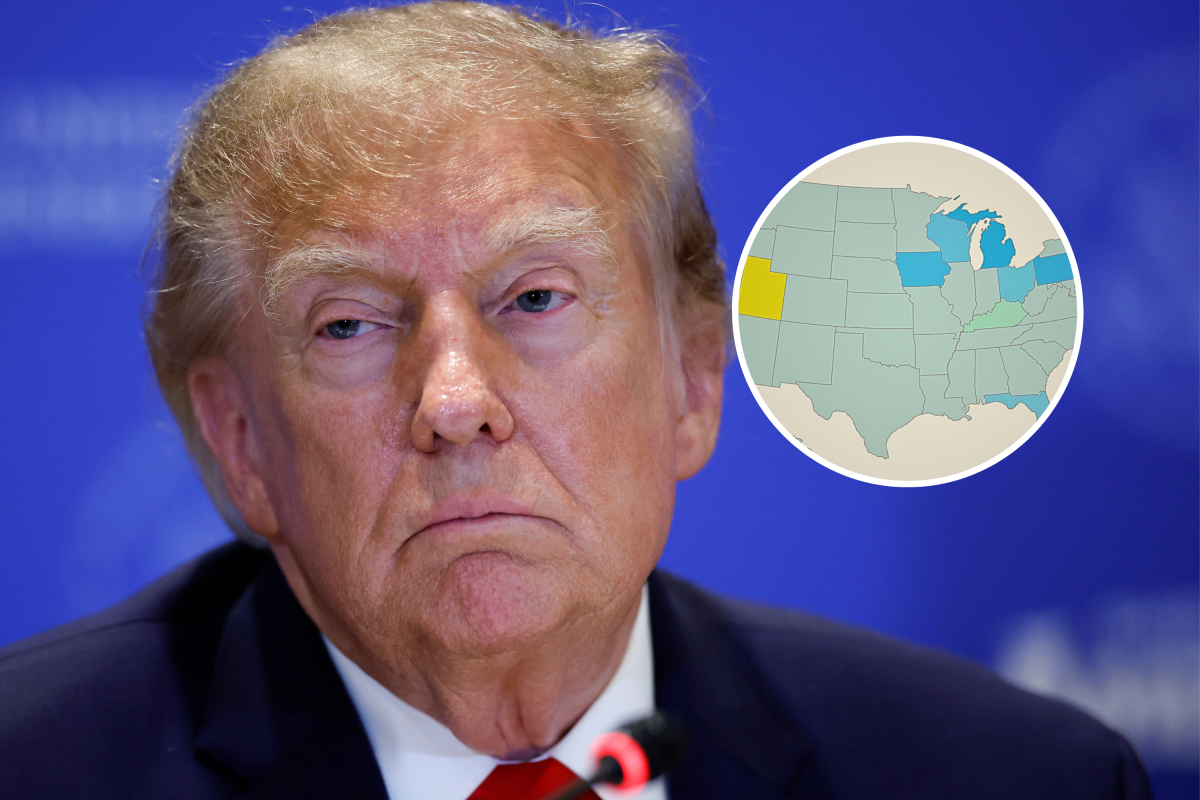
President Donald Trump’s approval rating trails his disapproval rating in eight of nine states where prominent Republicans have recently challenged his policies or created distance from him on individual issues, according to a Newsweek analysis of state-level data from Civiqs’ national rolling tracker.
Florida, Iowa, Kentucky, Maine, Michigan, Ohio, Pennsylvania, Utah and Wisconsin are home to Republicans who have opposed or questioned elements of Trump’s agenda.
Several of the Republicans involved continue to support Trump or have his endorsement.
But the disputes are emerging in states that include closely contested midterm battlegrounds and longtime Republican strongholds, at a time when polling shows broader dissatisfaction with the president’s performance and his handling of the war in Iran.
These splits with the president have included disagreements over the Iran war, immigration policy, tariffs on imports, presidential war powers, foreign dealings involving Donald Trump Jr., and the prominence given to Trump in campaign messaging.
Among the nine states, Trump is furthest underwater in Maine, where 31 percent approve and 63 percent disapprove, according to Civiqs’ rolling tracker, which had recorded 131,787 responses from registered voters as of September 22, 2026.
Michigan follows at 36 percent to 58 percent, while Pennsylvania stands at 36 percent to 57 percent.
Utah is the sole exception, with approval narrowly ahead, 46 percent to 45 percent.
Nationally, 35 percent approve of his performance, and 59 percent disapprove, according to the Civiqs data.
That gives the president a nationwide net approval rating (those who approve minus those who disapprove) of -24 percentage points.
The contrast with the start of Trump’s second term is stark. On January 20, 2025, he had positive net approval ratings in 24 states and was level in three others. Twenty months later, just 11 states remained positive.
Newsweek reached out to every Republican mentioned in this article via email for comment on Wednesday morning.
Several of these disagreements with Trump have emerged in politically important races where candidates in the November 3 midterm elections must retain voters without losing those concerned about living costs, fuel prices or administration policy.
The nine states do not form a single political bloc. They range from Maine, where Trump is more than 30 percentage points underwater, to Utah, where approval leads by one point.
Florida, Iowa, Kentucky and Ohio have recently supported Trump in presidential elections, while Michigan, Pennsylvania and Wisconsin have been closely fought battlegrounds.
Some of the steepest declines since the start of Trump’s second term occurred in states that initially gave him comfortable margins.
Kentucky fell from net +23 at the start of his second term to -10 on September 22, a 33-point decline.
Iowa moved from +6 to -20, Ohio from +8 to -16 and Florida from +9 to -15.
Pennsylvania declined from -3 to -21, Wisconsin from -4 to -17, Michigan from -6 to -22 and Maine from -12 to -32.
Utah remained positive but narrowed from +20 to +1.
The Iran war has produced the largest and most direct group of Republican breaks.
In July, Representatives Thomas Massie of Kentucky, Brian Fitzpatrick of Pennsylvania, Tom Barrett of Michigan and Warren Davidson of Ohio supported a House resolution calling for military action in Iran to stop unless Congress authorized it.
Opposition expanded in September when Iowa Representatives Mariannette Miller-Meeks and Zach Nunn supported a separate war-powers resolution after voting against earlier attempts to restrict the conflict.
Miller-Meeks said she would not support an "open-ended war" while Iowans were paying more at the pump.
Nunn, citing the deaths of two service members from Iowa, said sustained combat operations required congressional authorization once the negotiating window had closed.
The September measure passed the House by 220 votes to 204.
A separate Senate effort failed to advance by 49 votes to 47 in July, with Maine Senator Susan Collins the only Republican supporting it in that vote.
Those measures represented institutional challenges to Trump’s use of presidential war powers, rather than criticism limited to the conflict’s effect on prices.
Other Republicans have taken a different route, avoiding a confrontation over presidential authority while calling for the conflict to end.
Iowa Senate nominee Ashley Hinson, whom Trump endorsed last September as someone who would "be an outstanding Senator," said Iowans should not have to pay for the war "at the pump or the checkout line."
Her intervention followed her earlier support for Trump’s authority to pursue the conflict.
Hinson also called Trump’s expansion of lower-tariff beef imports a "bad idea," arguing that cheaper foreign supply could undercut Iowa cattle producers.
Michigan Senate candidate Mike Rogers also called for the war to end quickly and proposed temporarily halting U.S. diesel exports.
Michigan gubernatorial candidate John James subsequently said every available tool should be used to bring the conflict to a rapid conclusion.
Ohio Senator Jon Husted and Wisconsin gubernatorial candidate Tom Tiffany have also advocated an exit from the conflict.
On Tuesday, Tiffany said it was "time to move on," while Husted said the war "needs to come to an end as quickly as possible so that we can lower gas prices."
Husted, who is contesting a competitive Senate election against former Democratic Senator Sherrod Brown, linked his position to gasoline prices. Tiffany, who had previously opposed congressional resolutions to end the war, said the country should "come home" and focus on domestic concerns.
In Florida, gubernatorial candidate Byron Donalds removed several prominent references to Trump from his campaign homepage while retaining the president’s endorsement elsewhere. The change represented a narrowing of Trump’s role in the campaign’s presentation, rather than a withdrawal of support.
Florida Representative María Elvira Salazar took a more explicit policy position by criticizing the administration’s immigration crackdown in a campaign advertisement.
In Utah, Senator John Curtis requested an investigation into foreign business dealings and gifts involving Donald Trump Jr. His request concerned the president’s family rather than a formal White House policy.
Utah is also the only state in the analysis where Trump retains a positive net approval rating, although his advantage is only one percentage point, making it an important exception to the wider pattern.
The direction is also consistent with other recent national polling, although estimates differ by methodology.
A CBS News/YouGov poll conducted from September 8 to 11 among 2,460 U.S. adults found that 39 percent approved of Trump’s overall performance and 61 percent disapproved. The survey had a margin of error of plus or minus 2.3 percentage points
The survey found that 36 percent approved of Trump’s handling of Iran and 64 percent disapproved.
It also found that 66 percent of likely voters considered the conflict very important to their congressional vote.
Fifty-six percent said they would prefer a candidate who opposed Trump’s approach to Iran, compared with 32 percent who preferred one who supported it.
The same survey found that 71 percent of registered voters were unwilling to pay more for gasoline during the conflict. Ninety-three percent said they believed the war was making U.S. oil and gas prices at least a little higher.
Those findings help explain why several Republicans have framed their objections around fuel prices and household costs rather than a broader rejection of Trump’s presidency.
The White House has dismissed the significance of recent polling, instead pointing to Trump's 2024 election victory as the clearest measure of public support.
Spokesman Davis Ingle has repeatedly cited the nearly 80 million Americans who voted for Trump as evidence of the administration's mandate, framing that result as the overriding verdict on its agenda.
In a response the White House has used consistently, Ingle said: "The ultimate poll was November 5th 2024 when nearly 80 million Americans overwhelmingly elected President Trump to deliver on his popular and commonsense agenda."
Ingle added that Trump is working to create jobs, reduce inflation and improve housing affordability, while arguing that the effects of the administration's policies will become more apparent over time.
The White House maintains that the president has already delivered significant results and that "this is just the beginning as his agenda continues taking effect."
Newsweek’s reporters and editors used Martyn, our AI assistant, to produce this story. Learn more about Martyn here.