Masking lesbians and the "Palestinian Rachel Dolezal" have something in common - Newsweek
America's culture wars produced two almost too perfect specimens this week: a lesbian bar where relaxing a KN-95 mandate provoked accusations of eugenics and a wealthy white Philadelphia teacher who acknowledged spending years falsely presenting herself as Palestinian.
The stories are different but their respective absurdity rhymes.
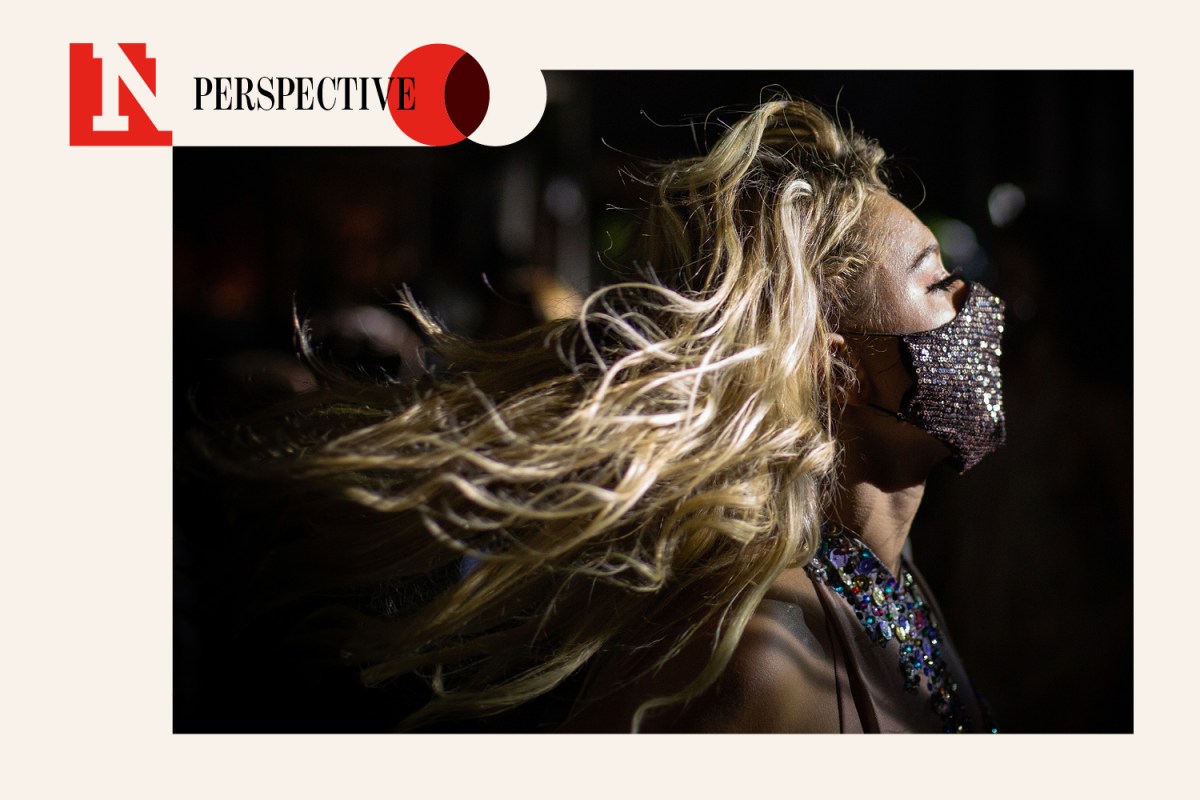
At Last Ditch Bar and Arts Venue in Greenfield, Massachusetts, customers had been required to wear a KN-95 mask "or better." When the financially struggling bar announced that Saturdays would become mask-optional, commenters accused it of ableism, racism and complicity in a "mass disabling event."
One commenter went so far as to wish that the venue would be firebombed, which gives some sense of how quickly a fairly ordinary change in bar policy was transformed, from the safety of social-media comment sections, into a struggle over life, death and moral complicity. The ensuing community meeting lasted three and a half hours and included mediators, Zoom participants and arguments over whether the presence of a licensed therapist was itself unsafe. True story.
In Philadelphia, teacher and pro-Palestinian activist Hannah Gann admitted that she has no Palestinian or Tunisian ancestry, after fellow activists investigated claims she had made about her background. She had been publicly described as Palestinian American and, according to reports, had also presented herself at times as Black.
Hence the inevitable nickname: the "Palestinian Rachel Dolezal." For anyone who has forgotten the 2015 original, Dolezal was the white president of the Spokane NAACP who publicly identified as Black until her white parents revealed her ancestry. Again, true story.
Gann could have demonstrated her solidarity with Palestinians by advocating for them. Apparently that was not enough, though, so she adopted the identity of the people whose cause she championed, complete with a fake family history to match.
There are defensible reasons to wear a mask, as we have all come to learn following the world-altering arrival of COVID-19. But Last Ditch had transformed the mask into something more than protective equipment. In a venue whose politics placed emphasis on protecting disabled, immunocompromised and other medically vulnerable people, the KN-95 had become a visible badge of allegiance to those causes—part public health measure, part moral uniform.
But then the bar tried to loosen its rule for one night a week because it was losing money. Its owner was working four jobs, had lived in a truck for six months and remained responsible for a $50,000 loan while the business struggled to pay its bills. Yet allowing customers to expose their faces on Saturdays was treated by some critics as an ethical capitulation. Even the apology became another offense: the bar initially posted it without alt-text, prompting a fresh accusation of ableism.
This is where earnestness crosses into theater: the accessory acquires moral content and wearing it demonstrates that one understands the suffering of others. It follows, then, that declining to wear amounts to evidence that one does not.
Gann appears to have taken the same impulse several stations farther down the line. She could have supported Palestinians while remaining exactly who she was. Instead, she invented Palestinian relatives.
A political identity had become so morally desirable that advocacy alone apparently would not do. She needed the costume to come with genealogy. One can't help but wonder whether her support to the cause as a white woman might have been more valuable than whatever sort of assistance she ended up offering.
This behavior is not the exclusive property of progressives, despite what recent examples might suggest. American politics has always offered incentives to embellish one's identity to suit an audience. America: land of the free, home of the self-invented.
George Santos provided a memorable Republican version that still incites giggles and tears. During his successful 2022 congressional campaign, Santos described himself as Jewish and said his grandparents had fled anti-Jewish persecution in Europe. Genealogical reporting found his maternal grandparents had been born in Brazil, after which Santos insisted that he had meant he was "Jew-ish." While we were all still wondering what exactly that means, the Republican Jewish Coalition said he had "misrepresented his heritage."
The political flavors differ, as they always do, but the mechanism is familiar, as it always is. Santos found an identity useful in a district with a substantial Jewish population and Gann assumed an identity that gave her a more intimate claim on the cause around which she organized. At Last Ditch, identity was communicated through a visible ritual rather than fabricated ancestry. The common thread? The conversion of belief into costume.
It's almost too clichéd to keep repeating this, but every mask is not performative, every kaffiyeh isn't insincere and every political identity cannot possibly be fraudulent. Still, political cultures in 2026 create status signals, and once a signal becomes proof of goodness or belonging, people have an incentive to display it ever more extravagantly.
Until now, the political costume has usually been easy enough to recognize: a slogan shouted ad nauseam at even unrelated protests, a red hat or a flag in red, green, white and black. But once political belonging becomes something that must be displayed, the costume has a way of growing more elaborate.
Sometimes, it means wearing a KN-95 to a lesbian bar in 2026 and treating its removal as a moral betrayal. Sometimes, it means borrowing an ancestry along with the cause. Eventually, apparently, even your grandparents can become accessories.