
Mecca Joint Defense Agreement tested by Yemen
By continuing to browse our site you agree to our use of cookies, revised Privacy Policy and Terms of Use. You can change your cookie settings through your browser.
Editor's Note: Military chiefs from Saudi Arabia, Pakistan and Türkiye met in Riyadh on Friday to discuss the regional security situation and ways to strengthen defense cooperation, marking a further step in Riyadh's efforts to diversify its security partnerships and build a broader regional defense network amid ongoing threats from Yemen's Houthi group. Wang Jin is a special commentator for CGTN and a professor at Institute of Middle Eastern Studies, China's Northwest University. The article reflects the author's opinions and not necessarily the views of CGTN.
Fighters of Yemen's Houthi group fight against the Saudi-backed forces in Taiz, Yemen, September 9, 2026. /VCG
Saudi Arabia is facing growing security pressure from Yemen's Houthi group. Repeated missile and drone attacks have exposed vulnerabilities in the kingdom's security environment and raised questions about the effectiveness of its traditional reliance on external military protection. Against this backdrop, Riyadh is seeking to diversify its security partnerships and build a broader regional defense network.
For years, Saudi Arabia has invested heavily in its military capabilities while supporting the Yemeni government in its conflict with the Houthis. Yet military superiority in terms of equipment and defense spending has not translated into a decisive outcome on the battlefield. The Houthis have retained the ability to launch attacks against targets inside Saudi Arabia, including strategically important infrastructure. This has demonstrated a fundamental problem for Riyadh: possessing advanced weapons does not necessarily mean being able to eliminate a determined adversary operating from across the border.
Saudi Arabia has pursued two major diplomatic approaches to address this challenge, but neither has provided a comprehensive solution.
The first has been to rely on the United States. Riyadh has traditionally regarded Washington as the central pillar of its security architecture and has hoped that greater US military involvement could contain the Houthi threat. But Washington has shown little appetite for entering another large-scale and open-ended Middle Eastern conflict. The US can provide air-defense systems, intelligence, military assistance and other forms of support, but direct and sustained American intervention in Yemen would carry significant strategic and political costs. The gap between what Saudi Arabia expects from its principal security partner and what the United States is prepared to provide has therefore become increasingly visible.
The second approach has been engagement with Iran. Saudi Arabia has hoped that Tehran could use its influence to restrain the Houthis and facilitate an end to the conflict. This channel, however, has clear limitations. The Houthis have their own political interests and military calculations and cannot simply be regarded as an actor controlled by Iran. At the same time, continuing tensions between Iran and the United States have made regional diplomacy considerably more complicated. Iran may have influence over the Houthis, but its ability to deliver a comprehensive settlement remains limited.
These difficulties have encouraged Riyadh to pursue a third option: building a more diversified security framework through regional and extra-regional partnerships. The emerging Saudi-Turkish-Pakistani defense arrangement is an important manifestation of this strategy. The agreement establishes a collective-defense principle under which an armed attack against one member is regarded as an attack against the others. It also seeks to strengthen military coordination, intelligence cooperation and broader defense capabilities.
The significance of the arrangement extends beyond the three countries themselves. It reflects Saudi Arabia's effort to reduce its dependence on any single external security provider and to create additional strategic options. Türkiye brings substantial military capabilities and growing influence in the Middle East, while Pakistan has long maintained close defense ties with Saudi Arabia. Bringing the two countries into a broader framework gives Riyadh additional political and security partners at a time when the regional security environment is becoming increasingly uncertain.
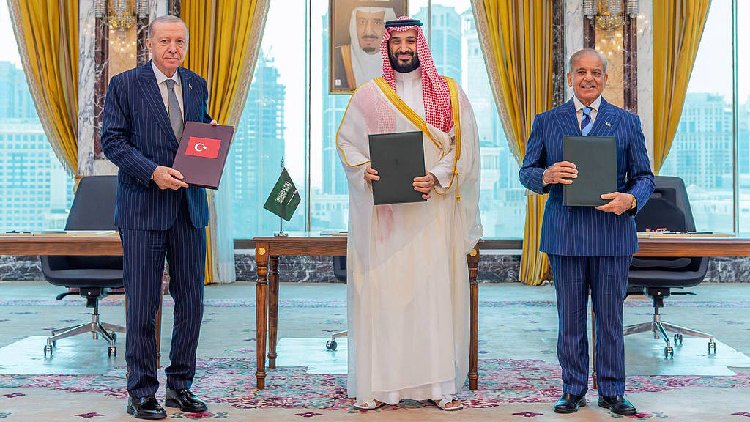
Saudi Crown Prince Mohammed bin Salman (C), Turkish President Recep Tayyip Erdogan (L), and Pakistani Prime Minister Shehbaz Sharif attend the signing ceremony of the Mecca Joint Defense Agreement at the Royal Court in Al-Safa Palace in Mecca, Saudi Arabia, August 7, 2026. /VCG
However, the new framework also has important limitations. First, neither Türkiye nor Pakistan is necessarily prepared to intervene directly in the Yemen conflict. Both countries are geographically distant from Yemen, and deploying large-scale forces to defend Saudi Arabia or participate in military operations against the Houthis would involve considerable political, economic and military costs. A defense agreement can strengthen deterrence without necessarily translating into immediate military intervention.
Second, the collective-defense principle still needs to be supported by practical mechanisms. The effectiveness of the arrangement will depend on how the three countries coordinate intelligence, air defense, military planning and crisis response. A political commitment does not automatically guarantee that military forces will be deployed when a member comes under attack. The absence of clear operational procedures could therefore limit the agreement's effectiveness during a major crisis.
Third, Egypt is not part of the current arrangement, which limits the agreement's role for Red Sea security. Egypt remains an important security actor for Saudi Arabia and has direct strategic interests in the Red Sea, the Suez Canal and the Bab al-Mandab Strait. Without Egypt, the new framework will have difficulty developing into a comprehensive mechanism for managing Red Sea security.
The broader significance of the Saudi-Turkish-Pakistani arrangement, therefore, lies not in its ability to immediately change the military balance in Yemen, but in what it says about the evolution of Saudi security policy. Riyadh is gradually moving from a security model heavily centered on one major external power toward a more diversified network of partnerships.
This shift does not mean that Saudi Arabia is abandoning its security relationship with the United States. Rather, it suggests that Riyadh is seeking greater strategic flexibility and additional layers of protection. The new defense framework can strengthen deterrence and expand Saudi Arabia's diplomatic and military options, but it cannot by itself resolve the Yemen conflict or the wider Red Sea crisis.
Ultimately, lasting stability will require more than military cooperation. The Houthi-Saudi conflict has demonstrated the limits of military solutions to deeply rooted regional conflicts. International mediation, regional diplomacy and a political settlement will remain essential. For Saudi Arabia, building a broader security network may reduce its strategic vulnerabilities, but diplomacy will still be indispensable to achieving lasting peace in Yemen and greater stability across the Red Sea region.
