
Millions dropped from SNAP food assistance as funding faces September uncertainty
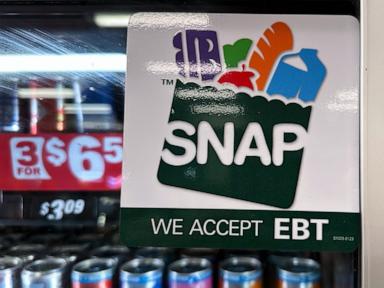
Starting Oct. 1, states will have to cover 75% of program administrative costs.
Supplemental Nutrition Assistance Program (SNAP) funding could face a major shake-up at the end of September unless Congress passes a resolution to delay major changes included in H.R. 1, commonly known as the GOP's One Big Beautiful Bill.
Starting Oct. 1, states will have to pick up 75% of the administrative costs of running the program, with the funding burden of providing benefits to participants set to shift from the federal to state level over the next few years.
State and national food assistance groups are calling on Congress to pass a resolution delaying the implementation of this cost shift, to give states more time to prepare for the bigger bill.
The federal food assistance program faced a funding lapse last fall, and experts are now warning of an uncertain future.
FILE PHOTO: A general view of the tobacco section of a 7-Eleven store at Manhattan, in New York City, U.S., October 1, 2024.Jessica Dinapoli/ReutersNationwide, roughly 5 million Americans have lost access to SNAP since the Republican-backed budget bill became law, including more than 1.5 million children, according to the Center on Budget and Policy Priorities.
Much of the decline can be attributed to changes in work requirements and administrative hurdles in applying, coupled with a major cost shift that states will have to bear if they want SNAP to remain fully funded, Dottie Rosenbaum, director of federal SNAP policy at the CBPP, told ABC News.
Under the law, the upper age limit for able-bodied adults without dependents who must meet work requirements was raised from 54 to 64.
Additionally, exemptions were changed for parents and other family members responsible for a dependent, lowering the qualifying age from 18 to 14.
"The declines we're seeing in SNAP participation so far are far deeper and far faster than the Congressional Budget Office predicted at the time the law was enacted, and it's especially alarming that more than one and a half million children have been cut," Rosenbaum said.
"We're hearing increasing reports ... of people struggling to put food on the table, of people facing untenable choices between, you know, paying their rent and buying groceries and other essentials, putting gas in their cars," Rosenbaum added.
The White House did not respond to a request for comment on the impact of the new work requirements. The administration has publicly supported the idea in the past.
"The American dream is not being on [a] food stamp program. ... The American dream is not being on all these programs. That should be a hand up, not a handout," Agriculture Secretary Brooke Rollins said in an interview on Fox Business in January.
Alongside the new work requirements, the budget outlined a major shift in costs from the federal government to the states.
Beyond each state's responsibility to pay 75% of SNAP's administrative costs starting in October, states are set to pay a percentage of the benefit costs tied to its error rate in the coming years.
The error rate measures underpayments and overpayments, resulting in mandatory additional payments ranging from 5% to 15% for most states.
The benefit cost shift will take effect as early as 2027 and could lead to cuts or major changes in other state-run programs as states try to make up the difference, food assistance leaders told ABC News.
These changes, some already implemented and others on the horizon, have forced food banks to step in and fill the gaps while lawmakers debate a more stable funding structure.
In Arizona, the state "took immediate action on error reduction efforts after H.R. 1 became law," the Arizona Dept. of Economic Security said. This included expanding documentation requirements, establishing a preauthorization review process and continuous income monitoring. More than 400,000 SNAP recipients lost access to the program thereafter, according to the CBPP.
"Which meant that the number of people visiting food banks increased by about the same amount," Terri Shoemaker, executive vice president of the Arizona Food Bank Network, said, crediting the state's changes in SNAP for the substantial drop in participation.
"We know that [the Arizona Department of Economic Security] is trying to get its arms around accuracy and reporting, but at the same time, we also know that there are people who were impacted by those changes who shouldn't have been," Shoemaker said.
When the changes began in Arizona, Shoemaker said, communities rallied to donate food to people who had lost access to SNAP. Still, she added, the response is not sustainable.
"For every one meal that Arizona food banks provide for families, SNAP usually provides about five," Shoemaker said. "Nationally, that statistic is more like one [meal from food banks] for every nine [meals from SNAP]. But if you think about that and food banks trying to fill that gap, it's just a scale and scope that is so vast that food banks are going to have a hard time keeping up."
In neighboring New Mexico, the impact can also be seen.
"Find out where your food bank distributes food and check out the length of a line," said Jill Dixon, the executive director of the Food Depot -- a collection of food banks covering northern New Mexico. "We have one in front of our building on the first and third Thursday of every month. That line usually extends over a mile and a half by the time it opens at 7 a.m."
In this Nov. 1, 2025, file photo, a SNAP EBT information sign is displayed at a gas station in Riverwoods, Ill.Nam Y. Huh/AP, FILEThe Food Depot distributed more than 8 million meals across much of New Mexico in 2025.
"These are people. They're not lines. It's not boxes of food. It's not anonymous. It's deeply personal, and it's right at the center of our community," Dixon said.
"We're going to see some hard times ahead," she added. "Long term, we really have a reckoning of how we're going to go about making sure that people are fed in a moment when it is incredibly hard to make ends meet."
In predominantly Republican states, the impact is similar. Louisiana has seen the second largest per-capita decline, with 21% of the state's SNAP recipients no longer having access to SNAP according to the CBPP.
Food Bank of North Central Arkansas CEO Jeff Quick said his state is facing a burden too large to bear without major changes. "We will never be able to food bank our way out of food insecurity," Quick said.
"At best, I think we may be unprepared or unable to cover the cost to continue SNAP in Arkansas, and again, if that worst-case scenario were to happen, it could have an estimated $1.2 billion negative economic impact on our state," he added.
Quick also said work requirements have hit harder in Arkansas, adding that a worker earning the state's $11-an-hour minimum wage may still be ineligible for SNAP benefits.
"We don't want to see anyone go hungry, and regardless of who you are or how you vote or how you legislate, we're all on the same path," Quick said. "We got to put great minds together around common causes to find solutions to hunger."
The White House did not comment on whether the administration supports delaying the cost shift.
Food bank organizations at the state and national levels are asking Congress to pass a resolution delaying the cost shift and allowing states more time to lower their error rates before taking on the additional costs.
"States need more time," Rosenbaum said. "They need more time to work to lower their error rate and improve their payment accuracy in a way that doesn't limit access to benefits."
Senate Agriculture Committee Chairman John Boozman released a version of the farm bill that would delay the cost shift of SNAP, though it has not advanced through the opposite chamber.
Lawmakers return to Washington from August recess on Sept. 14.


