Minna’s Cell of Death: Survivors recount how 37 mining suspects died in NSCDC custody - Premium Times Nigeria
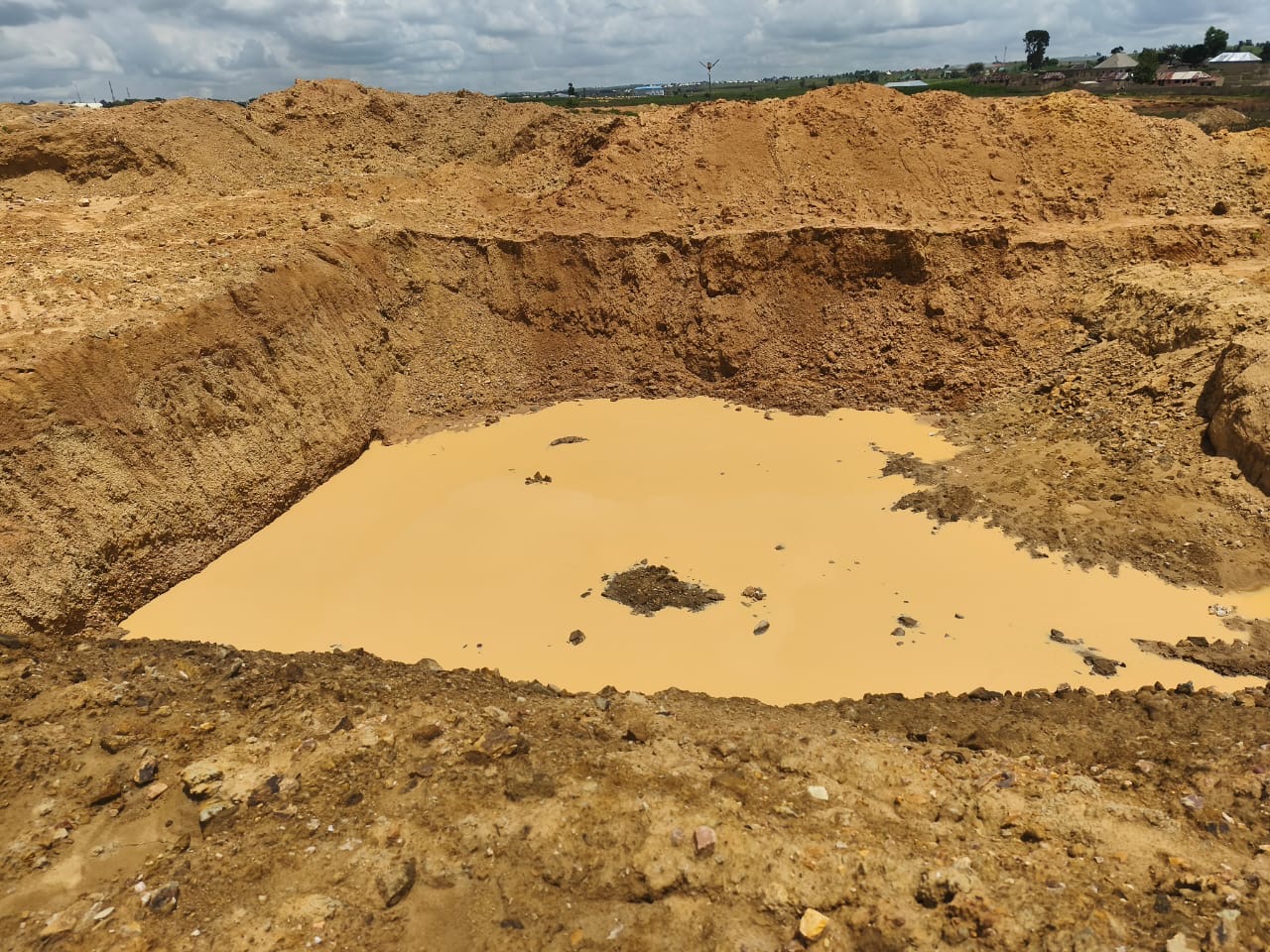
Illegal mining around the M.I. Wushishi/Lukoto area of the state capital.
For 19-year-old Adamu Isah, 17 September began like any other day. But it ended with him witnessing horrific deaths inside a cramped NSCDC detention cell in Minna, Niger State.
Mr Isah was among the suspects arrested by the Nigeria Security and Civil Defence Corps (NSCDC) for alleged illegal mining activities around the M.I. Wushishi/Lukoto area of the state capital.
A few days after they were arrested, 37 of the suspects died under harrowing circumstances in the detention facility.
Nearly a week after the incident, Mr Isah carried bite marks on his arm left by a gasping cellmate in the last minutes of his life.
Speaking with PREMIUM TIMES on Thursday, the young man narrated his arrest, detention, the conditions inside the cell and the events preceding the tragic deaths.
His account raises fresh questions about what happened inside the NSCDC detention facility, even as the authorities search for answers.
According to Mr Isah, he and several others were arrested in the M.I. Wushishi area as they reported for work at the mining pits.
They were subsequently taken to a detention facility around the PDP Secretariat, in the Bloodson Hospital area of Minna.
“They took us to their cell located around the PDP Secretariat,” Mr Isah said.
He said about 20 detainees were initially in the facility, but some were later released on bail.
“After spending two days there, around 20 people were taken out for bail. That left about 17 of us remaining inside the cell.”
As more people, including women, were brought into the facility, the detainees were eventually reorganised into separate cells for men and women.
The cells were small, poorly ventilated and overcrowded.
Mr Isah said that on the third day of their detention, officials sprayed a chemical substance around the entrance of their cell.
“It smelled like a fragrance or perfume, but it felt damp or moist, so we knew it wasn’t a normal spray,” he recalled.
According to him, the detainees became desperate for fresh air.
Within an hour, according to his account, an inmate began exhibiting a severe reaction.
“One Gwari man among us started struggling, foaming at the mouth and passed out,” he said.
Mr Isah said some became violently agitated before their deaths.
“Some went berserk, exhibiting signs of madness. Some started biting people,” he said.
“Some were banging their heads against the wall.”
He said he was bitten twice on his arm, showing the reporter the marks left by the bites.
In the commotion, he said detainees repeatedly screamed for help.
“We called out to them to open up, but they replied that we should all just die,” he said.
“About 17 of us managed to exit, but 11 of us made it out in a condition where we were rushed to the hospital.”
He said those who survived were subsequently given medical treatment.
“I was affected. Even now, my health is not fully restored,” he said.
Fifteen-year-old Zuwayra Aliyu was arrested around the Titin Kutum area while going towards a mine.
At the NSCDC facility, the names and other details of the arrested people were recorded before they were detained.
Zuwayra described the women’s cell as hot, poorly ventilated and infested with mosquitoes.
“Our cell had no window. There was just a small hole near the ceiling with a small mesh,” she said.
She said from their cell, the women could hear what was happening inside the men’s cell.
“They were shouting that the heat was killing them,” she recalled.
“They were screaming and begging for water.”
According to Zuwayra, the cries eventually turned into repeated banging.
“We were just hearing banging on the wall. We thought they wanted to break the wall to get out,” she said.
She said it was the following morning that they were told people had died.
“One of the NSCDC officers came out and said, ‘Women, the men have all died.’
“When they opened the door for us, we saw corpses piled on top of each other.”
Zuwayra said no woman died, although some fainted in their cell.
She corroborated the account that a substance was sprayed into the men’s cell.
“We heard them saying, ‘Officer, what are you spraying on us?’
There is currently no publicly established forensic evidence that a chemical substance caused the deaths.
Another survivor, 16-year-old Khadija Mohammed, was arrested alongside two other people on their way to the mining site (Zinari).
She said the men were moved into a small room.
“There were up to 65 men packed into that single room,” she said.
From about 8 p.m., she said, the men began banging on the door and asking for water.
“If they had allowed us, we would have helped them because we had water and food.”
She said the banging continued for hours. Some survivors, she said, squeezed into a toilet in an attempt to get access to air through a small opening.
“They lifted the children so they could catch a little bit of air to breathe,” she said.
Eventually, she said, the door was opened.
“We peeked into the room and saw the men piled on top of each other, all dead.”
Khadija also described an incident involving a substance used to clean the women’s toilet.
After the toilet was cleaned, she said the door was left open to allow air into the room.
“The smell of the chemical caused some women among us to faint,” she said.
She described the cell as “small, a bit long”, with a toilet carved into the room.
Fatima Sa’adu lost her 14-year-old son, Fahad, in the incident. She said Fahad supported the family with the money he earned.
“He was the one helping me. He provided my food and drink,” she said.
His father, she explained, was away in Zamfara for business.
“Even if my other children or his younger brother were sick, he would give me money from selling water so I could take them to the chemist.”
According to the mother, Fahad had been reluctant to go to the mining site because he was unwell.
She said that after he was arrested, she took food to him.
But, according to her, she was prevented from giving him the food.
She later witnessed him being brought out of a cell.
“As he was brought out, he hugged me tightly, crying, ‘Mother, mother!’
“I was crying. I wanted to pull him away, but I couldn’t.” Fahad died several minutes later.
For Isiaku Usman, the tragedy has created another form of anguish.
He went to the NSCDC office looking for his nephew, Kabiru Usman.
According to Mr Usman, his nephew’s name appeared on the list of those who died.
But the family could not locate his remains.
He said he had visited the mortuary twice and was shown bodies that remained unidentified. But he could not find that of Kabiru.
Now, he wants the authorities to help locate the remains so that the family can give him a proper burial.
Despite the tragedy, some miners have returned to the affected mining areas.
Speaking with PREMIUM TIMES’ correspondent at the mining site, the miners said they had few alternatives for earning a living.
One artisanal miner described mining as a hand-to-mouth occupation.
According to him, miners can spend several days at a site without finding enough gold to make meaningful money.
“It has been two days since we entered this bush. We haven’t even sold five naira worth of gold yet.”
For these miners, the issue is not simply whether mining is legal or illegal.
It is also about unemployment, poverty and the absence of alternative livelihoods.
Residents accuse miners of destroying homes and farmlands.
At the back of MI Wushishi along Always Hotels, residents complained about the expansion of mining activities into residential areas.
“They come every day. Even if we talk to them, they refuse,” a resident, Mal Awwal, said.
“They have dug all our backyard and are gradually coming into our compound.”
The scenario illustrates one of the central tensions surrounding artisanal mining.
The incident began with an NSCDC enforcement operation.
PREMIUM TIMES reported that the NSCDC linked the enforcement operation in part to concerns that artisanal miners were destroying farmland and residential properties.
The corps arrested scores of people around the M.I. Wushishi/Lukoto area of Minna.
The NSCDC initially said some detainees were found dead in the early hours of 17 September.
At the time, the corps attributed the deaths to a suspected disease outbreak, but said this had not been conclusively established.
The bodies were deposited at the General Hospital in Minna for medical examination.
But as accounts from survivors and relatives emerged, the tragedy triggered protests and unrest in Minna.
The state government imposed a curfew as the tension intensified.
The curfew was later lifted following a period of mourning and a special prayer session for the deceased.
The state government subsequently constituted a committee of inquiry and ordered forensic examinations and autopsies.
As the outrage spread, concerns quickly moved beyond Niger State.
The National Human Rights Commission and the Civil Society Legislative Advocacy Centre called for a transparent investigation and forensic autopsies.
President Bola Tinubu directed a comprehensive investigation, with Interior Minister Olubunmi Tunji-Ojo acting by inaugurating a 10-member independent committee on 22 September.
The committee was given two weeks to complete its work. Its mandate includes establishing the identities of the deceased, examining their arrest and detention, determining the circumstances and cause of death, identifying responsibility or negligence, and recommending appropriate action and compensation where applicable.
The committee’s secretary, Isa Chiroma, said members would visit relevant locations, interview survivors and other witnesses, obtain documents and examine other materials relevant to the incident.
A medical team has also begun work to determine the cause, mechanism and manner of death.
The Nigerian Bar Association’s Minna branch also established a 13-member committee to independently investigate the deaths.
The incident had triggered instant administrative action within the NSCDC.
The federal government suspended 20 officers involved in various aspects of the operation, including station guards, arresting officers, investigators, intelligence and legal personnel.
This included the state commandant of the NSCDC, Suberu Aniviye.
A new commandant, Abdulhamid Kabara, has since been deployed to the state.
The testimonies gathered for this report do not, by themselves, establish the cause of the 37 deaths.
But they raise questions that the ongoing investigation will have to answer.
What were the ventilation conditions inside the cell?
How many detainees were inside the men’s cell at the time?
When did the first detainee become critically ill?
How quickly did security personnel respond?
Were detainees provided sufficient water, ventilation and emergency medical attention?
Why did survivors describe unusual neurological and behavioural symptoms before some of the deaths?
What do the autopsies and toxicology examinations show?
And perhaps most importantly: could the deaths have been prevented?
These are questions the independent committee is expected to address.
The tragedy in Minna exposes a difficult reality beyond the immediate question of what happened inside the NSCDC cell.
On one side are government efforts to stop illegal mining, which authorities say damages farmland, threatens communities and undermines regulation of the mining sector.
On the other hand, there are young people who say mining is one of the few means available to them to survive.
Some of those interviewed after the incident described themselves as orphans, breadwinners and unemployed youths who enter mining sites not because they consider it a desirable occupation, but because they need money to eat.
The deaths have now added a third and more urgent question of how suspects should be treated after they are arrested.
For the families of the 37 deceased, the investigation is more than an institutional exercise.
For survivors such as Adamu Isah, the memory remains physical in the bite marks on his arm, in his continuing health complaints and in the recollection of people screaming for water behind a locked door.
For Fatima Sa’adu, the tragedy is the empty space left by a 14-year-old son who once helped provide food and medicine for his family.
For Isiaku Usman, the tragedy remains unfinished because his nephew’s body has yet to be found.
And for the miners who have returned to the pits, the question is how to survive when the work that feeds them is prohibited.
The government has promised an independent investigation.
What really happened inside the cell where 37 people died?
The answer may determine not only how the families of the dead receive justice, but also whether the tragedy becomes a turning point in how Nigeria enforces its mining laws, regulates detention and protects people held in state custody.