Modi @76. And he never had it easy
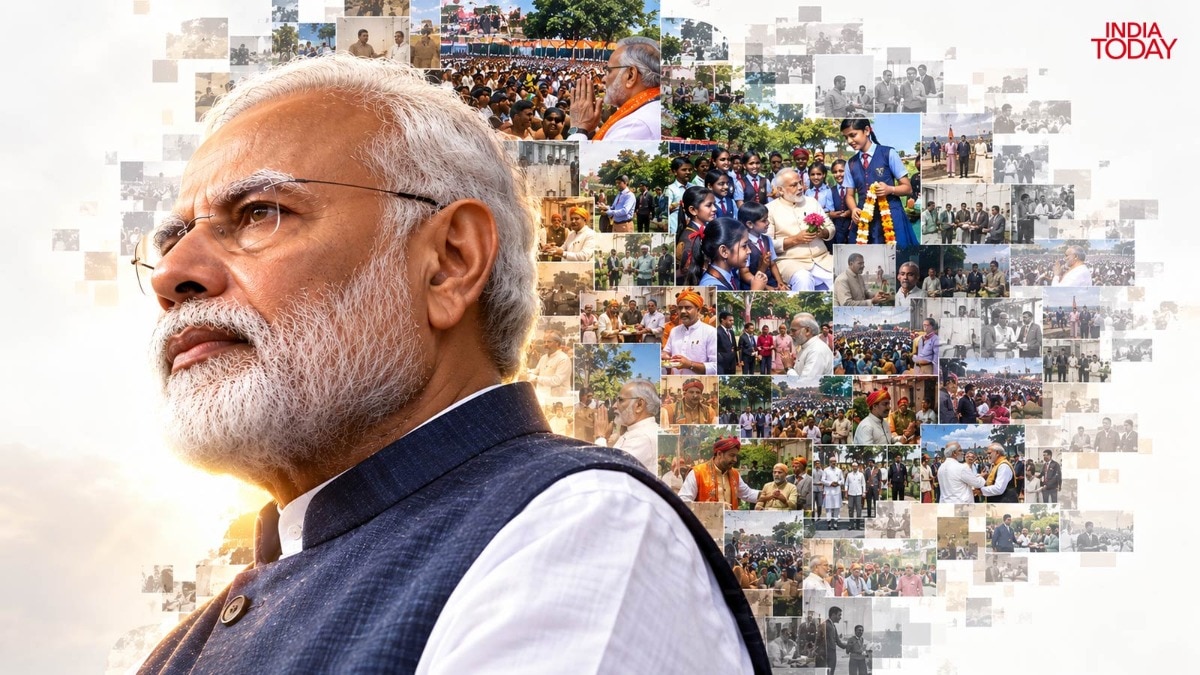
A war in the Middle East, and the one between Russia and Ukraine continuing, punitive tariffs by the US, soaring oil prices, inflation due to supply constraints and an uncertain world order. For Prime Minister Narendra Modi, 2026 has brought together a big set of challenges, with the government led by him doing it all to cushion India from global headwinds. And India has done much better than many other big economies.
Everyone thinks 2026 is the year PM Modi is facing huge challenges. Alongside the geopolitical headwinds, the PM Modi-led government faced an youth-led agitation by the Cockroach Janta Party (CJP), which culminated in the resignation of Dharmendra Pradhan as Union Education Minister in July.
Pradhan's exit marked a rare political setback for the government. His resignation came after weeks of protests over NEET-UG 2026 paper leaks and demands for accountability, making it only the second instance since 2014 of a sitting Union minister leaving the Modi government amid public pressure. This year, the BJP-led central government also witnessed a backlash by the "upper castes", which traditionally support the saffron camp, over the UGC Equity Regulations.
But if this feels like the toughest phase of Modi's political life, a look at his journey shows that the road, at least from the 1990s, was never smooth.
Prime Minister Narendra Modi turns 76 today.
A look at his political career shows a pattern of setbacks, rebellions, isolation and bounce backs. Long before he became the country's most recognisable political face, PM Modi was a Rashtriya Swayamsevak Sangh (RSS) pracharak, doing the most basic chores at the organisation's office in Ahmedabad.
He went underground during the Emergency in 1975, was pushed out of Gujarat politics at the height of his organisational career, spent nearly two years in political isolation, and when he finally became the chief minister of Gujarat, he struggled even to find a constituency from which to enter the Assembly.
Then came the Gujarat riots of 2002, the political storm that threatened his chief ministership, years of legal scrutiny and international condemnation, including the US decision in 2005 to deny him a diplomatic visa and revoke his existing tourist/business visa.
Yet each hurdle became another chapter in the Modi political journey as he overcame them. The crusader: For the first time, the Bharatiya Janta Party achieved a full majority and formed the government in the Centre in 2014 under the leadership of Prime Minister Narendra Modi. (Image: AFP via Getty) THE 1970s: MODI'S JOURNEY FROM SWEEPING FLOORS TO GOING UNDERGROUND
The story begins far from the Prime Minister's Office in New Delhi.
Born in Vadnagar on September 17, 1950, Modi grew up in a family of modest means and helped at the family's tea stall. He joined the RSS as a pracharak in the early 1970s and gradually moved into full-time organisational work. His early years were hardly glamorous. According to senior journalist Arvind Chaturvedi's book, The Real Modi: The Man Who Would be Prime Minister, the prime minister who was then an RSS worker held responsibilities that included preparing tea and breakfast and doing routine work at the organisation's office.
Then came the Emergency imposed by the then-Prime Minister Indira Gandhi.
When the Congress government imposed the Emergency in June 1975, the RSS was banned and its activists and workers were forced underground. Modi, then a young RSS worker, became involved in the underground resistance in Gujarat. He travelled in disguise, helped maintain networks of safe houses and distributed anti-Emergency literature. According to various accounts of the period, they describe him appearing in different disguises, once as a Sikh, to avoid arrest during the Emergency.
It was an early lesson in political survival for the politician who is currently the longest-serving elected head of government in the country.
But bigger tests were still waiting to come for the 25-year-old RSS pracharak. Incognito moment: PM Modi, who was in 1975 working for the RSS, concealed his real identity and amplified the anti-Emergency literature. (Image: File) THE 1990s: FROM BUILDING CADRE TO FACING BANISHMENT FROM GUJARAT
By the mid-1990s, Modi had become an important organisational figure in Gujarat BJP politics. That influence, however, also became a source of friction that eventually backfired.
In the book Narendra Modi: The Man, The Times, author and journalist Nilanjan Mukhopadhyay described that Modi was accused of interfering in the functioning of the BJP government despite not holding a constitutional office. The perception among some leaders was that he was exercising influence from outside the government — effectively attempting to drive the administration from the back seat.
"Modi was accused of interfering in government functioning without being a part of it and also for promoting factionalism in the party. At that time, the RSS ensured that though he beat a hasty retreat from Gujarat politics, he was not cast away," Mukhopadhyay wrote in his 2013 book.
These tensions exploded in 1995. Keshubhai Patel had become Gujarat's first BJP chief minister after the party's electoral breakthrough. Modi was an aide of Keshubhai.
Gujarat BJP leader Shankersinh Vaghela rebelled against Keshubhai and took a large group of MLAs to Khajuraho in Madhya Pradesh while the chief minister was away in the United States.
The rebellion produced the now-famous political labels: Hazoorias for Keshubhai loyalists and Khajurias for Vaghela's camp.
The central leadership eventually brokered a compromise to save the BJP government in Gujarat. The price was heavy. Keshubhai had to step aside and Modi had to leave Gujarat in form of a political exile as Suresh Mehta took over as the CM.
Mukhopadhyay, in his book, quotes Modi himself, describing the compromise as, "Keshubhai would go, and Modi would go out of Gujarat".
For the rising organiser, it was more than a transfer. It was "humiliation". The setback: Senior BJP leader Atal Bihari Vajpayee (L) asked Narendra Modi (C) to leave Gujarat and Keshubhai Patel to resign from the post of chief minister after a growing rebellion within the party in 1995. (Image: India Today Group) advertisementMODI'S 18 MONTHS OF POLITICAL EXILE, BUILT NETWORKS IN NORTHERN INDIA"Aapda ko avsar me badalna hoga (we will have to convert adversity into opportunity)," said Modi as the PM during the Covid pandemic in 2020. However, he had walked that path long before the talk.
As part of his political exile, Modi was sent to Delhi and Chandigarh as a national secretary by the BJP top brass. On paper, it was a party assignment. Politically, however, it was a very different story.
Modi's removal from Gujarat was seen by his opponents as evidence that he had overplayed his hand. In the 18-month period, Modi was "lonely and virtually friendless", facing a major political setback and public humiliation despite years of organisational work.
"When [Atal Bihari] Vajpayee got the party to endorse the compromise package in 1995 that led to Modi being ejected from Gujarat, it was a tacit acceptance of the party that he had overplayed his hand," Mukhopadhyay wrote.
"In Modi's version, this was a humiliation of sorts because his adversaries wasted no time in contending during conversations with journalists that his posting outside the state was not a promotion but an action of being sidelined. For the next eighteen months, Narendra Modi was lonely and virtually friendless," he added in his book Narendra Modi: The Man, The Times.
It was a strange interlude in the career of an RSS pracharak who was sent to the BJP in 1987, and who would eventually dominate Indian politics.
There was no Gujarat government to influence. No chief minister's office. No personal electoral constituency. No mass political base. There was only the organisation, a setback and time.
The gates of Gujarat were closed for Modi, but he had not disappeared. He built the party network and strengthened the party in the northern parts of India. The grind: In this image, Narendra Modi (L) and BJP veteran Murli Manohar Joshi hoisting the tricolour at Srinagar's Lal Chowk, Jammu and Kashmir in 1992. (Image: India Today Group) MODI'S HOMECOMING: WHEN A CHIEF MINISTER STRUGGLED TO FIND A SEAT
Six years later in 2001, the same Gujarat that had pushed Modi out would become the stage for his biggest political gamble.
By 2001, the BJP government under Keshubhai Patel was struggling amid political discontent, electoral setbacks and criticism of its handling of the aftermath of the devastating Bhuj earthquake. The situation was so bad in Gujarat for the BJP that it started reflecting in the local body polls. The central leadership led by former PM Atal Bihari Vajpayee eventually decided to replace Keshubhai.
On October 7, 2001, the 51-year-old Modi was sworn in as Gujarat's chief minister. But there was an immediate problem. Modi had never contested an election.
A chief minister who was not an MLA had six months to enter the state legislature. Finding him a safe seat was therefore important and urgent.
Modi wanted Ellis Bridge, a BJP bastion in Ahmedabad represented by Haren Pandya, who was given a cabinet berth in 1998 under the Keshubhai-led government after Modi insisted on proposing his name.
Pandya, who had his own political standing and constituency base, did not vacate the seat. Even a request from LK Advani did not change his mind.
"Modi expected his one-time protege [Haren Pandya] to remain loyal when he was evicted from Gujarat. But Pandya shifted his loyalty to Sanjay Joshi and through him to Keshubhai," Mukhopadhyay noted in his book.
The eventual solution to the seat dilemma came from Rajkot.
Vajubhai Vala, who was the finance minister of Gujarat, vacated the Rajkot-II seat, allowing Modi to contest his first election. The 51-year-old CM won the February 2002 by-election and entered the Gujarat Assembly.
But the victory itself was hardly the triumphant coronation that hindsight might suggest. His winning margin was smaller than the BJP's previous margin there, while the party lost two other by-elections held along with the Rajkot seat, which Modi contested.
The new chief minister had cleared his first electoral hurdle. He had barely settled into office when Gujarat was engulfed in catastrophe. Blockbuster comeback: Narendra Modi (C) was replaced with Keshubhai Patel (R) as the chief minister of Gujarat after BJP faced massive backlash in the state following the Bhuj earthquake. (Image: India Today Group) 2002 GODHRA RIOTS THAT COULD HAVE ENDED EVERYTHING
The Godhra train burning in February 2002 was followed by devastating communal violence across Gujarat.
The violence became the defining controversy of Modi's political career. He faced fierce criticism from opposition parties, sections of the media and civil society over the government's handling of the violence. The political pressure reached the BJP's highest levels.
Then-Prime Minister Vajpayee publicly spoke of "raj dharma", the duty of a ruler to govern without discrimination. By April, Modi's political survival was in question.
At the BJP National Executive meeting in Goa, he offered to resign as chief minister. The resignation was not accepted.
Modi was cleared of charges related to the 2002 Godhra riots by the Supreme Court in 2012, but then in 2002, the episode could have ended his Gujarat career.
Instead, the chief minister stayed. The controversy did not disappear. It followed him for years.
Even after blowback, Gujarat became the place where Modi began constructing a new political identity for the country — the Gujarat Model — one centred on development, investment and administrative performance alongside his existing ideological appeal. The mass leader: Chief Minister Narendra Modi became a household name in Gujarat and won Assembly elections for three consecutive terms. (Image: India Today Group) REBELLIONS NEVER STOPPED IN GUJARAT, MODI WAS SET FOR DELHI
Surviving the 2002 crisis did not mean Modi overcame all challenges in Gujarat BJP.
Keshubhai Patel remained a source of internal opposition against CM Modi in Gujarat within the BJP. Shankersinh Vaghela had already broken away. Former CM Sanjay Joshi, RSS leader Pravin Togadia and other figures represented different points of friction around Modi's growing authority.
There were tensions with sections of the RSS hierarchy too. Modi had risen through the organisation, but once he occupied executive power, the relationship changed.
Then came the phase of Modi's political journey that would eventually take him from Gujarat to Delhi. The transformation was gradual.
The Gujarat chief minister increasingly presented himself not merely as a Hindutva politician but as a development-oriented administrator. The Vibrant Gujarat summits, investment pitches and emphasis on infrastructure and governance helped build the "Vikas Purush" image around him.
By the early 2010s, the political equation inside the BJP started changing. The statesman: As the head of Gujarat's government and later the Centre, Narendra Modi has not only delivered electoral victories but has also built a strong public profile around his policy initiatives. (Image: India Today Group) 2012 VICTORY IN GUJARAT, MODI BECAME BJP'S PM FACE
LK Advani remained the party's most senior national leader, but Modi's political reach had begun extending far beyond Gujarat. His third consecutive Gujarat election victory in 2012 strengthened his claim to a national role.
The following year, that possibility became reality and everything changed from then on for the BJP and Indian politics.
On September 13, 2013, the BJP formally announced Modi as its prime ministerial candidate for the 2014 Lok Sabha election. The journey from the RSS office floor to the BJP's top national post had taken decades.
It had passed through a tea stall, underground safe houses, party rebellions, political exile, an unwanted transfer, a chief minister's seat without an electoral constituency, the Gujarat riots, resignation drama, international condemnation and repeated internal battles.
And that is why the story of Modi at 76 is not simply the story of power.
It is the story of a septuagenarian who spent much of his career operating under pressure, sometimes from opponents, sometimes from allies, sometimes from his own party and, at crucial moments, from the organisation that had helped build him.
The challenges have changed over the decades.
The young pracharak once worried about arrest. The BJP organiser worried about being pushed out. The chief minister fought for political survival. The Gujarat leader fought to establish his own model and authority. The prime minister has faced an entirely different scale of pressure.
The challenges have just become monstrous since he was re-elected in 2019. The two years of the Covid pandemic and lockdowns were followed by the Russia-Ukraine war. The second stint of Donald Trump as US President saw India being targeted with punitive tariffs. Then there was the Pahalgam terrorist attack and the four-day war with Pakistan in May 2025. Then came the Iran-US war that jeopardised energy supplies from the Middle East.
The pattern remains familiar. The challenges, some temporary setbacks and then the bounce backs. For PM Modi, the easy chapter never seems to have arrived. He is 76 and still battling challenges with similar energy.- EndsPublished By: Avinash KateelPublished On: Sep 17, 2026 07:00 IST