
Modi and Xi hold talks: ‘Partners not rivals, committed to resolution of boundary question’ - The Indian Express
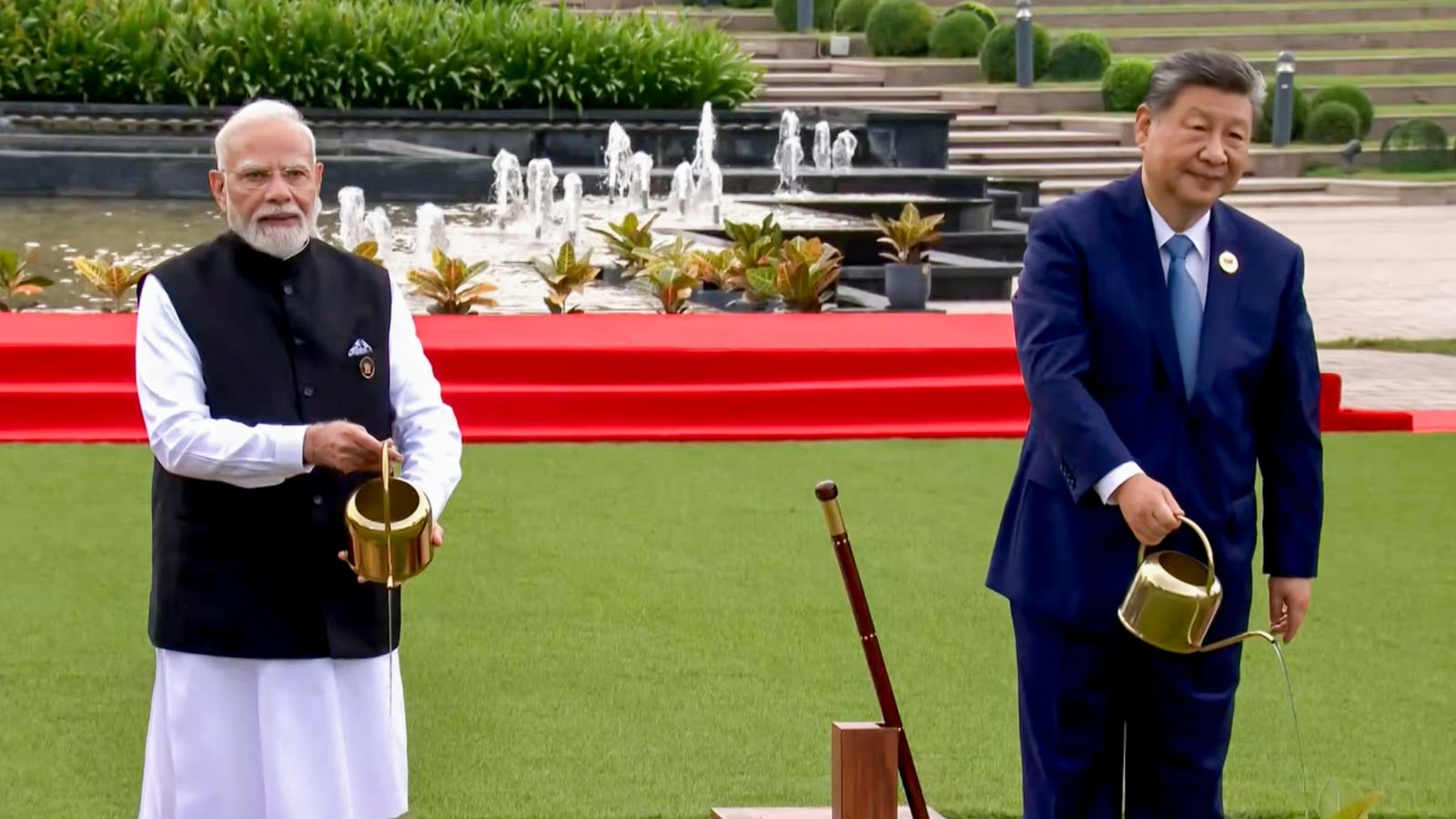
Two years after their meeting in Russia’s Kazan led to the disengagement of troops along the Line of Actual Control in eastern Ladakh after a tense military standoff that began 2020, Prime Minister Narendra Modi and Chinese President Xi Jinping said Saturday that “differences should not become disputes” and committed themselves to “a fair, reasonable, and mutually acceptable resolution of the boundary question”.
Holding bilateral talks in New Delhi on the sidelines of the BRICS Summit – it was their first meeting in India in seven years amid efforts to restore relations that plummeted after the Chinese incursions six years ago – Modi and Xi said “both countries should take a strategic and long term perspective of their ties”.
During the meeting, the Prime Minister, according to a statement from the Ministry of External Affairs, highlighted that “both sides must be guided by three mutuals: mutual respect, mutual sensitivity and mutual interest”.
These “three mutuals” have been part of Delhi’s redlines over the last five years.
The Chinese Foreign Ministry statement on the talks quoted Xi telling Modi that “China and India are partners rather than rivals” providing “development opportunities rather than threats to each other”.
The two sides, Xi said, should “address each other’s economic and trade concerns in a balanced way and promote the sound and steady development of economic and trade relations”.
According to the MEA statement, Modi said “peace and tranquility in the border areas remains an essential basis for the continued development of bilateral relations”. He underlined the need for both sides to observe existing agreements and understandings on border related issues.
“The two leaders expressed commitment to a fair, reasonable, and mutually acceptable resolution of the boundary question proceeding from the political perspective of their overall bilateral relations and the long-term interests of the two peoples,” it stated.
Last month, National Security Advisor Ajit Doval and Chinese Foreign Minister Wang Yi, who are the Special Representatives of their countries for the boundary talks, met in Beijing. The meeting resulted in eight outcomes and consensus including the decision to advance discussions on “an early and substantial harvest” of boundary delimitation and border management.
The SRs also agreed on two new border military hotlines in the eastern and middle sectors, two new meeting points for military commander-level meetings, and on holding the trans-border river meeting.
According to the Chinese Foreign Ministry statement, Xi told Modi that “institutional exchanges between the two countries have gradually resumed, the cooperation list has continued to lengthen, and the bilateral trade volume has hit a new high. This situation has not come easily and needs to be cherished”.
“China and India have different national realities. We should draw on each other’s strengths, support each other, help each other succeed, and develop together. In the face of the changing and turbulent international landscape, the world’s two most populous countries and important members of the Global South shoulder important responsibilities,” it quoted Xi.
Modi and Xi, the MEA said, took note of the “progress in people-to-people ties and underscored the need to further promote cultural exchanges, business linkages and greater mobility” between the two countries.
“On economic and trade relations, they underlined the need to address each other’s concerns, including structural trade imbalance and supply chain issues, and facilitation of meaningful and predictable market access,” it stated.
“The two leaders agreed that both sides must continue to expand common ground on regional and global issues, and in addressing challenges,” it stated.
Modi “appreciated China’s support for India’s BRICS chairship and its contributions towards the success of the BRICS Summit”.
The Chinese statement said Xi made “four observations on promoting the steady and sustained development of China-India relations”.
“First, calibrate the direction with an objective and rational strategic perception. China and India are partners rather than rivals, and development opportunities rather than threats to each other. This is a strategic judgment made based on the development stage and international environment of the two countries, and one that conforms to the common interests of the two countries and the two peoples.”
“Second, help each other succeed in the spirit of win-win cooperation. Both sides should focus on development as the greatest common denominator, and strengthen friendly exchanges and mutually beneficial cooperation. It is important to expand cooperation in people-to-people exchanges, direct flights, and other areas to effectively improve the public perception of bilateral relations. The two sides should also address each other’s economic and trade concerns in a balanced way and promote the sound and steady development of economic and trade relations.” “Third, remove irritants with the political wisdom of mutual respect and mutual understanding. The two sides should stay committed to advancing bilateral relations and resolving the boundary question, seek parallel, mutually reinforcing progress, and maintain peace and tranquility in the border areas,” the statement said on the border issue.
“Fourth, contribute to a better world with open and inclusive multilateral coordination. The two sides should support each other’s BRICS chairship, strengthen coordination in the United Nations, the Shanghai Cooperation Organization, and the G20, work together to address global challenges, and unequivocally uphold international fairness and justice,” it said.
“India always views its relations with China from a strategic and long-term perspective. It hopes to be a partner, not a rival, of China, and regards each other’s development as an opportunity, not a challenge.”
“India has an independent foreign policy, and developing relations with China is not affected by any third party,” it quoted Modi telling Xi, alluding to India’s ties with the US.
“India’s policy and position on issues relating to Taiwan and Tibet remain unchanged, and it will not allow any force to engage in anti-China activities on its territory,” the Chinese statement said.
It also quoted the Prime Minister telling the President: “The Indian side would like to work with China on the basis of mutual respect and mutual trust to maintain high-level exchanges, strengthen strategic communication, promote mutually beneficial cooperation, and deepen people-to-people exchanges, so that the bilateral relations will enjoy greater development. The two sides should work together to maintain peace and tranquility in the border areas.”
“India appreciates China’s support for its hosting the BRICS Summit, and will fully support China’s BRICS chairship next year. India will maintain close coordination and collaboration with China to jointly promote stronger Global South cooperation, advance world multipolarity and economic growth, and act as a force for stability and progress in a turbulent world,” it said.
Top Chinese leader Cai Qi and Chinese Foreign Minister Wang Yi, among others, attended the meeting which is expected to give new impetus to efforts for restoration of ties.
Xi last visited India in October 2019 when he travelled to Mamallapuram near Chennai for the second informal bilateral summit of leaders.
His participation in the BRICS summit is an important signal to India – he had skipped the G20 summit at the Bharat Mandapam in New Delhi three years ago amid strained ties.
Following the disengagement of troops along the LAC in eastern Ladakh in November 2024, the two countries have taken incremental steps to stabilise ties: resumption of direct flights, easing of visa restrictions, revival of the Kailash Mansarovar pilgrimage and easing of curbs on Chinese investments.
But pressing issues remain, including visa denials and restrictions on Indian businesses, challenges in the sharing of trans-boundary river data, and the active collusion of China and Pakistan during the India-Pakistan hostilities that followed Operation Sindoor in May 2025.
Shubhajit Roy, Diplomatic Editor at The Indian Express, has been a journalist for more than 27 years now. Roy joined The Indian Express in October 2003 and has been reporting and writing explainers and analysis on foreign affairs for about 19 years now. Based in Delhi, he has also led the National government and political bureau at The Indian Express in Delhi — a team of reporters who cover the national government and politics for the newspaper. He has got the Ramnath Goenka Journalism award for Excellence in Journalism ‘2016. He got this award for his coverage of the Holey Bakery attack in Dhaka and its aftermath. He won the Ramnath Goenka Journalism award, 2023, for the second time for his reporting of the Oct 7 attacks on Israel and the war in Gaza. He also got the IIMCAA Award for the Journalist of the Year, 2022, (Jury’s special mention) for his coverage of the fall of Kabul in August 2021 — he was one of the few Indian journalists in Kabul and the only mainstream newspaper to have covered the Taliban’s capture of power in mid-August, 2021. ... Read More
Divya A reports on travel, tourism, culture and social issues - not necessarily in that order - for The Indian Express. She's been a journalist for over a decade now, working with Khaleej Times and The Times of India, before settling down at Express. Besides writing/ editing news reports, she indulges her pen to write short stories. As Sanskriti Prabha Dutt Fellow for Excellence in Journalism, she is researching on the lives of the children of sex workers in India. ... Read More

