MOE studying possibility of letting teachers focus on fewer responsibilities beyond classroom teaching - Mothership
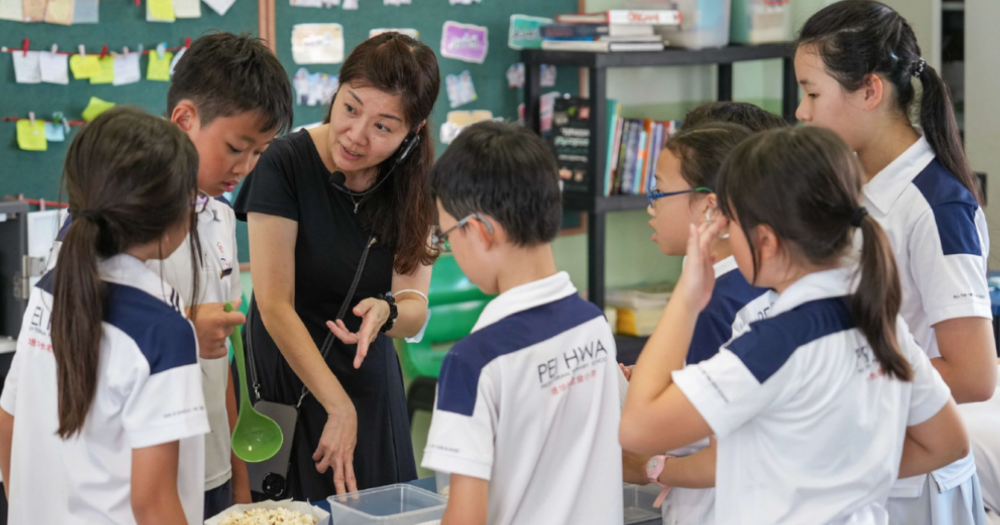
This is part of MOE's efforts to recalibrate teachers' work more deliberately.
Singapore's Ministry of Education (MOE) is building on ongoing efforts to adjust and manage teachers' workload, so they can spend more time on teaching and interacting with students.
As part of these efforts, MOE is looking into the possibility of allowing teachers to focus on two of these three responsibilities beyond classroom teaching: form teachership, co-curricular activities (CCAs), and committee work.
Speaking at MOE Schools Work Plan Seminar on Sep. 16, Education Minister Desmond Lee said teachers today have to juggle a range of responsibilities beyond lesson delivery, from supporting diverse student needs and counselling, to parent engagement, administrative duties, CCAs, and committee work.
According to MOE, committee work includes student development, staff development, partnerships, and timetabling.
"Many teachers have told us that switching constantly between different responsibilities takes not just time, but also mental bandwidth," said Lee.
As such, MOE is studying whether teachers could focus on two of the three areas, taking into account the needs of each school as well as the teachers’ strengths and interests.
This will allow teachers to devote more of their time and attention to classroom practice and deeper interactions with students.
Though schools have received additional support, including more allied educators and administrative staff, the ministry wants to take a step further to better organise teachers' work, said Lee.
This includes looking at how schools can draw more deliberately on coaches, instructors, non-teaching staff, and external partners to support CCAs and student development programmes, including administrative duties.
MOE is also exploring how existing school spaces can be adapted to support learning.
Future classrooms could include mobile and modular furniture that can be reconfigured easily, spaces for both whole-class and small-group learning, and technology-enabled environments that allow smoother transitions between physical and digital learning, said Lee.
He cited Queenstown Secondary School as an example, noting how flexible furniture and varied seating arrangements in their classrooms help to support different teaching approaches.
MOE is also examining where smaller classes could make the greatest difference to teaching and learning.
Smaller classes can allow teachers to better cater to individual learning needs, and create more engaging and effective learning environments, Lee said.
However, he noted that this would have to be part of a broader redesign of teaching and learning.
"Smaller classes do not automatically mean less working load. Smaller classes may mean teachers take on more teaching," he said, adding that such changes will therefore have to be implemented in a sustainable manner.
MOE will also continue to leverage technology to strengthen teachers’ professional work and simplify routine processes.
An example of such an effort is the Teacher Workspace.
Teacher Workspace is a platform that brings together key student information, tools, and workflows that teachers use on a regular basis.
As such, this reduces the need for teachers to navigate between different digital systems and gives them a more holistic view of each student's needs and development.
The platform will be rolled out to all MOE schools by 2027, and more features will be introduced progressively, announced Lee.
Building on strong foundations in academic and 21st Century Competencies (21CC) domains, MOE will also strengthen learner-centred teaching approaches, such as inquiry-based and collaborative learning.
"Preparing students for the future is not only about what they learn," said Lee. "It is also about how they learn."
He said students will need to go beyond acquiring subject knowledge to synthesise and apply what they know, tackle authentic and open-ended problems, and take greater ownership of their learning.
At Telok Kurau Primary School, for example, students applied science concepts to redesign the school’s outdoor garden shed into a better learning environment.
MOE will also review how teachers can provide more purposeful feedback to students.
This includes giving teachers clearer guidance on the forms of marking that best support learning, as well as examining how technology can augment the feedback process.
All these measures are part of two shifts MOE will make to strengthen holistic development and prepare students for a more uncertain future: reimagining learning and redesigning classrooms.
The shifts will be piloted in six schools from January 2027: St. Anthony's Canossian, Woodgrove and Zhangde Primary Schools, as well as Commonwealth, Deyi and Jurongville Secondary Schools.
"This is a complex pilot, so we will proceed carefully," Lee said, adding that MOE will work closely with the six pilot schools to provide guidance and support.
The ministry will also assess what can be learnt from the pilots before considering how the approaches can be applied more widely across schools.