MOUNTAINEERING: THE CHANGING MOUNTAINS
On July 30, 2026, an avalanche swept through an international expedition on the 8,051-metre Broad Peak, killing all 10 climbers, among them a beloved Pakistani mountain guide, Sohail Sakhi, and renowned British-Nepali mountaineer Nirmal ‘Nims’ Purja.
The obvious question, particularly in a year when climbers across the Karakoram range have repeatedly complained of unstable conditions, is whether climate change played a role.
There is no evidence yet to say that it did, at least not directly. Fida Ali Arandu, a veteran Pakistani mountaineer and a member of the Purja’s Elite Exped team, believes climate change may have contributed, but also points to another factor: heavy snowfall in the days before the accident and what he considered an overly hurried summit push. His advice is simple: after heavy snowfall, wait, let the mountain settle and only move when conditions are clear.
Naila Kiani, who has climbed 12 of the world’s highest mountains, says the question surrounding the serac collapse that triggered the Broad Peak avalanche remains unresolved. Was it the result of a normal accumulation of snow and ice, or had warming temperatures contributed to instability? “We’re still trying to analyse” what happened, she says.
Glaciers are retreating, routes are shifting and rockfall and avalanches are becoming more common. Even the traditional seasons are no longer predictable. Is climate change rewriting the rules of mountaineering?
That uncertainty is important. Not every avalanche is caused by global warming. Avalanches have always been part of mountaineering. What is changing, however, is the mountain environment in which those avalanches occur and, increasingly, the predictability of that environment.
For mountaineers who have spent years travelling through the Karakorams, the changes are becoming impossible to ignore.
MOUNTAINs IN FLUX
Sajid Sadpara has spent nearly a decade climbing major peaks in the Himalayas and Karakorams. He says one of the most obvious changes has been the formation of new glacial lakes and the changing nature of established climbing routes.
On Gasherbrum I this year, something as mundane as leaving a bottle of water outside the tent became an indication of a much warmer mountain. At Camp 1, water that previously would have frozen overnight did not. Climbers wearing heavy down jackets found themselves feeling hot.
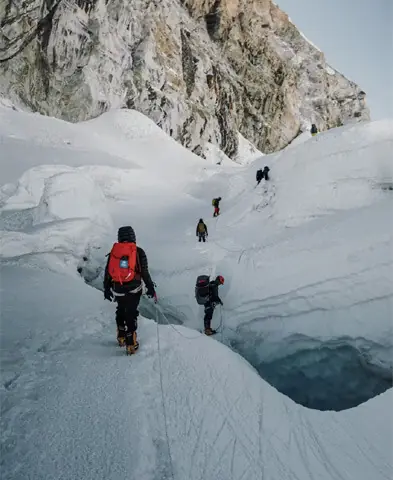
Then there were the crevasses. A familiar route between Camp 1 and Camp 2 had changed enough that the team had to find an alternative. The new route took considerably longer. “These changes are happening in front of our eyes,” Sadpara says.
Fida Ali has witnessed a similar transformation over decades of travelling through the Karakorams. Glaciers that once appeared stable are retreating; large blocks of glacial ice are breaking away and falling into rivers. Even after August — traditionally the point when temperatures begin dropping and mountain surfaces start to refreeze — rivers, he says, are continuing to swell.
The science supports the broader picture. A 2026 review published in Natural Hazards, an academic journal that publishes research on the causes and effects of natural disasters, found within the the Himalaya-Karakoram region widespread retreat and expansion of glacial lakes under a warming climate, with more than 388 documented glacial lake outburst flood (GLOF) events across the region. The researchers also identify ice avalanches and extreme precipitation among the important triggers of these events.
For climbers, glacier retreat is not simply an environmental statistic. It changes the route beneath their feet. Snow bridges disappear. Crevasses widen. Ice becomes less predictable. Rock previously held together by frozen ground becomes exposed. And that can transform a route that has been considered familiar for generations.
WHEN ROCK REPLACES ICE
Kiani remembers seeing the Baltoro Glacier for the first time in 2018. Since then, she’s made multiple trips until her last in 2024. She says the landscape now looks dramatically different. “In several sections where there used to be ice and snow, there is now rock,” she says. “These changes used to take decades. And they are now happening in months.”
She also experienced increased rockfall on Everest in 2023, an area where she had not expected to encounter such frequent falling rock. Fida Ali knows the danger personally. Last year, while climbing Nanga Parbat, he was struck in the head by falling rock. Bleeding heavily, he managed to descend to Camp 1 and eventually Base Camp himself. For climbers, rockfall can be particularly dangerous because it can be difficult to predict.
The relationship between warming and rockfall is increasingly well documented in mountain environments. As temperatures rise, permafrost — ground that has remained frozen for years or centuries — can thaw. Glaciers also retreat, removing some of the physical support they provide to surrounding slopes.
The consequences are visible far beyond Pakistan. In the French Alps, 2026 has seen an extraordinary number of rockfalls around Mont Blanc. Extreme heat and thawing permafrost were identified as major factors in the destabilisation. In Switzerland, the 2025 collapse of part of the Birch Glacier above the village of Blatten triggered a massive rockslide and destroyed much of the village. Scientists and authorities linked the instability to a combination of glacier retreat, thawing permafrost and geological conditions.
The implication for mountaineering is profound: routes traditionally considered safe during the summer can no longer necessarily be treated that way.
THE SEASON IS CHANGING
Perhaps the most significant consequence for climbers is not simply that mountains are becoming warmer, but that the old calendar is becoming less reliable. For decades, the main Karakoram climbing season has broadly centred around June to August. But Sadpara believes that may have to change. “We are thinking of changing the season of climbing K2,” he says.
He and other climbers are considering earlier spring attempts or moving expeditions towards autumn. Waqar Ali, the head guide at Karakoram Expeditions has reached a similar conclusion from his own experience. He says that, over the past two years, conditions have increasingly failed to conform to the traditional June 15-August 15 window.
This year was a particularly stark example. Persistent storms, heavy snowfall, unstable snow, avalanches and rockfall disrupted expeditions across the Karakoram. No climbers summited K2 or Gasherbrum I during the 2026 summer season, while many teams were unable to find a sufficiently safe weather window on other major peaks.
Weather forecasting itself is becoming more complicated. Sadpara describes checking multiple forecasting services before a Gasherbrum I summit attempt, only to encounter storms and strong winds at the summit, despite apparently favourable forecasts. The problem is not necessarily that forecasts are becoming useless. Rather, rapidly changing conditions can make the margin between a safe forecast and dangerous reality much smaller.
MOUNTAIN BOOM VS CHANGING MOUNTAIN
All of this is happening as mountaineering itself is becoming increasingly popular. The release of 14 Peaks: Nothing Is Impossible on Netflix in 2021 brought Nims Purja’s extraordinary campaign to climb all 14 eight-thousanders to a global audience. The documentary turned an already growing interest in high-altitude climbing into something far more visible and accessible to millions of viewers.
Purja’s death on Broad Peak this year, therefore, carries an additional poignancy. The man who helped bring Himalayan mountaineering into living rooms around the world became one of the victims of the increasingly unpredictable environment he spent his life navigating.
More people are now going into the high mountains, just as the mountains themselves are changing. That creates a difficult paradox. Increased interest brings tourism, employment and income to mountain communities. But it also means more climbers, more infrastructure and greater pressure on fragile environments. Gilgit-Baltistan officials have already begun reviewing trekking regulations, following a series of accidents during the 2026 season.
For the mountaineers themselves, however, the central challenge is more immediate. “The routes are changing,” says Sadpara. “Mountaineering is becoming harder and riskier.”
Perhaps that is the most important distinction. Climate change is changing the conditions that mountaineers have spent generations learning to read. The question facing mountaineers is, therefore, about adaptation to that change. It’s not simply whether they can climb higher, faster or harder. It is whether they can learn to climb a mountain that is changing underneath them.
The writer is a journalist, documentary filmmaker and radio correspondent.
Instagram: @madeeha.syed
Published in Dawn, EOS, September 27th, 2026