Netanyahu’s Empty Seats Became His Strongest Prop - Newsweek
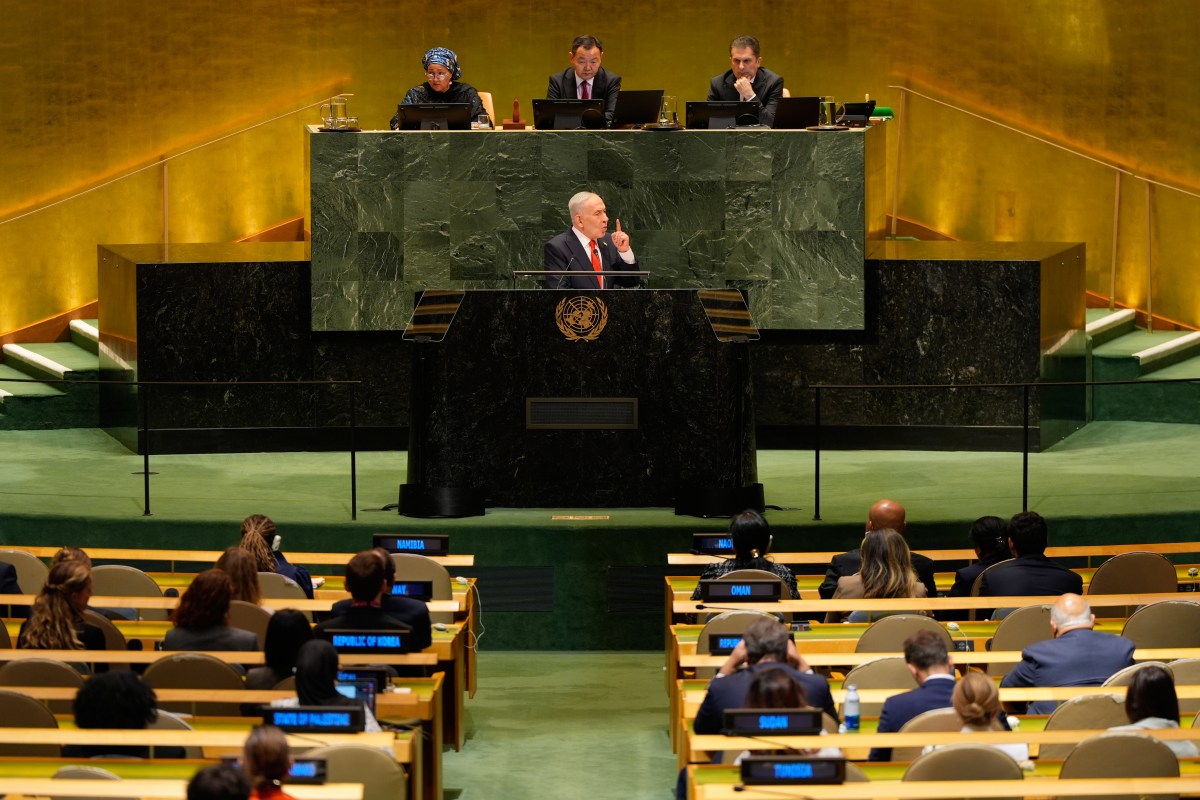
A half-empty chamber is supposed to communicate isolation. In the diplomatic imagination, absence is a judgment. The speaker is no longer worth hearing. But modern politics has made that symbolism (and much of diplomacy’s old modus operandi) unstable. Today, rejection can be repackaged as proof of courage, condemnation slowly starts being called persecution and the establishment’s refusal to listen becomes, in the hands of a practiced populist, evidence that the speaker is saying what the establishment cannot bear to hear.
Benjamin Netanyahu understands this grammar well.
The scale of Thursday’s walkout was difficult to miss. As Netanyahu approached the podium at the United Nations General Assembly in New York, dozens of delegates rose and filed out, amid boos and cheers, until a majority of the chamber’s seats were empty. The protest had been encouraged in advance by the Palestinian Mission to the U.N., which had urged members among the organization’s 193 states to fill the chamber and then collectively walk out when Netanyahu was announced. As the departures continued, General Assembly President Khalilur Rahman repeatedly called for order.
Netanyahu did not wait for the spectacle to acquire a meaning.
“If there are any other moral cowards who have not yet left the hall, please do so now,” he told the remaining delegates, immediately absorbing the protest into the argument he had come to make.
The walkout, though, did not need to persuade anyone in the hall. Its real political life began once the cameras caught it. On television, on social media and in the partisan afterlife of the speech, the empty seats became scenery for a familiar Netanyahu argument—Israel stands alone because others have lost their nerve, their judgment or their moral clarity.
The diplomats intended to make themselves absent. Visually, though, they became their own declared enemy's supporting cast.
The official meaning of the walkout was plain enough. Those who left wanted to register disgust with Netanyahu and his government’s conduct. In diplomatic terms, it was a rebuke.
Turns out, though, that this particular political spectacle was not solely owned by the people staging it.
Netanyahu was speaking in New York, but one of his most important audiences was elsewhere. Israelis watching at home, supporters abroad and voters who have long been receptive to his claim that Israel is judged by standards its enemies escape.
To those viewers, the empty chairs can tell a different story. Netanyahu appears embattled, not abandoned, his isolation recast as proof of steadfastness. It is a political identity he has cultivated for years—the leader standing against a hostile outside world—and one with a peculiar internal logic: the larger the chorus against him becomes, the easier it can be to portray resistance to that chorus as a source of authority. In this kind of politics, opposition does more than constrain a leader. It can help construct the character he presents to his supporters: the solitary defender whose enemies, simply by gathering against him, become evidence for the role. Suddenly, the empty room suggests martyrdom, which is an image that feels particularly useful when it comes to a politician whose identity has been built partly around refusing international pressure.
Of course, the walkout was still a walkout and given the breadth of Thursday's protest, the repercussions cannot be reduced to optics. When diplomats leave in such numbers, the more consequential question is why so many governments have concluded that remaining in the room is itself untenable. Netanyahu may be able to turn estrangement into a story of defiance for supporters, but diplomatic estrangement carries costs that rhetoric cannot simply dissolve.
The symbol can have multiple political meanings.
Netanyahu has spent years portraying international criticism of Israel as evidence of international failure rather than Israeli failure and the United Nations has been particularly useful terrain because its legitimacy is contested inside Israel and among many of Israel’s supporters abroad. That’s all to say that the walkout sort of fits pretty neatly into that story—but a leader cannot indefinitely turn isolation into strength, especially if that isolation starts carrying measurable costs, like policy changes toward Israel and weakened alliances.
Thursday’s scene, then, captures a tension in modern political communication: humiliation and validation can now occupy the same paragraph. The diplomats saw their departure as condemnation while Netanyahu presented it as vindication (or, at least, validation).
But readings are true to someone, somewhere…but which one will survive?
For now, the empty seats gave Netanyahu something politicians usually have to manufacture.
In an era when political identity is increasingly built through enemies as much as allies, that can be a remarkably durable prop.