Nigeria: What's the real motivation behind Dangote's IPO 'for the people?'
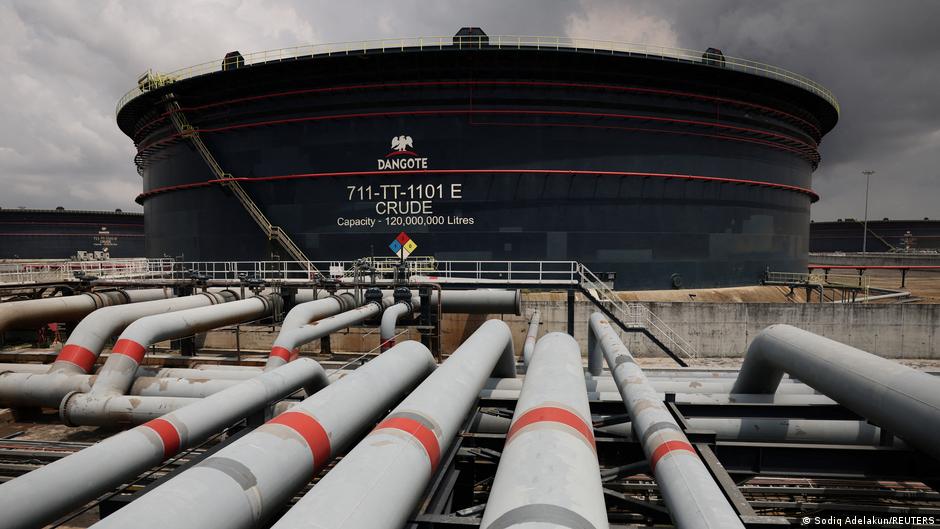
"Of the people, by the people, for the people" — or rather a market-driven strategy_Image: Sodiq Adelakun/REUTERSAdvertisementNigerian industrialist Aliko Dangote is turning to the public in hopes of financing the next growth phase of his oil refinery: The richest man in Africa announced that he is seeking to attract about $1.6 billion by going public.
This initial public offering of Dangote Industries is intended to help support a $14.3 billion expansion, which would more than double the refinery's production capacity. In absolute numbers, it would increase capacity from 700,000 barrels per day (bpd) to 1.4 million bpd.
It would also include new petrochemical and refining units designed to reduce Nigeria's reliance on imports of some petrochemical products, while also allowing the plant to produce different grades of diesel.
This plan would make the refinery one of the largest single-site refining complexes in the world.
Dangote's ambitious plans also include the launch of a processing plant in Kenya to extend his reach from the Atlantic to the Indian Ocean, which is planned to be launched in partnership with Eastern African governments.
In the absence of solutions, the refinery has turned into an important supplier of petrol and other fuels at home and abroad; in fact, it made Nigeria a net exporter of refined fuel for the first time after reaching its full capacity earlier this year.
The refinery reported making an after-tax profit of $1.82 billion in the first half of 2026, which compares to a $476 million loss for all of 2025.
Things appear to be on the up-and-up for Dangote — so, why is the company seeking public investment now?
Ayodele Oni, an energy analyst and partner with the Bloomfield Law Practise in Lagos, told DW that the public offering could be a "game-changer," as it alters the role of who could stand to benefit from Dangote's expansion drive.
Oni explained that equity invested by potentially millions of Nigerian and international shareholders would shield the corporation from having to rely solely on expensive dollar debt "with permanent Naira capital, which matches a business now earning heavily in Naira."
This could also unlock additional longterm investment since any "listed company answers to … its shareholders every quarter." "[T]hat transparency is precisely what long-term lenders and international partners want to see before the next billion is committed."
He also highlighted the fact that this would turn into a sustainable model for Dangote, as this approach would be designed to permanently "lower its cost of capital for every future phase."
Oni summarized the potential of the deal by referring to it as a restructuring of both who bears the risk — and who stands to share with the reward, with "the people" being the greatest beneficiaries of the IPO, at least to his mind.
However, opening up the ownership of the refinery business to ordinary citizens does not automatically mean that many can and will afford it.
The pricing of the initial offering is indeed priced at an affordable 525 Naira ($0.40, €0.34) at a piece for each of the 4.1 billion ordinary shares, and a minimum of just 10 shares.
At the signing ceremony in Lagos, Dangote said that the company is trying to "make sure that the majority of … our drivers, our cook, our servants, our managers, everybody will have an opportunity to have a stake in the refinery."
However, in a country where almost two-thirds of the population are struggling with extreme poverty, according to Nigeria's National Bureau of Statistics (NBS), this figure can translate into 10% of the minimum wage — for those who are fortunate enough to have a job.
Entry-level employees and those performing menial tasks at Dangote are fortunate enough to earn almost four times the minimum wage in Nigeria, according to local media reports — though this still translates into only about $150 a month in a country that has been witnessing steep inflation, especially in petrol prices. For most, seeing any personal benefit by investing in Nigeria's oil remains a pipe dream.
Charles Asiegbu, a policy and economic analyst, who has worked as a consultant for various Nigerian organizations, believes Dangote's description of the offer being "for the people" could meanwhile still qualify as a "psychological masterstroke" for those who can afford to invest.
"With millions as shareholders, it would shift from [being] a private enterprise to a national asset in the public consciousness," he said.
Olamilekan Oladehinde, a Nigerian retail investor, told DW that he is "excited" to partake in the launch and buy shares; to his mind, Dangote is now much more than just a private enterprise but rather a key national asset that addresses direct social problems in Nigeria, including fuel shortages.
"They're trying to expand, and that's something I am very proud and happy to identify with," he said. "The fact that it's also owned by a Nigerian makes me more than happy, and that's why I will be buying a stake in the company," he said about the richest man in Africa.
Oladehinde also told DW he has no concerns about investing in Dangote — despite that fact that various market experts have cautioned investors to be mindful of potential risks, especially because refining is a cyclical business.
According to Oni, Dangote is riding on a wave due to the current situation across the Middle East; however, these fortunes might change — especially when the tensions around the Strait of Hormuz eventually ease; a return to steep competition in oil prices from those Middle Eastern countries could then saturate markets.
However, Oni also mitigated those concerns by highlighting Dangote's strengths: "The Middle East disruption showed that a refinery on [Nigeria's] Atlantic coast can supply Europe and the Americas faster than the Gulf can; and at 700,000 bpd, the plant has already proven the model, so the expansion is about scale on an existing site, which is the cheapest capacity anyone can build."
For Oladehinde, this is exactly the outlook he will be betting on: "I believe the time has come for us. We can't lose this the momentum," he told DW.