No explicit request: Probe clears Hindu group over Eiffel Tower women staff row
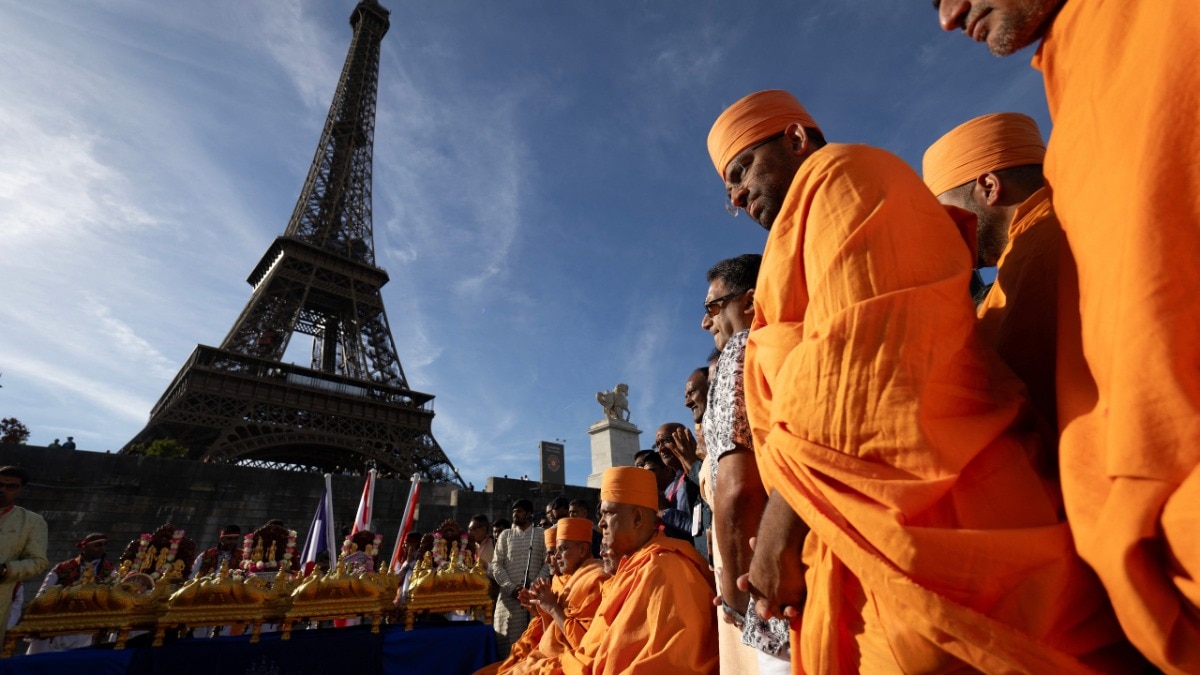
The controversy over female employees being sidelined during a Hindu religious delegation's visit to the Eiffel Tower has taken a new turn. An investigation found that a chain of miscommunication and operational failures led to women being removed or replaced at their posts.
The findings, cited by Le Parisien, come three weeks after a visit by a delegation from the Bochasanwasi Akshar Purushottam Swaminarayan Sanstha (BAPS), a Hindu religious organisation on September 5. They were published days after Patrick Branco-Ruivo, the director general of the company operating the Eiffel Tower, announced that he would step down at the end of the year, reported AFP.
Branco-Ruivo, who has headed the Societe d'Exploitation de la Tour Eiffel (SETE) since 2018, has not accepted sole responsibility for what happened. In a message to employees, he insisted that he had never ordered staff to remove or replace women during the visit.
"I wish to reiterate that at no point did I give any instructions aimed at removing or replacing women within this delegation," he said.
The investigation by the General Inspectorate of the City of Paris (IGVP) cited it the report, however, found that women were indeed excluded from several positions during the visit. Rather than identifying a single order from the top, investigators described the episode as the result of a "collective dysfunction" involving errors in communication, interpretation and execution.'NO EXPLICIT REQUEST' TO EXCLUDE WOMEN
According to the investigation summary obtained by Le Parisien, the Inspectorate General was tasked with examining the episode on September 8 and began its work the following day. Investigators conducted 14 interviews and examined documents supplied by SETE at their request.
Their conclusion was significant: investigators found no evidence of an "explicit request from the Hindu religious delegation to exclude women from the entire procession". This broadly matched what people close to the delegation had told Le Parisien immediately after the controversy erupted.
"There was no such request from them," a person in the delegation's entourage told the newspaper at the time. The investigation found no written instruction, email or other document from the delegation expressing such a demand.
Instead, the report said the original request presented to SETE concerned something narrower: "the lack of physical contact between religious figures and women." That distinction is crucial to understanding how the situation escalated. According to the investigators, a request concerning physical contact was gradually converted into operational instructions that went much further.HOW A 'NO-CONTACT' REQUEST TURNED INTO ROW
On the day of the visit, security control posts were reportedly assigned to men. The same applied to certain positions involving agents responsible for the group and employees stationed at the elevator exits. The changes were reportedly made that very morning. The situation became more pronounced as the delegation moved through the monument.
"During the ascent of part of the delegation to the North pillar," the investigation report said, employees responsible for reception and customer relations were asked to temporarily leave the delegation.
A female employee working for a cleaning services provider was also required to wait for her break, while another woman was replaced by a male employee in an elevator during the group's descent.
Taken together, these decisions meant that women were effectively removed from several roles during the visit.
The Inspectorate General therefore concluded that, despite the initial instructions, "women were indeed excluded during this visit". The report attributed the outcome to an internal process in which a requirement concerning no physical contact was progressively transformed into the assignment of male staff to different positions.
As the instructions passed through the organisation, the implementation expanded to the point where female employees already working in those positions were dismissed from their posts or replaced.'THE MESSAGE GOT DISTORTED'
The investigation's description of the chain of events has shifted attention away from the idea of a single written order and towards the way information travelled through the Eiffel Tower's management structure. One Parisian elected official compared it to the childhood game of "telephone", in which a message changes as it is passed from one person to another.
"It's a bit like what we used to call 'telephone' as children," the official told Le Parisien.
"By having an instruction circulate by word of mouth, the message got distorted. Until we reached these failures."
The Inspectorate General used similar language in its own assessment.
"The dissemination of information at multiple levels was confused with its validation," the report stated. According to the investigators, operational procedures passed between different hierarchical levels and were gradually treated as if they had already been formally approved.HOW THE EIFFEL TOWER CONTROVERSY BEGAN
The controversy dates back to September 5, when around 100 people associated with the BAPS visited the Eiffel Tower. The delegation was in France as part of celebrations linked to the inauguration of a traditional Hindu stone temple in Bussy-Saint-Georges, in Seine-et-Marne, near Paris.
According to union representatives, female employees were asked to step away from their workstations as the delegation moved through the monument.
"As the delegation passed through, women were asked to leave their workstations so that men could take their places," Diane Davoine, a union representative, told Reuters. Workers later said some female employees were moved to other areas, while others were replaced by male colleagues. Some were also reportedly instructed not to pass through particular sections of the Eiffel Tower while the group was present.
The incident triggered anger among staff, who described the arrangements as women being "sidelined, replaced and made invisible because of their sex". The dispute did not remain confined to internal discussions. Within days, it developed into a staff protest that briefly disrupted operations at one of the world's most visited landmarks.
On September 7, employees gathered to discuss the incident and seek assurances from management that such treatment would not happen again. Following the incident, management also apologised to employees over the incident. The controversy then widened beyond the workplace. Questions were raised about whether the delegation had specifically asked for female employees to be removed and, if so, how such a request had been handled by the Eiffel Tower's management.
BAPS said its delegation had travelled to France for events surrounding the inauguration of the Hindu temple near Paris. The organisation said the Eiffel Tower visit had been scheduled at the beginning of opening hours because of the size of the group and to minimise disruption to other visitors.
"To the best of our knowledge, at no point was anyone prevented access to the Eiffel Tower. Nevertheless, we sincerely apologise for any pain or inconvenience caused," BAPS said.
SETE had acknowledged that the delegation had requested arrangements to limit "interactions with women". The company said at the time that "these conditions should not have been accepted."WHY PATRICK BRANCO-RUIVO IS LEAVING
The findings have also complicated the question of responsibility. Branco-Ruivo's departure does not amount to an admission that he personally ordered female employees to be removed.
The SETE chief has repeatedly denied issuing such an instruction. His decision to leave at the end of the year was instead presented as a way of protecting employees and preserving the organisation's team.
"This chain of events does not erase individual responsibilities," the investigators warned.
They pointed to "differentiated responsibilities in a series of errors in judgment, validation, and execution". That means responsibility was spread across different stages of the process -- from how the original request was understood, to how it was communicated, approved and finally implemented on the ground.
One elected official cited by Le Parisien acknowledged that the episode still required leadership to take responsibility.
"When things go wrong, you have to know how to protect your teams," the official said.
"He has taken responsibility for his actions. I don't think he harbors any bitterness..."
Branco-Ruivo will therefore remain at SETE until the end of the year, bringing an eight-year tenure at the Eiffel Tower operating company to a close. The investigation's findings leave behind a more complicated picture than a simple order to remove women.- Ends