Occupy Wall Street’s Strange Legacy - Newsweek
Fifteen years ago today, hundreds of protesters began gathering around a small park in Lower Manhattan. Adbusters, the Canadian anti-consumerist magazine, had summoned them to protest economic inequality and corporate power. They had hoped to "occupy" Wall Street but police barricades instead directed them to nearby Zuccotti Park. The camp lasted until November 15, when police cleared it.
So, the tents did not last, but the slogan endured anyway.
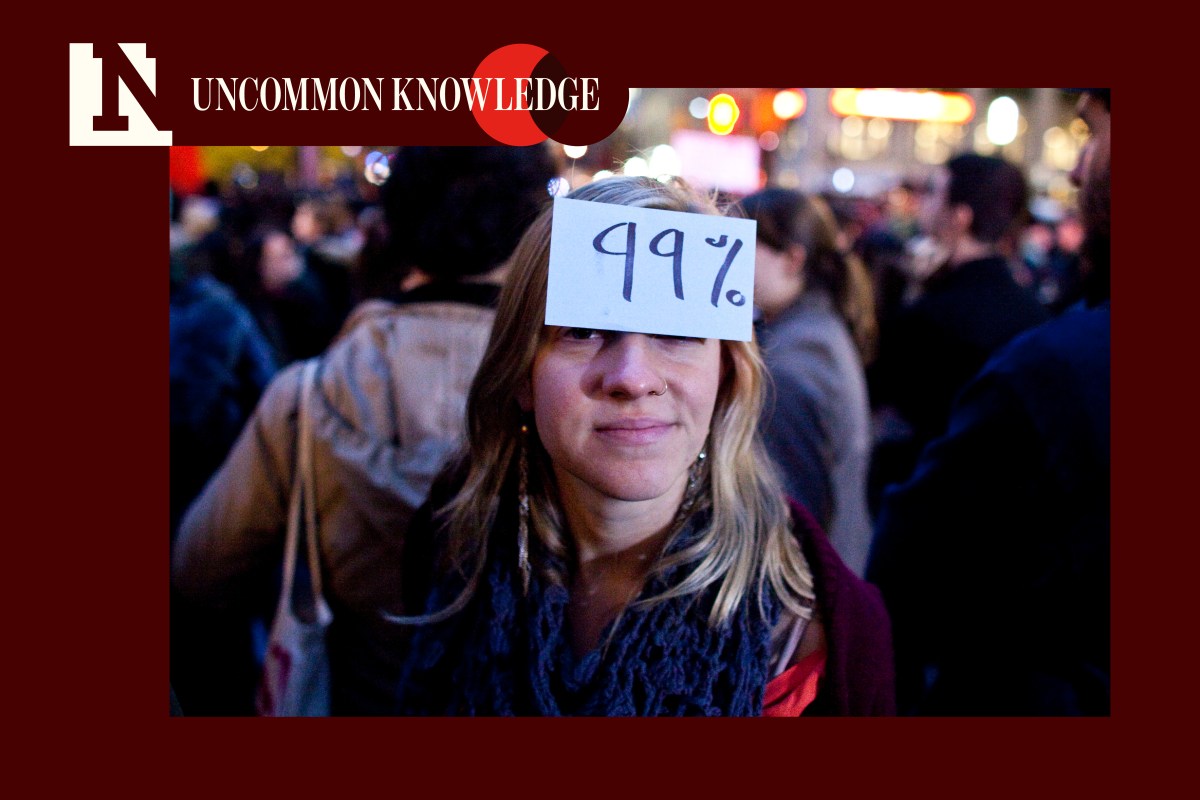
"We are the 99 percent" took complex, deeply held concerns about the financial crisis, Wall Street and inequality and reduced them to five words. Were those the right words? Might another two words—"Donald Trump"—be equally appropriate?
At the end of 2011, the richest 1 percent of American households owned 29 percent of U.S. household net worth. The bottom half owned 0.4 percent. Today, the Federal Reserve estimates that the top 1 percent owns 31.6 percent. So far, that sounds like the warning of Occupy: the protesters went home, and the 1 percent got richer.
Except that the bottom half now owns 2.5 percent. Its share, though still minuscule beside that of the very rich, is more than six times what it was at the end of 2011. The ratio between the share of national wealth owned by the top 1 percent and the bottom 50 percent has fallen from roughly 72.5 to 1, to 12.6 to 1.
And two days before Occupy's anniversary, the Census Bureau provided another complication. Real median household income reached $87,460 in 2025, up 2.6 percent in a year and the highest recorded level in a series going back to 1967. The official poverty rate fell to 10.2 percent.
America did not become economically equal after Occupy. Nor did the bottom half sink ever further beneath the plutocrats. The country got richer, wealth at the very top became more concentrated, and households at the bottom rebuilt some of their net worth obliterated around the financial crisis—all at once.
What also changed is that Occupy's language became a permanent fixture of political discussion, and today's president may be one of the biggest beneficiaries.
Naomi Klein, whose politics emerged from a very different tradition from Trump's, argued in an interview published this week in The Guardian that "extreme wealth has a deranging effect," part of a broader critique of billionaire political power. Progressive arguments for taxing concentrated wealth are hardly museum pieces either: California voters are currently considering a proposed one-time tax on billionaire assets, backed by figures including Senator Bernie Sanders and Representative Ro Khanna.
Yet the right also underwent its own populist revolution.
Trump's version replaced Occupy's Wall Street villains with a broader establishment: Washington politicians, lobbyists, the media, bureaucrats and other institutional power centers. But the architecture was familiar. In his first inaugural address in 2017, Trump said that "a small group in our nation's Capital has reaped the rewards of government" while "the people have borne the cost." He said power was being transferred from Washington "back to you, the American People."
That convergence has become so pronounced that populist Republicans and Democratic Socialists now overlap on corporate power, free markets and government intervention, even as they stress their enormous ideological differences. The spectacle appeared on stage this week when Sanders and former Trump strategist Steve Bannon joined the same "Pro-Human Assembly" to warn about the dangers of AI.
One way to measure Occupy is to ask whether the 1 percent still has too much money. On that measure, the revolution has failed.
The Fed estimates that the richest 1 percent held 29.0 percent of aggregate household net worth in the fourth quarter of 2011. Their share rose to 29.8 percent by the end of 2013, 30.6 percent in 2014, 30.8 percent in 2017 and, after some fluctuation, 31 percent by the end of 2024. It reached 31.8 percent at the end of 2025 before slipping slightly to 31.6 percent in the first quarter of 2026.
Score one for the occupiers' diagnosis of concentrated wealth. But it's not game over.
The bottom half of American households owned just 0.4 percent of aggregate household wealth at the end of 2011. That share rose to 0.7 percent in 2012, 1 percent in 2014, 1.3 percent in 2016, 1.7 percent in 2019 and 2.2 percent by the end of 2020. It reached 2.7 percent during 2022 before settling at 2.5 percent today.
That does not mean the wealth gap disappeared. A system in which half the population collectively owns 2.5 percent of household wealth is hardly Scandinavian socialism. Nor should the sixfold increase from 0.4 percent be read as a sixfold increase in the prosperity of a typical poor household.
But the change is real, and it produces the most counterintuitive number on Occupy's anniversary.
In late 2011, the top 1 percent collectively owned a share of national wealth roughly 72.5 times that of the entire bottom half. Today it is about 12.6 times as large. That ratio fell not because the rich were dispossessed—their share actually rose—but because the bottom half recovered dramatically from an extraordinarily weak post-crisis position.
That is the strange line on the chart.
The line for the 1 percent barely moves: 29 percent, 30 percent, 31 percent. The line for the bottom 50 percent creeps upward from almost zero. But the third line—the ratio between them—plunges.
In 2011, inequality could easily be imagined as a story of a financial elite thriving while ordinary household balance sheets remained wrecked by recession. Fifteen years later, the rich possess a larger slice of wealth than they did when Occupy began, but the bottom half also possesses a much larger slice than it did then.
Income tells a similarly awkward tale. The Census Bureau's new figures show 2025 real median household income at an all-time high of $87,460, 2.6 percent above 2024. But the same report found no statistically significant improvement at the 10th percentile (the poorest Americans), while incomes at the 90th percentile rose 1.7 percent.
This is not quite the America imagined in Zuccotti Park. Nor is it the America implied by a simple conservative story in which economic gains inevitably trickle down evenly. It is a country in which aggregate prosperity and extreme concentration coexist. Which may help explain why Occupy's most durable legacy was not a policy or collection of policies but a way of arranging political reality.
For much of the postwar era, American economic argument was described horizontally: Republicans versus Democrats, capital versus labor, taxes versus spending, markets versus government. Occupy's real victory was to rotate the axis. Politics became vertical. There was the overwhelming majority down here and a tiny collection of people with disproportionate power up there.
The identities assigned to "up there" could then change.
Sanders could fill the category with billionaires and corporations. Progressive campaigners could put Wall Street, landlords or pharmaceutical companies in it. Trump could fill it with Washington insiders, news organizations, universities, federal agencies and global institutions. The objects of suspicion were different, but the underlying proposition—that ordinary Americans had lost control to an entrenched minority—proved remarkably robust.
Trump has complicated the picture still further. His movement combines attacks on elite institutions with support from enormously wealthy donors. Financial Times calculates that just 20 mega-donors have supplied more than one dollar in every three raised so far and that 16 of those 20 favor Republicans.
An echo exists abroad, too. British debate recently has been consumed by enormous donations from two cryptocurrency billionaires to Nigel Farage's populist Reform UK, prompting critics on the left to ask how an anti-establishment movement squares its rhetoric with dependence on very rich benefactors.
That tension may be less contradictory than it appears.
Economic elites and cultural or institutional elites are not necessarily the same people. A billionaire can plausibly regard himself as an outsider to universities, government agencies or legacy media—culture, in other words. A working-class voter can resent professionals more intensely than entrepreneurs with vastly greater fortunes. And a politician can attack one hierarchy while depending financially on another.
Occupy gave that category a number: the 1 percent. Trump gave it a location: the swamp.